
Understanding 1 kilometer distance is useful in travel, exercise, mapping, and everyday navigation. Many people hear “1 km” but may not clearly understand how far it really is.
This guide explains 1 kilometer in miles, meters, and real-life comparisons so you can easily visualize the distance.
What Does 1 Kilometer Mean?
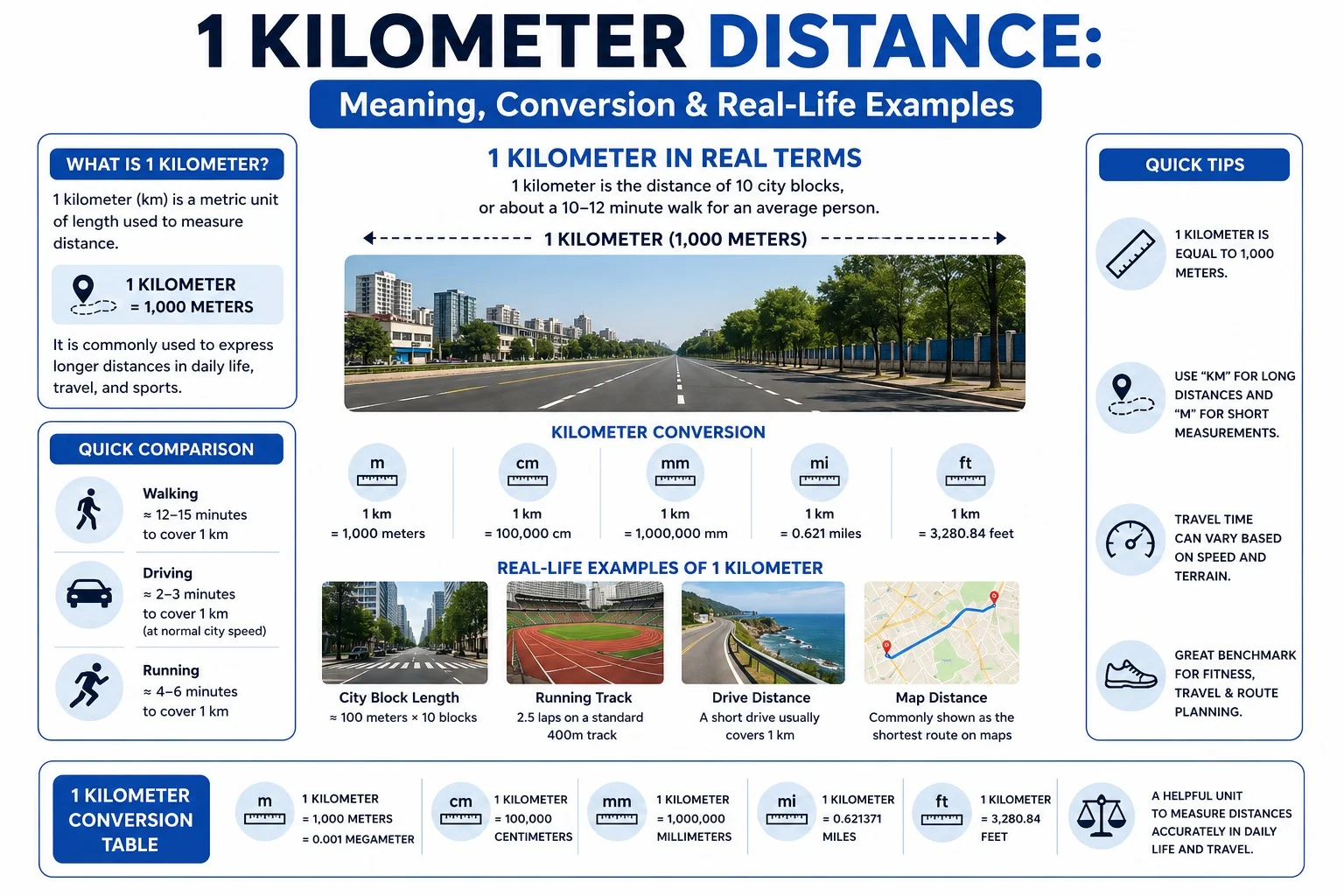
A kilometer is a unit of distance in the metric system.
So, 1 kilometer means:
- One thousand meters
- A short travel distance
- Commonly used in walking, running, road signs, and maps
It is a distance most people can walk comfortably in several minutes.
1 Kilometer in Other Units
Let’s convert 1 kilometer into other measurements.
1 Kilometer in Miles
Since 1 kilometer = 0.621371 miles:
1 kilometer ≈ 0.62 miles
1×0.621371=0.621371
1 Kilometer in Meters
Since 1 kilometer = 1,000 meters:
1 kilometer = 1,000 meters
1×1000=1000
1 Kilometer in Feet
Since 1 kilometer = 3,280.84 feet:
1 kilometer ≈ 3,280.84 feet
1×3280.84=3280.84
Quick Conversion Table
| Unit | 1 Kilometer Equals |
|---|---|
| Miles | 0.62 mi |
| Meters | 1,000 m |
| Feet | 3,280.84 ft |
| Yards | 1,093.61 yd |
How Far Is 1 Kilometer in Real Life?
To understand 1 kilometer, compare it with familiar distances.
Walking & Running Comparison
| Activity | Time Needed |
|---|---|
| Walking | 10–15 minutes |
| Running | 4–8 minutes |
| Cycling | 2–4 minutes |
👉 1 km is a common warm-up or short exercise distance.
Driving Comparison
- Around 1–3 minutes by car depending on traffic
- Very short city travel distance
- Common spacing between turns or exits
City & Landmark Examples
- About 10 football fields in length
- Several city blocks (depends on city layout)
- Distance between nearby neighborhoods
- Standard road sign interval in many countries
Common Uses of 1 Kilometer Measurement
1. Fitness & Exercise
- Walking goals
- Running laps
- Warm-up routes
2. Travel & Navigation
- GPS directions
- Road signs
- Distance markers
3. Education
- Metric system learning
- Map scale exercises
- Distance estimation
4. Urban Planning
- Neighborhood spacing
- Park trail distances
- Street layout planning
Why 1 Kilometer Is Important
The 1 kilometer measurement is widely used because:
- Basic metric distance benchmark
- Easy to walk and estimate
- Common in maps and signs
- Useful for fitness goals
- Standard global reference distance
Expert Tips to Visualize 1 Kilometer
1. Think in Miles
1 km ≈ 0.62 miles.
2. Walking Method
About a 10–15 minute walk.
3. Football Field Method
Around 10 football fields end-to-end.
4. City Method
Several city blocks in many urban areas.
1×0.621371=0.621371
Common Mistakes People Make
❌ Confusing Kilometers With Miles
1 km is shorter than 1 mile.
❌ Underestimating Walking Time
It takes several minutes, not seconds.
❌ Ignoring Terrain
Hills and traffic lights affect time.
❌ Assuming All City Blocks Match
Block sizes vary widely.
Practical Importance of 1 Kilometer Measurement
Understanding 1 kilometer helps in:
- Planning walks
- Reading road signs
- Fitness tracking
- Estimating local travel time
- Learning metric distances
FAQs
1. How many miles is 1 kilometer?
1 kilometer ≈ 0.62 miles
2. How long does it take to walk 1 kilometer?
Around 10 to 15 minutes.
3. Is 1 kilometer far?
It is a short and manageable distance.
4. How long does it take to drive 1 km?
Usually 1 to 3 minutes.
5. How do I visualize 1 kilometer?
Think of a 10-minute walk or 10 football fields.
Conclusion
Understanding 1 kilometer distance becomes easy when compared with real-life examples like walking time, football fields, and city blocks. It equals 0.62 miles or 1,000 meters, making it a common measurement in travel, exercise, and navigation.
Whether you’re walking, driving, or planning routes, knowing what 1 kilometer looks like helps you make better decisions.
👉 Final Tip
Next time you hear “1 km,” just imagine a 10-minute walk—that’s your easiest real-world reference.
Discover More Articles
100 Kilometers Distance: Meaning, Conversion & Real-Life Examples