
How Many Feet Are in 1 Story? Average Building Height
If you’re wondering how many feet are in 1 story, there isn’t one exact number…
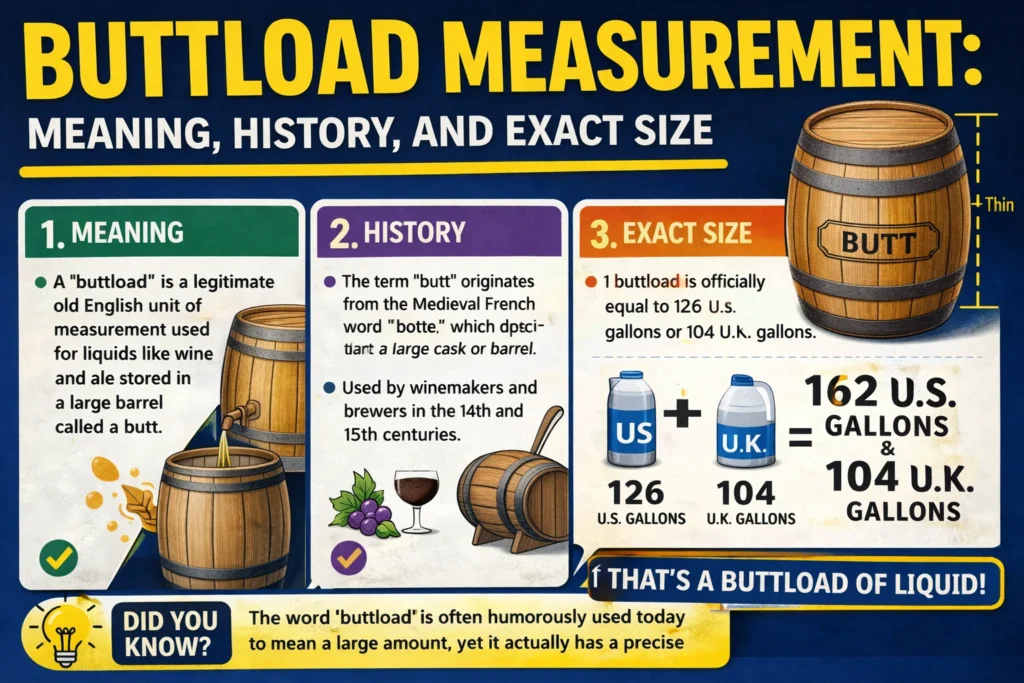
Many people use the word buttload as a joke or slang term meaning “a lot.” But what surprises many readers is this: the buttload measurement has real historical roots.
Long before it became modern slang, a butt was an actual unit used for storing and transporting liquids, especially wine and ale. So yes, a buttload once had a measurable size.
This guide explains the real meaning of buttload, where it came from, how large it was, and why the term still survives today.
Historically, a buttload meant the amount held in a butt, which was a large cask or barrel used for liquids.
The word “load” simply means a quantity or amount, so a buttload was the load or contents of one butt cask.
In modern conversation, people often use buttload to mean:
But historically, it referred to a real measured container.
Yes—partly.
The slang word evolved from a real container called a butt. A butt was a recognized cask size in historical trade systems, especially for:
So while “buttload” was not always a formal scientific unit, it was based on a real storage volume.
The exact size varied by era, region, and what was stored. However, a common English wine butt was:
Because older measurements changed over time, exact numbers can differ.
One common reference:
1 butt = 126 gallons
1 butt=126 gallons
Approximate conversion:
126 imperial gallons ≈ 573 liters
126 older wine gallons may differ
That’s why sources sometimes list different totals.
Traditionally:
| Unit | Approximate Equivalent |
|---|---|
| 1 Butt | 126 gallons |
| Liters (varies by standard) | 477–573 L |
| Hogsheads | 2 |
| Half Butt | 63 gallons |
The word butt did not come from anatomy.
It comes from older European words related to barrels or casks. Historical language sources trace it through medieval trade terminology involving large containers.
So when people say “buttload,” the original meaning is literally:
a cask-load
That makes the phrase much older than many assume.
Over time, the literal container meaning faded from daily life. But the funny sound of the word survived.
Today, buttload is informal slang meaning:
Examples:
In these cases, no one means an actual barrel.
To understand how large a historical buttload was:
| Comparison | Similar Volume |
|---|---|
| Standard bathtub | Close to some estimates |
| 700+ soda cans | Roughly in range depending on size |
| Large household water storage | Similar scale |
| Several full kegs combined | In some cases |
That shows a real buttload was substantial.
| Historical Unit | Relative Size |
|---|---|
| Barrel | Smaller or context-dependent |
| Hogshead | Half a butt |
| Butt | 2 hogsheads |
| Tun | Larger than a butt in some systems |
These systems changed by product and country, so context matters.
Historical trade measurements often varied because:
That’s why buttload measurements may appear inconsistent across sources.
The buttload measurement is interesting because it blends:
Few slang words come from actual container sizes, which makes this one memorable.
False. It comes from a genuine cask measurement.
False historically. The original “butt” meant barrel or cask.
Not always. Sizes varied by time and region.
No. Its roots are much older.
That helps explain the true origin.
About 126 gallons is a common historical reference.
Words often shift from literal meanings to exaggerated everyday phrases.
Older units were less standardized than modern metric systems.
Writers use the word because it sounds:
That makes it common in comedy, conversation, and informal marketing language.
You may enjoy knowing the history if you:
Yes. It comes from a historical cask called a butt.
A common reference is 126 gallons, though standards varied.
From the word butt, meaning a large barrel or cask.
No. Today it is informal slang.
No. The original term referred to containers, not body parts.
The buttload measurement is more than a joke phrase—it has real historical roots tied to large liquid casks used in trade. Often linked to 126 gallons, it later evolved into slang meaning “a very large amount.”
Next time you hear someone say they have a buttload of something, you’ll know the phrase carries centuries of measurement history behind it.
If you’re wondering how many feet are in 1 story, there isn’t one exact number…
If you’ve ever wondered how many feet do low beam headlights illuminate, the answer depends…

If you’re planning to build a house, one of the most important material questions is…