
If you’re buying mulch, soil, compost, or gravel, you may be wondering:
How many 3 cubic feet bags are in a cubic yard?
Quick Answer
Since:
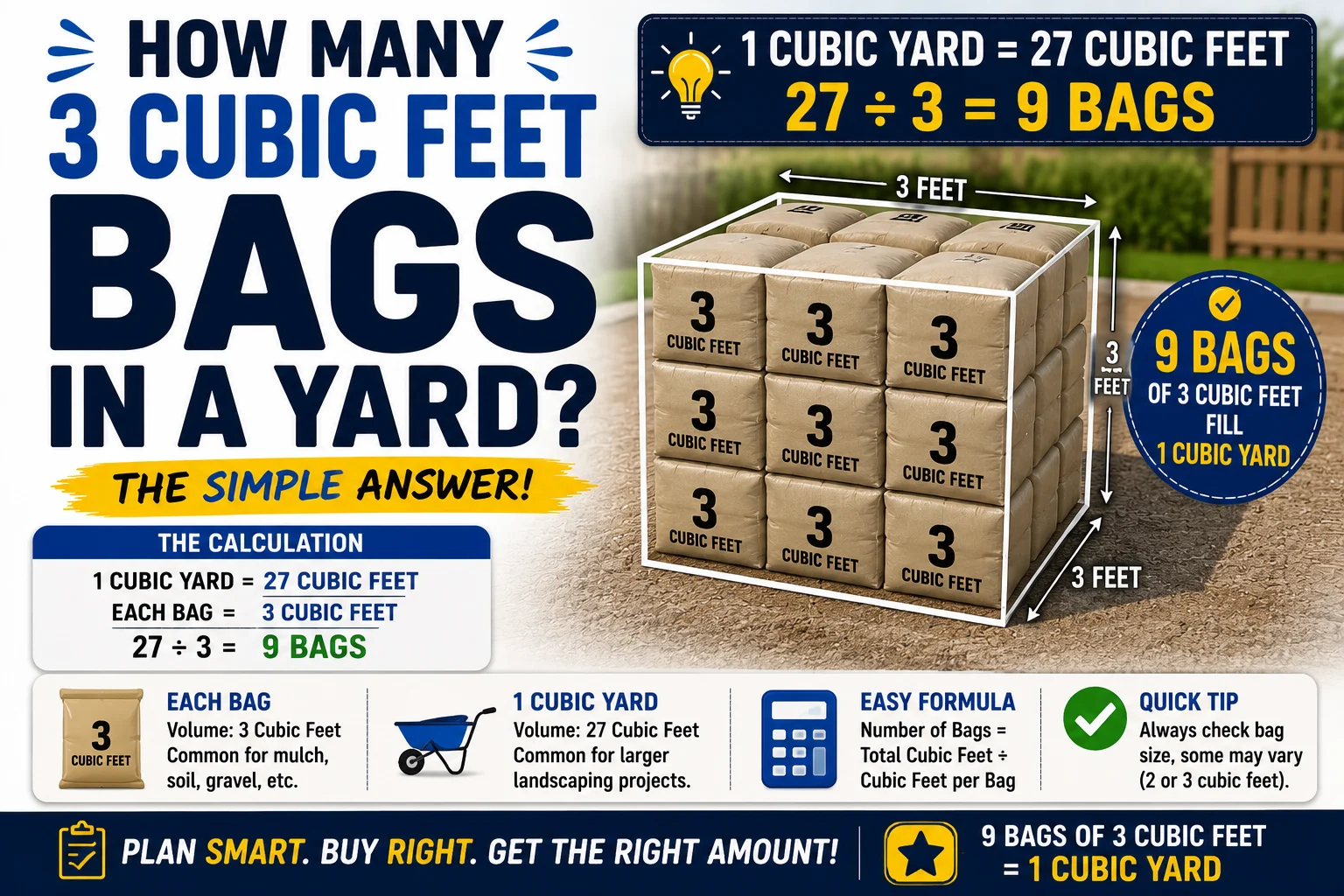
- 1 cubic yard = 27 cubic feet
A 3-cubic-foot bag covers:
- 3 cubic feet
Calculation:
27 ÷ 3 = 9 bags
Final Answer
You need 9 bags of 3 cubic feet each to equal 1 cubic yard.
Quick Conversion Table
| Bag Size | Bags Per Cubic Yard |
|---|---|
| 1 cu ft | 27 bags |
| 1.5 cu ft | 18 bags |
| 2 cu ft | 13.5 bags (14 bags recommended) |
| 2.5 cu ft | 10.8 bags (11 bags recommended) |
| 3 cu ft | 9 bags |
Why Is the Answer 9 Bags?
A cubic yard contains:
27 cubic feet
Each bag contains:
3 cubic feet
Formula:
Number of Bags = 27 ÷ Bag Size
For 3-cubic-foot bags:
27 ÷ 3 = 9 bags
Cubic Yard Formula
To determine how many bags you need:
Bags Needed = 27 ÷ Bag Size (in cubic feet)
Example:
Bag size = 3 cu ft
27 ÷ 3 = 9 bags
Cubic Yard to Bag Conversion Chart
| Cubic Yards | 3-cu-ft Bags Needed |
| 0.5 | 4.5 bags (5 bags recommended) |
| 1 | 9 bags |
| 2 | 18 bags |
| 3 | 27 bags |
| 4 | 36 bags |
| 5 | 45 bags |
Round up when purchasing materials to ensure complete coverage.
Common Landscaping Examples
Mulch
One cubic yard of mulch equals:
9 bags (3 cu ft each)
Topsoil
One cubic yard of topsoil equals:
9 bags
Compost
One cubic yard of compost equals:
9 bags
Decorative Stone
One cubic yard of decorative rock equals approximately:
9 bags, if each bag contains 3 cubic feet.
Bagged Material vs. Bulk Delivery
Bagged Material
Advantages:
- Easier to transport
- Cleaner storage
- Convenient for small projects
Bulk Material
Advantages:
- Lower cost per cubic yard
- Fewer packages
- Better for large landscaping projects
For projects requiring several cubic yards, bulk delivery is often more economical.
Coverage Estimates
One cubic yard (9 bags) covers approximately:
| Depth | Coverage |
| 1 inch | 324 sq ft |
| 2 inches | 162 sq ft |
| 3 inches | 108 sq ft |
| 4 inches | 81 sq ft |
These estimates apply to mulch, compost, and similar loose materials.
Tips Before Buying
Before purchasing:
- Measure your project area.
- Determine the desired depth.
- Calculate the total cubic feet required.
- Add 5–10% extra for settling, uneven ground, and waste.
Buying a little extra can help avoid additional trips to the store.
FAQs
How many 3-cubic-foot bags make one cubic yard?
9 bags
Why is it 9 bags?
Because:
- 1 cubic yard = 27 cubic feet
- Each bag = 3 cubic feet
27 ÷ 3 = 9
How many 3-cubic-foot bags make 2 cubic yards?
You need:
18 bags
Is buying bulk cheaper than buying bags?
Usually, yes.
Bulk materials generally cost less per cubic yard than bagged products.
Should I round up?
Yes.
If your calculation results in a fraction of a bag, purchase the next whole bag.
Does this apply to mulch and soil?
Yes.
The conversion is based on volume, so it applies to any material sold in 3-cubic-foot bags.
How many cubic feet are in one cubic yard?
There are exactly:
27 cubic feet
Common Mistakes to Avoid
- Confusing cubic feet with square feet.
- Forgetting to round up partial bags.
- Ignoring the depth of material needed.
- Buying exactly the calculated amount without allowing for waste.
Accurate measurements help ensure you purchase enough material.
Quick Facts
- 1 cubic yard = 27 cubic feet
- 1 cubic yard = 9 bags of 3 cubic feet
- 2 cubic yards = 18 bags
- 3 cubic yards = 27 bags
- Add 5–10% extra for waste and settling.
- Bulk delivery is often more economical for large projects.
Final Thoughts
The answer to “How many 3 cubic feet bags are in a cubic yard?” is simple: 9 bags. Since one cubic yard contains 27 cubic feet, dividing by the 3 cubic feet per bag gives exactly 9 bags. Whether you’re spreading mulch, adding topsoil, or installing decorative stone, this conversion makes estimating materials quick and accurate.