

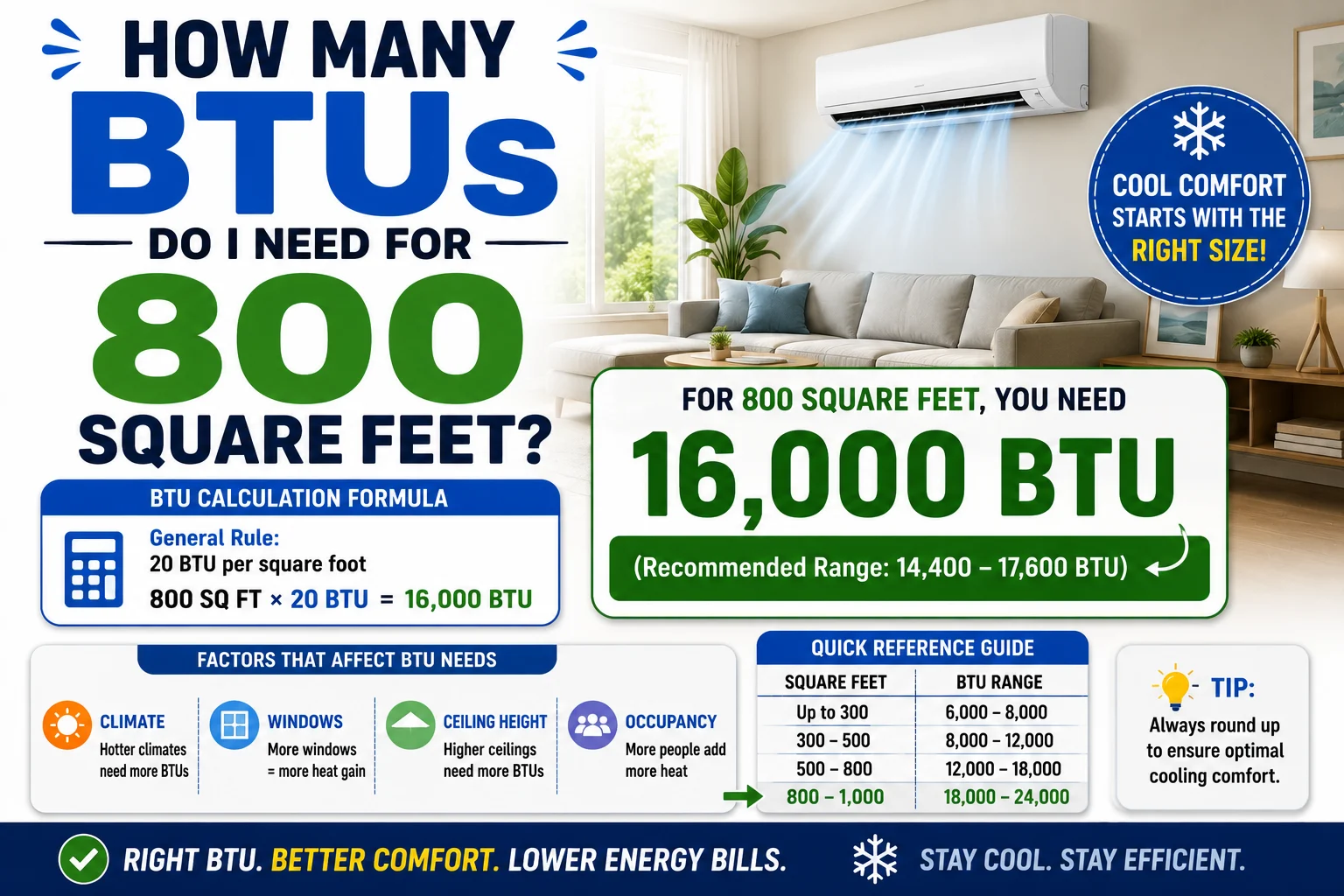
If you’re shopping for an air conditioner, one of the first questions you’ll probably ask is, “How many BTUs do I need for 800 square feet?” Choosing the correct cooling capacity is essential for keeping your home comfortable while avoiding higher energy bills and unnecessary wear on your HVAC system.
An air conditioner that’s too small will struggle to cool your space, run continuously, and increase electricity costs. On the other hand, an oversized unit may cool the room too quickly without removing enough humidity, leaving your home feeling damp and uncomfortable.
For most homes, an 800-square-foot area typically requires between 18,000 and 24,000 BTUs, depending on factors such as insulation, ceiling height, sun exposure, climate, and occupancy.
In this comprehensive guide, you’ll learn how BTUs work, how to calculate the right cooling capacity, what factors affect your needs, and how to choose the best air conditioner for an 800-square-foot space.
Quick Answer
For an 800-square-foot room, apartment, or open living area, the recommended cooling capacity is:
| Area | Recommended BTUs |
|---|---|
| 800 sq ft | 18,000–24,000 BTUs |
General Recommendations
- 18,000 BTUs – Well-insulated homes in mild climates
- 20,000–22,000 BTUs – Average homes with standard insulation
- 24,000 BTUs – Hot climates, poor insulation, high ceilings, or rooms with lots of sunlight
Most homeowners find that an 18,000 BTU (1.5-ton) unit is sufficient for average conditions, while a 24,000 BTU (2-ton) unit performs better in challenging environments.
What Is a BTU?
BTU stands for British Thermal Unit.
It measures the amount of heat an air conditioner can remove from a room in one hour. The higher the BTU rating, the greater the cooling capacity.
For example:
- A 12,000 BTU unit removes less heat than an 18,000 BTU unit.
- A 24,000 BTU air conditioner can cool a larger or hotter space more effectively than a smaller model.
Choosing the right BTU rating ensures your AC runs efficiently and maintains a comfortable indoor temperature.
How to Calculate BTUs for 800 Square Feet
A common rule of thumb is to allow 20–25 BTUs per square foot for residential cooling.
Basic Formula
BTUs Needed = Square Feet × BTUs per Square Foot
For 800 square feet:
- 800 × 20 = 16,000 BTUs
- 800 × 25 = 20,000 BTUs
While this calculation provides a good starting point, HVAC professionals often recommend 18,000–24,000 BTUs to account for real-world conditions such as heat gain, windows, and occupancy.
Recommended BTU Size for 800 Square Feet
Here’s a quick guide based on different home conditions.
| Home Condition | Recommended BTUs |
|---|---|
| Excellent insulation | 18,000 BTUs |
| Average insulation | 20,000–22,000 BTUs |
| Hot climate | 24,000 BTUs |
| Large windows | 24,000 BTUs |
| High ceilings | 24,000 BTUs |
| Open floor plan | 24,000 BTUs |
If your home stays cool naturally, you may not need the highest BTU rating. However, if your space receives direct afternoon sun or has poor insulation, a larger unit is often the better choice.
BTU Chart by Room Size
Use this chart as a general guideline.
| Room Size | Recommended BTUs |
|---|---|
| 150 sq ft | 5,000 BTUs |
| 250 sq ft | 6,000 BTUs |
| 350 sq ft | 8,000 BTUs |
| 450 sq ft | 10,000 BTUs |
| 550 sq ft | 12,000 BTUs |
| 700 sq ft | 14,000–16,000 BTUs |
| 800 sq ft | 18,000–24,000 BTUs |
| 1,000 sq ft | 24,000–30,000 BTUs |
| 1,200 sq ft | 30,000 BTUs or more |
Remember that these figures are estimates. A professional Manual J load calculation provides the most accurate sizing.
Factors That Affect BTU Requirements
Square footage is only one part of the equation. Several factors can increase or decrease your cooling needs.
Climate
Homes in hotter regions require more cooling capacity than those in cooler climates.
Insulation
Well-insulated homes retain cool air better, reducing the required BTUs.
Ceiling Height
Standard BTU recommendations assume 8-foot ceilings. Taller ceilings increase the volume of air that needs cooling.
Sun Exposure
Large south- or west-facing windows allow more solar heat into your home, increasing the cooling load.
Occupancy
Each additional person adds body heat. If the space is regularly occupied by several people, you’ll likely need more BTUs.
Heat-Producing Appliances
Kitchens, home offices with multiple computers, and rooms with large electronics generate extra heat.
What Type of Air Conditioner Is Best for 800 Square Feet?
Several AC options can effectively cool an 800-square-foot area.
Window Air Conditioner
A large window AC with around 18,000 BTUs may work well for a single open room.
Pros
- Affordable
- Easy to install
- Good for one large room
Cons
- Noisy
- Limited cooling range
- Blocks part of a window
Portable Air Conditioner
Portable units offer flexibility but are generally less efficient than window models.
Best for:
- Temporary cooling
- Rental properties
- Rooms where window units aren’t allowed
Mini Split System
A ductless mini split is one of the most efficient options.
Benefits include:
- Quiet operation
- High energy efficiency
- Zoned cooling
- No ductwork required
Many homeowners choose an 18,000 BTU mini split for an 800-square-foot apartment or living area.
Central Air Conditioning
If you’re cooling an entire home, a central HVAC system sized through a professional load calculation is the best long-term solution.
Is 18,000 or 24,000 BTUs Better?
The answer depends on your home.
Choose 18,000 BTUs if:
- Your home is well insulated.
- You live in a mild climate.
- The room has average sun exposure.
- Ceiling height is around 8 feet.
Choose 24,000 BTUs if:
- You live in a hot or humid climate.
- The room gets strong afternoon sunlight.
- The ceilings are higher than 8 feet.
- The space has an open layout.
- Several people occupy the room regularly.
Avoid choosing a larger unit simply because “bigger is better.” Oversized air conditioners often cycle on and off too quickly, reducing humidity control and increasing wear on the system.
Common Mistakes When Choosing BTUs
Avoid these common errors.
Buying an Undersized Unit
An AC that’s too small will run continuously without adequately cooling the space.
Choosing the Largest Unit Available
Oversized units cool too quickly, leaving excess humidity in the air.
Ignoring Insulation
A well-insulated home may require fewer BTUs than a poorly insulated one of the same size.
Forgetting Ceiling Height
Higher ceilings increase the volume of air that needs cooling.
Not Considering Sunlight
Rooms with large windows often require additional cooling capacity.
Expert Tips for Choosing the Right AC
- Measure your space accurately before shopping.
- Consider the local climate and average summer temperatures.
- Look for ENERGY STAR® certified models to reduce energy costs.
- Clean or replace air filters regularly to maintain efficiency.
- Seal air leaks around doors and windows.
- Use blackout curtains in sunny rooms to reduce heat gain.
- Schedule regular maintenance to keep your AC performing efficiently.
FAQs
1. How many BTUs do I need for 800 square feet?
Most 800-square-foot spaces require 18,000–24,000 BTUs, depending on insulation, climate, and room conditions.
2. Is an 18,000 BTU air conditioner enough for 800 square feet?
Yes, in many average homes with good insulation and moderate climates, an 18,000 BTU unit provides sufficient cooling.
3. Is 24,000 BTUs too much for 800 square feet?
Not necessarily. A 24,000 BTU unit is appropriate for hotter climates, open floor plans, high ceilings, or rooms with significant sun exposure. However, it may be oversized for smaller, well-insulated spaces.
4. How many tons of AC do I need for 800 square feet?
An 800-square-foot area typically requires 1.5 to 2 tons of cooling capacity (18,000–24,000 BTUs).
5. Can I cool 800 square feet with a portable air conditioner?
Yes, but you’ll generally need a high-capacity portable unit, and it may not cool as efficiently as a window AC or ductless mini split. For whole-space comfort, an 18,000–24,000 BTU mini split or central system is usually a better choice.
Conclusion
If you’re wondering how many BTUs do I need for 800 square feet, the ideal range for most homes is 18,000 to 24,000 BTUs. The right size depends on more than just square footage—it also varies based on insulation, ceiling height, climate, sun exposure, and occupancy.
Choosing a properly sized air conditioner will improve comfort, lower energy bills, and extend the lifespan of your HVAC system. If you’re unsure, use these guidelines as a starting point and consider a professional load calculation for the most accurate recommendation.