
Whether you’re working on a construction project, calculating storage capacity, shipping packages, purchasing appliances, or studying geometry, understanding volume measurements is essential. One of the most common volume conversion questions is:
How many cubic inches are in a cubic foot?
While converting feet to inches is straightforward, converting cubic feet to cubic inches requires understanding three-dimensional space. Since volume measures length, width, and height together, the conversion involves cubing the standard length conversion factor.
In this complete guide, you’ll learn exactly how many cubic inches are in a cubic foot, why the conversion works, practical examples, real-world applications, conversion charts, and answers to frequently asked questions.
How Many Cubic Inches Are in a Cubic Foot?
The exact conversion is:
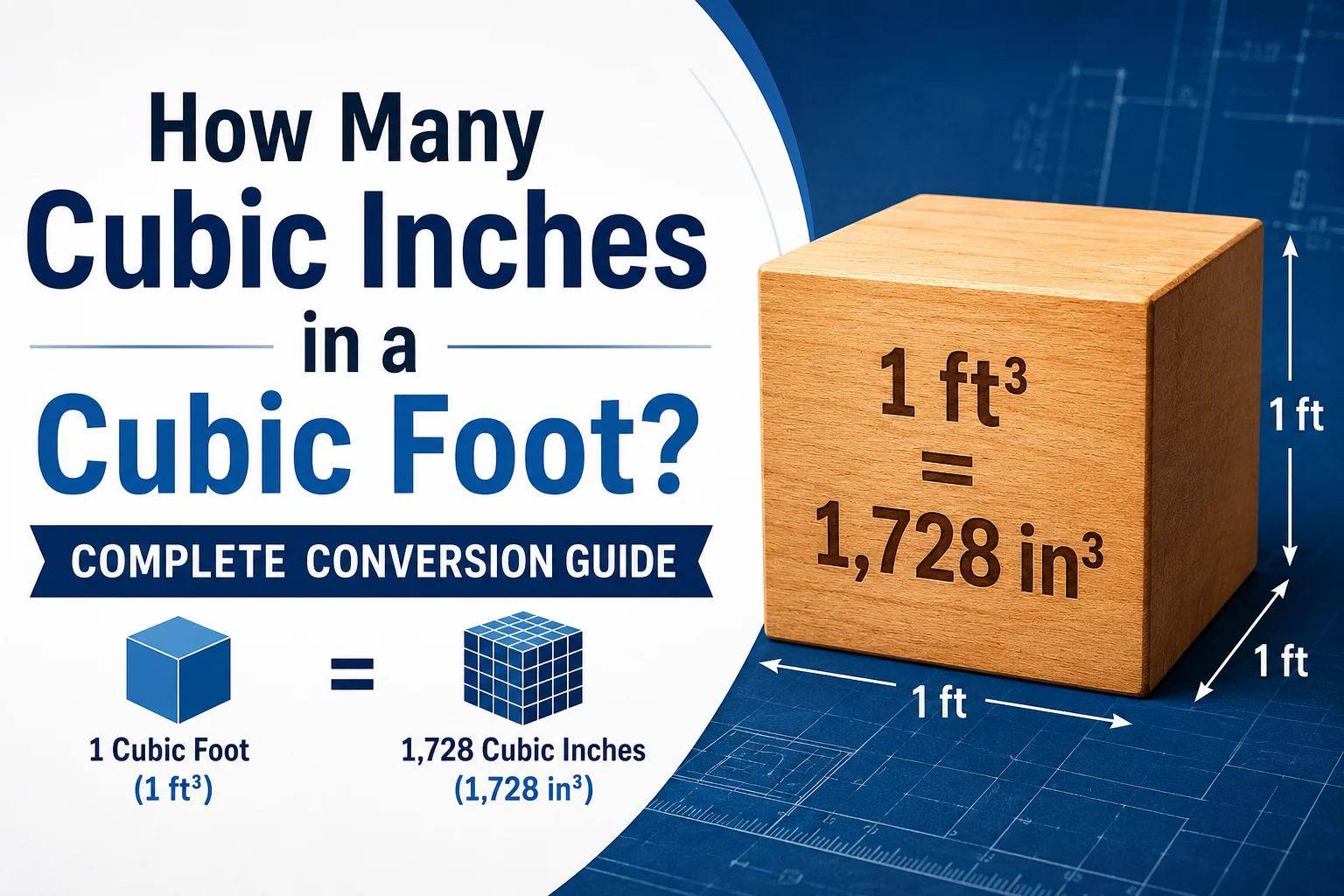
1 cubic foot = 1,728 cubic inches
Quick Answer
| Cubic Feet | Cubic Inches |
|---|---|
| 1 cubic foot | 1,728 cubic inches |
Therefore:
There are exactly 1,728 cubic inches in one cubic foot.
Understanding Cubic Measurements
Before performing volume conversions, it’s important to understand what cubic units represent.
What Is a Cubic Inch?
A cubic inch is a unit of volume equal to a cube measuring:
- 1 inch long
- 1 inch wide
- 1 inch high
Its abbreviation is:
in³
What Is a Cubic Foot?
A cubic foot is a unit of volume equal to a cube measuring:
- 1 foot long
- 1 foot wide
- 1 foot high
Its abbreviation is:
ft³
Because a foot is much larger than an inch, a cubic foot contains many cubic inches.
Why Does a Cubic Foot Equal 1,728 Cubic Inches?
Most people know:
1 foot = 12 inches
However, volume measurements involve three dimensions:
- Length
- Width
- Height
To convert cubic feet into cubic inches, the conversion factor must be cubed.
123=1728
This means:
1 cubic foot = 1,728 cubic inches
Visualizing One Cubic Foot
Imagine a box that measures:
- 12 inches long
- 12 inches wide
- 12 inches high
The volume calculation is:
12 × 12 × 12 = 1,728
This box contains:
1,728 cubic inches
which equals:
1 cubic foot
Formula for Converting Cubic Feet to Cubic Inches
Use the following formula:
Cubic Inches=Cubic Feet×1728
This formula works for any cubic-foot measurement.
Example Conversions
Example 1: Convert 2 Cubic Feet
Calculation:
2 × 1,728 = 3,456
Result:
2 cubic feet = 3,456 cubic inches
Example 2: Convert 5 Cubic Feet
Calculation:
5 × 1,728 = 8,640
Result:
5 cubic feet = 8,640 cubic inches
Example 3: Convert 10 Cubic Feet
Calculation:
10 × 1,728 = 17,280
Result:
10 cubic feet = 17,280 cubic inches
Formula for Converting Cubic Inches to Cubic Feet
Sometimes you’ll need to reverse the conversion.
Use:
Cubic Feet=1728Cubic Inches
Example
Convert 3,456 cubic inches to cubic feet.
3,456 ÷ 1,728 = 2
Result:
3,456 cubic inches = 2 cubic feet
Cubic Feet to Cubic Inches Conversion Chart
| Cubic Feet | Cubic Inches |
|---|---|
| 1 | 1,728 |
| 2 | 3,456 |
| 3 | 5,184 |
| 4 | 6,912 |
| 5 | 8,640 |
| 10 | 17,280 |
| 15 | 25,920 |
| 20 | 34,560 |
| 25 | 43,200 |
| 50 | 86,400 |
This chart is useful for quick reference during projects.
Real-World Applications
Shipping and Packaging
Shipping companies often calculate package volume using cubic inches.
For larger shipments, cubic feet may be used instead.
Understanding both measurements helps estimate shipping costs accurately.
Appliance Capacity
Many refrigerators, freezers, and storage units list capacity in cubic feet.
Manufacturers may also provide dimensions in inches.
Converting between units helps compare products.
Construction Projects
Builders frequently calculate:
- Concrete volume
- Excavation volume
- Storage space
- Material requirements
Volume conversions are essential for accurate estimates.
Furniture Planning
Large furniture pieces are often measured using dimensions in inches while room capacity may be discussed in cubic feet.
Storage Units
Storage facilities commonly advertise capacity in cubic feet.
Knowing cubic inches can provide a more detailed understanding of available space.
How to Calculate Cubic Feet From Dimensions
If you know the dimensions of an object in feet:
Use:
Length × Width × Height
Example
A box measures:
- 2 feet long
- 2 feet wide
- 2 feet high
Calculation:
2 × 2 × 2 = 8
Result:
8 cubic feet
How to Calculate Cubic Inches From Dimensions
If dimensions are measured in inches:
Length × Width × Height
Example
A box measures:
- 24 inches long
- 12 inches wide
- 6 inches high
Calculation:
24 × 12 × 6 = 1,728
Result:
1,728 cubic inches
This equals exactly:
1 cubic foot
Common Volume Measurements Compared
| Unit | Equivalent |
|---|---|
| 1 Cubic Inch | 16.387 cm³ |
| 1 Cubic Foot | 1,728 in³ |
| 1 Cubic Foot | 28.317 liters |
| 1 Cubic Foot | 0.0283 m³ |
| 1 Cubic Yard | 27 ft³ |
These comparisons help place cubic-foot measurements into perspective.
Visualizing 1,728 Cubic Inches
Many people find it difficult to imagine 1,728 cubic inches.
Here are some examples:
Small Refrigerator Space
A compact refrigerator compartment may contain roughly one cubic foot of storage.
Storage Cube
Many storage organizers are designed around one-cubic-foot compartments.
Large Moving Box
Some moving boxes are close to one cubic foot in volume.
Tool Storage Area
Portable toolboxes often provide capacities measured in cubic inches and cubic feet.
Common Mistakes When Converting Volume
Forgetting to Cube the Conversion Factor
A common error is multiplying by 12 instead of 1,728.
Remember:
Length conversion:
12 inches = 1 foot
Volume conversion:
12 × 12 × 12 = 1,728
Mixing Length and Volume Units
Never compare:
- Inches to cubic feet
- Feet to cubic inches
Ensure both measurements represent volume.
Using Incorrect Dimensions
Always verify that length, width, and height use the same unit before calculating volume.
Rounding Too Early
Use exact values throughout calculations for maximum accuracy.
Practical Examples
Example: Aquarium Capacity
Suppose an aquarium measures:
- 24 inches long
- 12 inches wide
- 12 inches high
Volume:
24 × 12 × 12 = 3,456 cubic inches
Convert to cubic feet:
3,456 ÷ 1,728 = 2
Result:
2 cubic feet
Example: Storage Bin
Dimensions:
- 18 inches
- 18 inches
- 18 inches
Volume:
18 × 18 × 18 = 5,832 cubic inches
Convert:
5,832 ÷ 1,728 = 3.375
Result:
3.38 cubic feet
Frequently Asked Questions
How many cubic inches are in one cubic foot?
There are exactly:
1,728 cubic inches in 1 cubic foot.
Why is the answer 1,728?
Because:
12 inches × 12 inches × 12 inches = 1,728 cubic inches.
What is the formula for cubic feet to cubic inches?
Use:
Cubic Inches = Cubic Feet × 1,728
How many cubic inches are in 5 cubic feet?
5 × 1,728 = 8,640
5 cubic feet = 8,640 cubic inches
How many cubic inches are in 10 cubic feet?
10 × 1,728 = 17,280
10 cubic feet = 17,280 cubic inches
How do I convert cubic inches to cubic feet?
Divide cubic inches by 1,728.
Quick Reference Table
| Cubic Feet | Cubic Inches |
|---|---|
| 1 | 1,728 |
| 2 | 3,456 |
| 5 | 8,640 |
| 10 | 17,280 |
| 20 | 34,560 |
| 50 | 86,400 |
| 100 | 172,800 |
Conclusion
The answer to “How many cubic inches are in a cubic foot?” is:
1 cubic foot = 1,728 cubic inches
This conversion exists because:
- 1 foot = 12 inches
- Volume uses three dimensions
- 12³ = 1,728
Whether you’re calculating storage capacity, shipping volumes, appliance sizes, construction materials, or educational problems, understanding that one cubic foot equals 1,728 cubic inches is essential for accurate measurements.
Quick Reference
- 1 cubic foot = 1,728 cubic inches
- 2 cubic feet = 3,456 cubic inches
- 5 cubic feet = 8,640 cubic inches
- 10 cubic feet = 17,280 cubic inches
- Formula: Cubic Inches = Cubic Feet × 1,728
Understanding this conversion will help you work confidently with volume measurements in construction, engineering, storage planning, shipping, and everyday projects.