

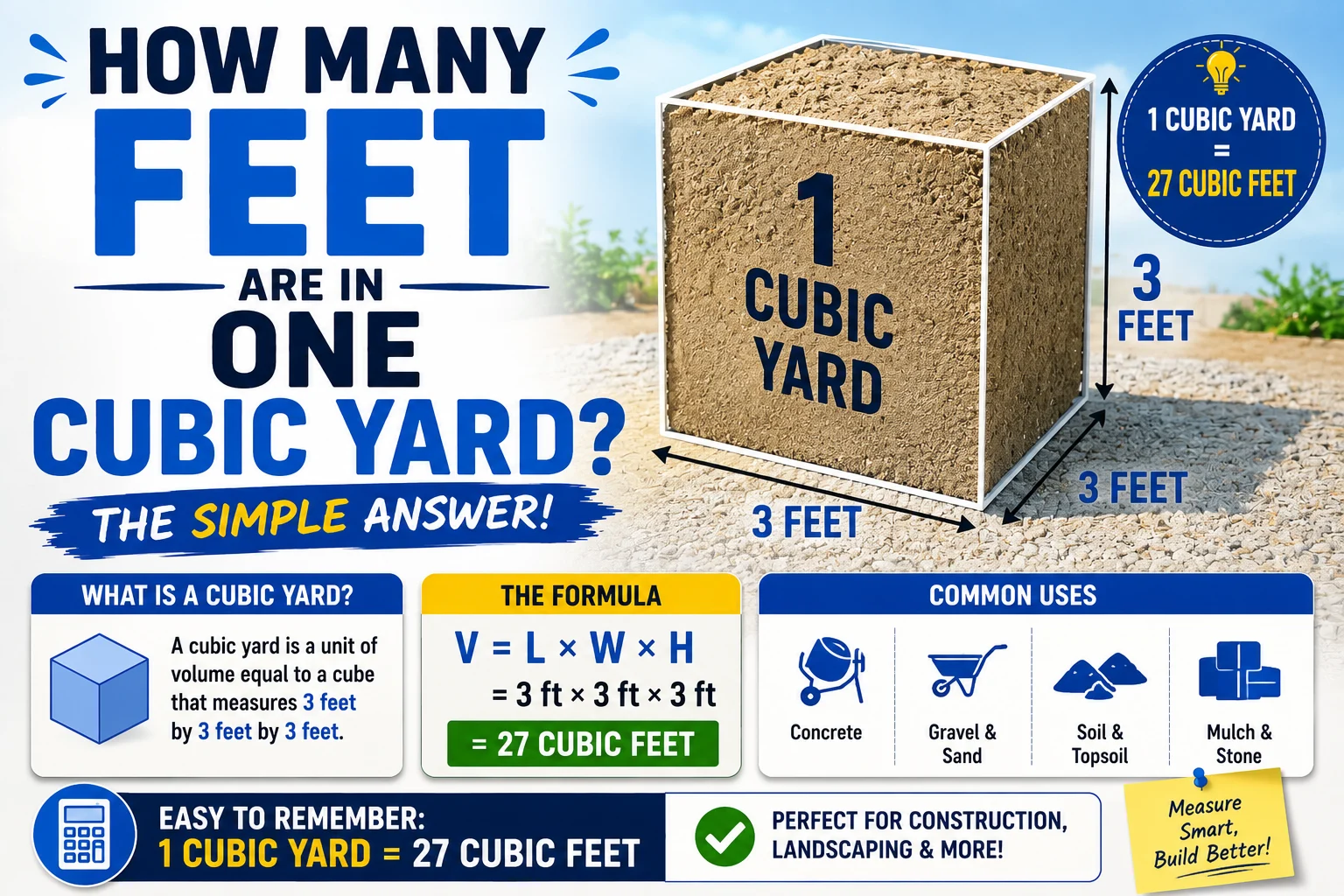
If you’re buying mulch, concrete, gravel, soil, or other bulk materials, you may be wondering:
How many feet are in one cubic yard?
This question is slightly misleading because yards measure length, while cubic yards measure volume. You can’t directly convert cubic yards to feet without specifying that you’re converting to cubic feet.
Quick Answer
1 cubic yard = 27 cubic feet
This is the standard conversion used in construction, landscaping, excavation, and home improvement projects.
Quick Conversion Table
| Cubic Yards | Cubic Feet |
|---|---|
| 1 | 27 cu ft |
| 2 | 54 cu ft |
| 3 | 81 cu ft |
| 5 | 135 cu ft |
| 10 | 270 cu ft |
Why Is One Cubic Yard Equal to 27 Cubic Feet?
A yard is equal to:
3 feet
A cubic yard is a cube measuring:
- 3 feet long
- 3 feet wide
- 3 feet high
The volume is calculated by multiplying all three dimensions:
3 × 3 × 3 = 27 cubic feet
So:
1 cubic yard = 27 cubic feet
Cubic Yard Formula
To convert cubic yards into cubic feet:
Cubic Feet = Cubic Yards × 27
Examples:
- 1 cubic yard = 27 cubic feet
- 2 cubic yards = 54 cubic feet
- 4 cubic yards = 108 cubic feet
- 8 cubic yards = 216 cubic feet
Cubic Feet to Cubic Yards Formula
To convert cubic feet back into cubic yards:
Cubic Yards = Cubic Feet ÷ 27
Examples:
- 27 cubic feet = 1 cubic yard
- 54 cubic feet = 2 cubic yards
- 135 cubic feet = 5 cubic yards
Cubic Yard Conversion Chart
| Cubic Yards | Cubic Feet |
| 0.25 | 6.75 cu ft |
| 0.5 | 13.5 cu ft |
| 0.75 | 20.25 cu ft |
| 1 | 27 cu ft |
| 1.5 | 40.5 cu ft |
| 2 | 54 cu ft |
| 3 | 81 cu ft |
| 4 | 108 cu ft |
| 5 | 135 cu ft |
| 10 | 270 cu ft |
Common Uses for Cubic Yards
Cubic yards are commonly used to measure:
- Mulch
- Topsoil
- Compost
- Gravel
- Sand
- Concrete
- Fill dirt
- Decorative stone
Suppliers usually sell these materials by the cubic yard.
Real-Life Examples
Mulch
One cubic yard of mulch covers approximately:
- 324 square feet at 1 inch deep
- 162 square feet at 2 inches deep
- 108 square feet at 3 inches deep
Concrete
One cubic yard of concrete equals:
27 cubic feet
This is enough to pour several small slabs, depending on thickness.
Gravel
Bulk gravel is almost always ordered by the cubic yard.
Knowing that each cubic yard contains 27 cubic feet helps estimate delivery quantities.
Cubic Feet vs. Square Feet
These measurements are often confused.
Cubic Feet
Measures:
Volume
Example:
A pile of mulch
Square Feet
Measures:
Area
Example:
A lawn or floor
Depth must be known to convert between square feet and cubic feet.
How to Measure Cubic Yards
Measure:
- Length (feet)
- Width (feet)
- Depth (feet)
Multiply:
Length × Width × Depth
This gives:
Cubic feet
Then divide by 27.
Example:
10 × 9 × 3 = 270 cubic feet
270 ÷ 27 = 10 cubic yards
FAQs
How many cubic feet are in one cubic yard?
There are exactly:
27 cubic feet in one cubic yard
Why is it 27?
Because one yard equals three feet.
3 × 3 × 3 = 27.
Can you convert cubic yards directly to feet?
No.
Feet measure length, while cubic yards measure volume.
The proper conversion is to cubic feet.
How many cubic feet are in two cubic yards?
Two cubic yards equal:
54 cubic feet
How many cubic feet are in five cubic yards?
Five cubic yards equal:
135 cubic feet
What materials are measured in cubic yards?
Common materials include:
- Mulch
- Gravel
- Concrete
- Sand
- Soil
- Compost
Is a cubic yard larger than a cubic foot?
Yes.
One cubic yard contains:
27 cubic feet
Common Mistakes to Avoid
- Confusing feet with cubic feet.
- Mixing square feet and cubic feet.
- Forgetting to divide cubic feet by 27.
- Estimating material quantities without measuring depth.
Using the correct units prevents ordering too much or too little material.
Quick Facts
- 1 cubic yard = 27 cubic feet
- 1 yard = 3 feet
- Cubic yards measure volume
- Cubic feet also measure volume
- Mulch, gravel, sand, and concrete are commonly sold by the cubic yard.
- Divide cubic feet by 27 to convert to cubic yards.
Final Thoughts
Although people often ask “How many feet are in one cubic yard?”, the correct conversion is 1 cubic yard = 27 cubic feet. This standard measurement is used throughout construction, landscaping, gardening, and home improvement projects. Understanding the difference between linear feet, square feet, and cubic feet makes estimating material quantities much easier and helps ensure accurate purchases.