

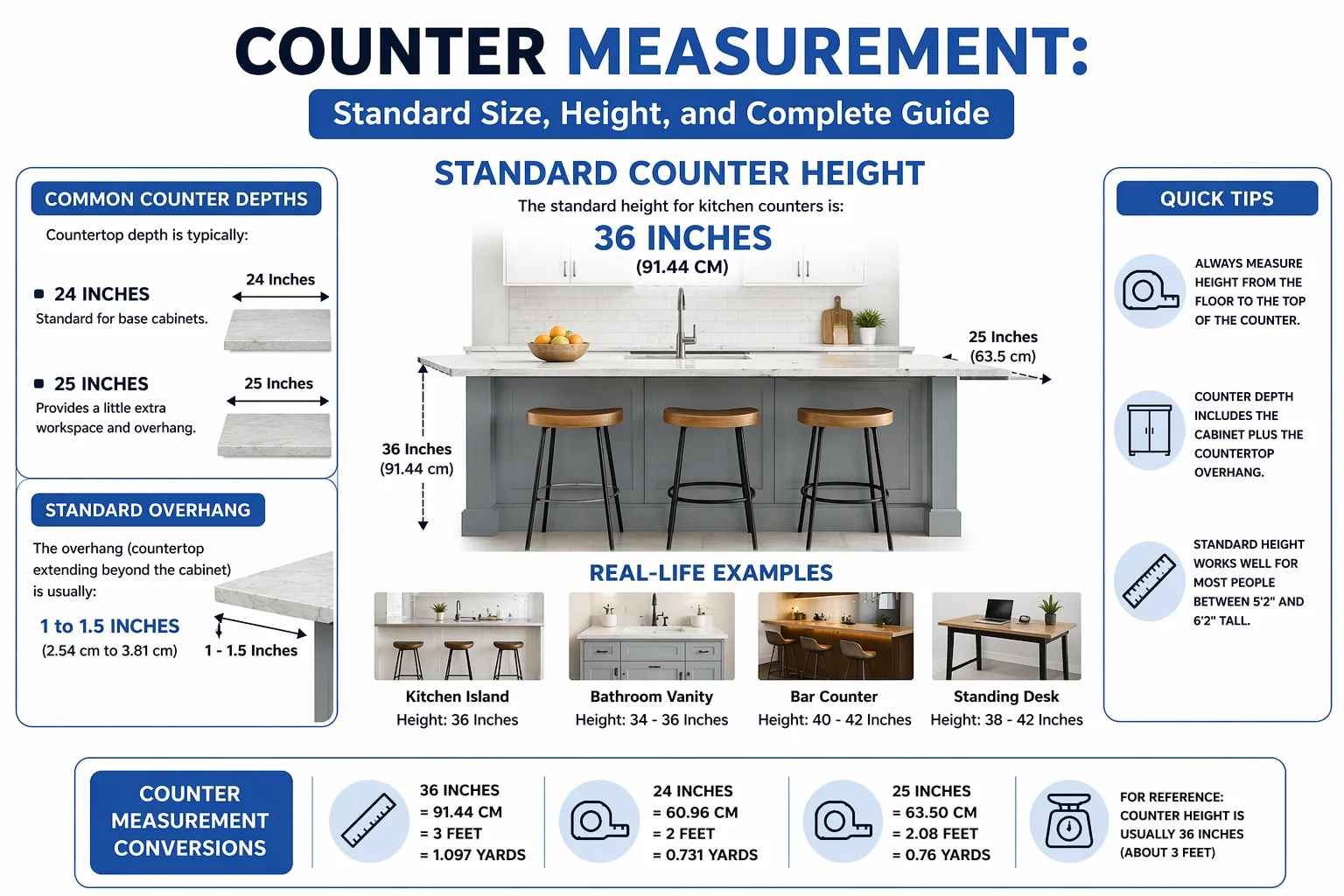
Understanding counter measurement is essential when designing or renovating a kitchen, bathroom, or workspace. Counters are one of the most used surfaces in any home, so their size directly affects comfort, efficiency, and usability.
Whether you are building a new kitchen or replacing countertops, knowing the correct counter dimensions helps you make better decisions.
What Is Counter Measurement?
Counter measurement refers to the standard dimensions of a countertop, including:
- Height
- Depth
- Thickness
- Total usable surface area
These measurements ensure the counter is comfortable for daily activities like cooking, washing, or working.
Standard Kitchen Counter Measurements
Most kitchen counters follow ergonomic standards to ensure comfort and usability.
Counter Height
The standard kitchen counter height is:
- 36 inches (3 feet) from the floor
36÷12=3
This height is designed to reduce strain while cooking and preparing food.
Counter Depth
The standard counter depth is:
- 24 inches (2 feet)
24÷12=2
This provides enough workspace while keeping everything within reach.
Counter Thickness
Countertop thickness varies based on material:
- Standard: 1.25 inches
- Thick stone slabs: up to 2–3 inches
- Modern slim designs: 0.75 inches
Counter Measurement in Inches, Feet, and CM
| Measurement Type | Inches | Feet | Centimeters |
|---|---|---|---|
| Height | 36 in | 3 ft | 91.44 cm |
| Depth | 24 in | 2 ft | 60.96 cm |
| Thickness (standard) | 1.25 in | — | 3.18 cm |
36×2.54=91.44
24×2.54=60.96
Types of Counters and Their Sizes
1. Kitchen Counter
- Height: 36 inches
- Depth: 24 inches
- Used for cooking and food prep
2. Bathroom Counter
- Height: 32–36 inches
- Depth: 20–22 inches
- Designed for sinks and storage
3. Bar Counter
- Height: 40–42 inches
- Depth: 20–30 inches
- Used for seating and serving drinks
4. Workstation Counter
- Adjustable height depending on usage
- Can range from 28–30 inches (sitting desks)
Why Counter Measurement Matters
Correct counter measurement improves:
1. Comfort
Proper height reduces back and shoulder strain.
2. Efficiency
Good spacing makes cooking and cleaning easier.
3. Safety
Prevents awkward bending or reaching.
4. Design Flow
Helps maintain balanced kitchen layout.
How to Measure a Counter Correctly
Step 1: Measure Height
From floor to top surface.
Step 2: Measure Depth
From wall to front edge.
Step 3: Measure Length
From one end of counter to another.
Step 4: Check Level
Ensure surface is even.
Quick Measurement Formula
Counter Height=Floor to countertop surface
Counter Depth=Wall to front edge
Common Mistakes in Counter Measurement
❌ Wrong Height Assumption
Many people install counters too high or too low.
❌ Ignoring User Height
Counter height should match user comfort.
❌ Not Considering Appliances
Appliances affect usable space.
❌ Skipping Clearance Space
Always leave space for movement.
Expert Tips for Kitchen Design
1. Follow Ergonomic Standards
36 inches is ideal for most adults.
2. Match Cabinet Height
Counters should align with base cabinets.
3. Consider Multiple Users
Adjust for family members of different heights.
4. Plan for Appliances
Dishwashers and ovens need proper clearance.
Counter Measurement in Real Life
To visualize:
- Counter height (36 inches) ≈ waist height
- Counter depth (24 inches) ≈ arm’s reach
- Kitchen counter length varies by kitchen size
9. FAQs
1. What is standard counter height?
The standard kitchen counter height is 36 inches (3 feet).
2. What is standard counter depth?
The standard depth is 24 inches (2 feet).
3. Why is counter height 36 inches?
It is designed for ergonomic comfort during cooking.
4. Can counter height be customized?
Yes, it can be adjusted based on user needs.
5. What material is best for counters?
Granite, quartz, and marble are popular durable options.
10. Conclusion
Understanding counter measurement is essential for creating a functional and comfortable kitchen or workspace. Standard dimensions like 36-inch height and 24-inch depth are designed for efficiency and ergonomics.
Whether you are designing a new kitchen or upgrading your home, correct counter sizing ensures better usability and long-term comfort.
👉 Final Tip
Always design your counter based on user height and daily usage because the right measurement makes every task easier and more comfortable.
Discover More Articles
15 Kilograms Weight: Meaning, Conversion & Real-Life Examples
12 Kilograms Weight: Meaning, Conversion & Real-Life Examples