

If you’re planning a concrete project, one of the most important measurements to understand is how many cubic feet in 1 yard of concrete.
The answer is straightforward:
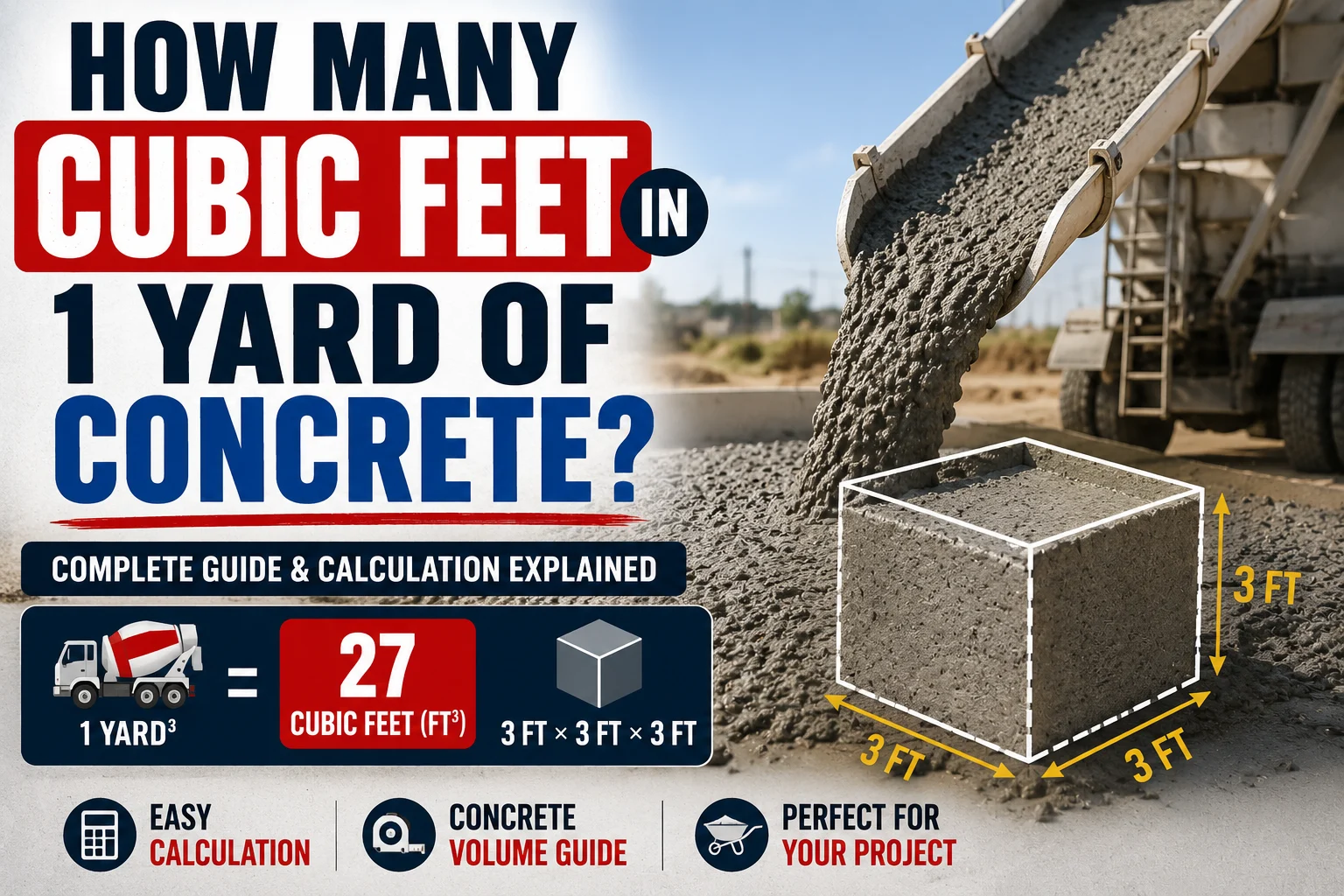
1 cubic yard of concrete = 27 cubic feet.
This is a volume conversion, not a measurement of length. A cubic yard describes a three-dimensional space that is 1 yard long × 1 yard wide × 1 yard high.
Because:
1 yard = 3 feet
a cubic yard contains:
3 × 3 × 3 = 27 cubic feet
So, when a concrete supplier says you need 1 cubic yard of concrete, they are referring to 27 cubic feet of concrete.
This conversion is especially useful when estimating concrete for driveways, patios, sidewalks, slabs, foundations, footings, steps, and other construction projects.
Quick Answer: How Many Cubic Feet Are in 1 Yard of Concrete?
There are exactly 27 cubic feet in 1 cubic yard of concrete.
The calculation is:
1 cubic yard = 3 ft × 3 ft × 3 ft
1 cubic yard = 27 cubic feet
Therefore:
- 1 cubic yard = 27 cubic feet
- 2 cubic yards = 54 cubic feet
- 3 cubic yards = 81 cubic feet
- 4 cubic yards = 108 cubic feet
- 5 cubic yards = 135 cubic feet
- 10 cubic yards = 270 cubic feet
The conversion is the same whether you’re measuring concrete, soil, gravel, mulch, or another material sold by cubic yards.
Why Is 1 Cubic Yard Equal to 27 Cubic Feet?
The key is understanding the word cubic.
A regular yard is a measurement of length.
A cubic yard measures volume.
Since:
1 yard = 3 feet
a cube that measures 1 yard on every side is:
- 3 feet long
- 3 feet wide
- 3 feet high
To calculate its volume:
3 × 3 × 3 = 27 cubic feet
Therefore:
1 cubic yard = 27 cubic feet
This is why you multiply by 27 when converting cubic yards into cubic feet.
Cubic Yard vs. Cubic Foot
It’s easy to confuse these two measurements.
A cubic foot is the volume of a space measuring:
1 ft × 1 ft × 1 ft
A cubic yard is:
3 ft × 3 ft × 3 ft
So one cubic yard contains 27 individual cubic feet.
| Measurement | Equivalent Volume |
|---|---|
| 1 cubic foot | 1 cu ft |
| 1 cubic yard | 27 cu ft |
| 2 cubic yards | 54 cu ft |
| 3 cubic yards | 81 cu ft |
| 5 cubic yards | 135 cu ft |
| 10 cubic yards | 270 cu ft |
When ordering concrete, suppliers commonly use cubic yards rather than cubic feet.
How to Convert Cubic Yards to Cubic Feet
The formula is simple:
Cubic Feet = Cubic Yards × 27
For example, if you need 4 cubic yards:
4 × 27 = 108 cubic feet
Therefore:
4 cubic yards = 108 cubic feet
Another Example
Suppose your project requires 2.5 cubic yards.
Calculate:
2.5 × 27 = 67.5 cubic feet
So:
2.5 cubic yards = 67.5 cubic feet
This formula works for any number of cubic yards.
How to Convert Cubic Feet to Cubic Yards
You can also convert in the opposite direction.
Use:
Cubic Yards = Cubic Feet ÷ 27
For example, if you calculate that your project requires 81 cubic feet:
81 ÷ 27 = 3 cubic yards
Therefore:
81 cubic feet = 3 cubic yards
If your calculation produces 50 cubic feet:
50 ÷ 27 ≈ 1.85 cubic yards
You would typically discuss the appropriate ordering quantity with your concrete supplier rather than ordering an amount below your calculated requirement.
How Much Concrete Is 1 Cubic Yard?
One cubic yard of concrete is a substantial amount of material.
It contains:
27 cubic feet of concrete
How much surface area that covers depends on the thickness of the concrete.
For example, 1 cubic yard can cover approximately:
| Concrete Thickness | Approx. Area Covered by 1 Cubic Yard |
| 2 inches | 162 sq ft |
| 3 inches | 108 sq ft |
| 4 inches | 81 sq ft |
| 5 inches | 64.8 sq ft |
| 6 inches | 54 sq ft |
| 8 inches | 40.5 sq ft |
| 10 inches | 32.4 sq ft |
| 12 inches | 27 sq ft |
These figures assume a perfectly measured area with no waste or variation in thickness.
The thicker the slab, the smaller the surface area that one cubic yard can cover.
How Many Square Feet Does 1 Yard of Concrete Cover?
There is no single square-foot coverage figure because coverage depends on concrete thickness.
For a 4-inch slab, one cubic yard covers approximately:
81 square feet
For a 6-inch slab:
54 square feet
For a 12-inch slab:
27 square feet
The basic relationship is:
Area = Volume ÷ Thickness
You must convert the thickness into feet before using the formula.
For example, 4 inches equals:
4 ÷ 12 = 0.333 feet
Then:
27 ÷ 0.333 ≈ 81 square feet
So one cubic yard of concrete can cover approximately 81 square feet at 4 inches thick.
How to Calculate How Many Cubic Yards of Concrete You Need
To estimate concrete for a rectangular slab, use this formula:
Length × Width × Thickness = Cubic Feet
Then convert cubic feet to cubic yards:
Cubic Feet ÷ 27 = Cubic Yards
The important step is converting inches into feet.
Example: Concrete Patio
Suppose you’re building a patio that is:
- 20 feet long
- 10 feet wide
- 4 inches thick
First convert thickness:
4 ÷ 12 = 0.333 feet
Now calculate volume:
20 × 10 × 0.333 = 66.6 cubic feet
Convert to cubic yards:
66.6 ÷ 27 ≈ 2.47 cubic yards
So the basic estimate is approximately 2.47 cubic yards.
Because concrete projects can have measurement differences and installation waste, you may want to include a reasonable allowance when determining the order quantity.
Concrete Calculation Examples
Example 1: 10 × 10 Foot Slab
Suppose a slab is:
10 ft × 10 ft × 4 inches
Convert 4 inches:
4 ÷ 12 = 0.333 ft
Calculate:
10 × 10 × 0.333 = 33.3 cubic feet
Convert to yards:
33.3 ÷ 27 ≈ 1.23 cubic yards
So the project requires approximately 1.23 cubic yards before any additional allowance.
Example 2: 20 × 20 Foot Slab
For a 20 × 20-foot slab that is 4 inches thick:
20 × 20 × 0.333 = 133.2 cubic feet
Then:
133.2 ÷ 27 ≈ 4.93 cubic yards
The estimated requirement is approximately 4.93 cubic yards.
Example 3: 30 × 10 Foot Driveway
Suppose the driveway is:
- 30 feet long
- 10 feet wide
- 6 inches thick
Convert 6 inches:
6 ÷ 12 = 0.5 feet
Calculate:
30 × 10 × 0.5 = 150 cubic feet
Convert:
150 ÷ 27 = 5.56 cubic yards
So the driveway requires approximately 5.56 cubic yards before considering waste, site conditions, or other factors.
Concrete Coverage Chart
The following chart shows approximately how much area one cubic yard of concrete covers at different thicknesses.
| Thickness | Approx. Coverage |
| 2 inches | 162 sq ft |
| 3 inches | 108 sq ft |
| 4 inches | 81 sq ft |
| 5 inches | 64.8 sq ft |
| 6 inches | 54 sq ft |
| 7 inches | 46.3 sq ft |
| 8 inches | 40.5 sq ft |
| 9 inches | 36 sq ft |
| 10 inches | 32.4 sq ft |
| 12 inches | 27 sq ft |
These are theoretical coverage figures based on exactly 27 cubic feet per cubic yard.
How Many Cubic Feet Are in 2 Yards of Concrete?
Since 1 cubic yard equals 27 cubic feet:
2 × 27 = 54 cubic feet
Therefore:
2 cubic yards = 54 cubic feet
This amount could cover approximately:
- 162 square feet at 4 inches? No—because 1 yard covers 81 square feet at 4 inches, so 2 yards covers 162 square feet at 4 inches.
- 108 square feet at 6 inches
- 81 square feet at 8 inches
Thickness determines the coverage.
How Many Cubic Feet Are in 3 Yards of Concrete?
Multiply 3 by 27:
3 × 27 = 81 cubic feet
Therefore:
3 cubic yards = 81 cubic feet
At a 4-inch thickness, 3 cubic yards can theoretically cover:
81 ÷ 0.333 ≈ 243 square feet
Again, this is a theoretical estimate and does not include waste or variations in the finished slab thickness.
How Many Cubic Feet Are in 5 Yards of Concrete?
Calculate:
5 × 27 = 135 cubic feet
Therefore:
5 cubic yards = 135 cubic feet
At 4 inches thick, this would cover approximately:
135 ÷ 0.333 ≈ 405 square feet
At 6 inches thick:
135 ÷ 0.5 = 270 square feet
The thicker the concrete, the less surface area the same volume will cover.
Why Concrete Is Sold by the Cubic Yard
Concrete is a three-dimensional material, so it makes sense to sell it according to volume.
A concrete slab has three important dimensions:
- Length
- Width
- Thickness
Multiplying these measurements gives the volume.
For example:
20 × 10 × 0.333 = 66.6 cubic feet
Concrete suppliers commonly convert this number into cubic yards because ready-mix concrete is typically ordered and delivered by the cubic yard.
This makes it easier to estimate the amount required for construction projects.
Should You Order Exactly the Calculated Amount?
It’s usually not wise to assume that your mathematical calculation will perfectly match the amount used at the job site.
Small differences can occur because of:
- Uneven ground
- Slightly different slab thickness
- Form dimensions
- Spillage
- Waste
- Irregular shapes
- Changes during installation
For this reason, contractors often include an appropriate additional allowance.
However, avoid simply adding a large amount without reason. Excess concrete can be expensive and difficult to dispose of.
For a significant project, your concrete contractor or supplier can help determine the appropriate order quantity.
Common Mistakes When Calculating Concrete
Mistake 1: Forgetting to Convert Inches to Feet
If your slab is 4 inches thick, don’t enter “4” directly into a formula using feet.
Instead:
4 inches ÷ 12 = 0.333 feet
Mistake 2: Confusing Cubic Feet With Square Feet
Square feet measure area.
Cubic feet measure volume.
Concrete quantity requires a volume calculation.
Mistake 3: Dividing by 3 Instead of 27
One yard equals 3 feet, but one cubic yard equals 27 cubic feet.
You must account for all three dimensions.
Mistake 4: Ignoring Slab Thickness
A 4-inch slab and a 6-inch slab covering the same area require different amounts of concrete.
Mistake 5: Forgetting Irregular Sections
If the project isn’t rectangular, divide it into smaller sections and calculate each section separately.
Tips for Estimating Concrete Accurately
Measure Carefully
Use accurate measurements for length and width.
Confirm Thickness
Don’t assume the thickness if your project plans specify something different.
Break Complex Areas Into Sections
For an L-shaped patio, calculate each rectangle separately and add the volumes.
Check Your Units
Keep all measurements in feet before calculating cubic feet.
Add an Appropriate Allowance
Discuss the appropriate allowance with your contractor or concrete supplier.
Confirm the Order With the Supplier
For large projects, provide the supplier with your dimensions and calculated volume so they can help verify the order quantity.
FAQs
1. How many cubic feet are in 1 yard of concrete?
There are exactly 27 cubic feet in 1 cubic yard of concrete. This comes from multiplying 3 feet by 3 feet by 3 feet.
2. How many cubic feet are in 2 yards of concrete?
Two cubic yards contain:
2 × 27 = 54 cubic feet
Therefore, 2 cubic yards = 54 cubic feet.
3. How many square feet does one yard of concrete cover?
It depends on thickness. One cubic yard contains 27 cubic feet and can cover approximately 81 square feet at 4 inches thick, or 54 square feet at 6 inches thick.
4. How do I calculate how much concrete I need?
Multiply the length by the width by the thickness in feet to get cubic feet. Then divide the result by 27 to convert cubic feet into cubic yards.
Length × Width × Thickness ÷ 27 = Cubic Yards
5. Is a cubic yard the same as a yard of concrete?
When concrete suppliers say “one yard of concrete,” they generally mean one cubic yard, which equals 27 cubic feet. It is a volume measurement, not a linear yard.
Conclusion
So, how many cubic feet in 1 yard of concrete? The answer is exactly 27 cubic feet.
The conversion is based on the fact that one yard equals 3 feet:
3 × 3 × 3 = 27 cubic feet
When estimating a concrete project, first calculate the volume in cubic feet by multiplying the length, width, and thickness. Then divide the result by 27 to determine the number of cubic yards needed.
Remember that concrete coverage depends on thickness. One cubic yard can cover approximately 81 square feet at 4 inches thick, but only about 54 square feet at 6 inches thick.
For the most accurate order, measure carefully, account for the actual project shape and thickness, and confirm your final quantity with your concrete supplier or contractor. A correct volume estimate can help prevent costly shortages, excess material, and delays during your concrete project.