

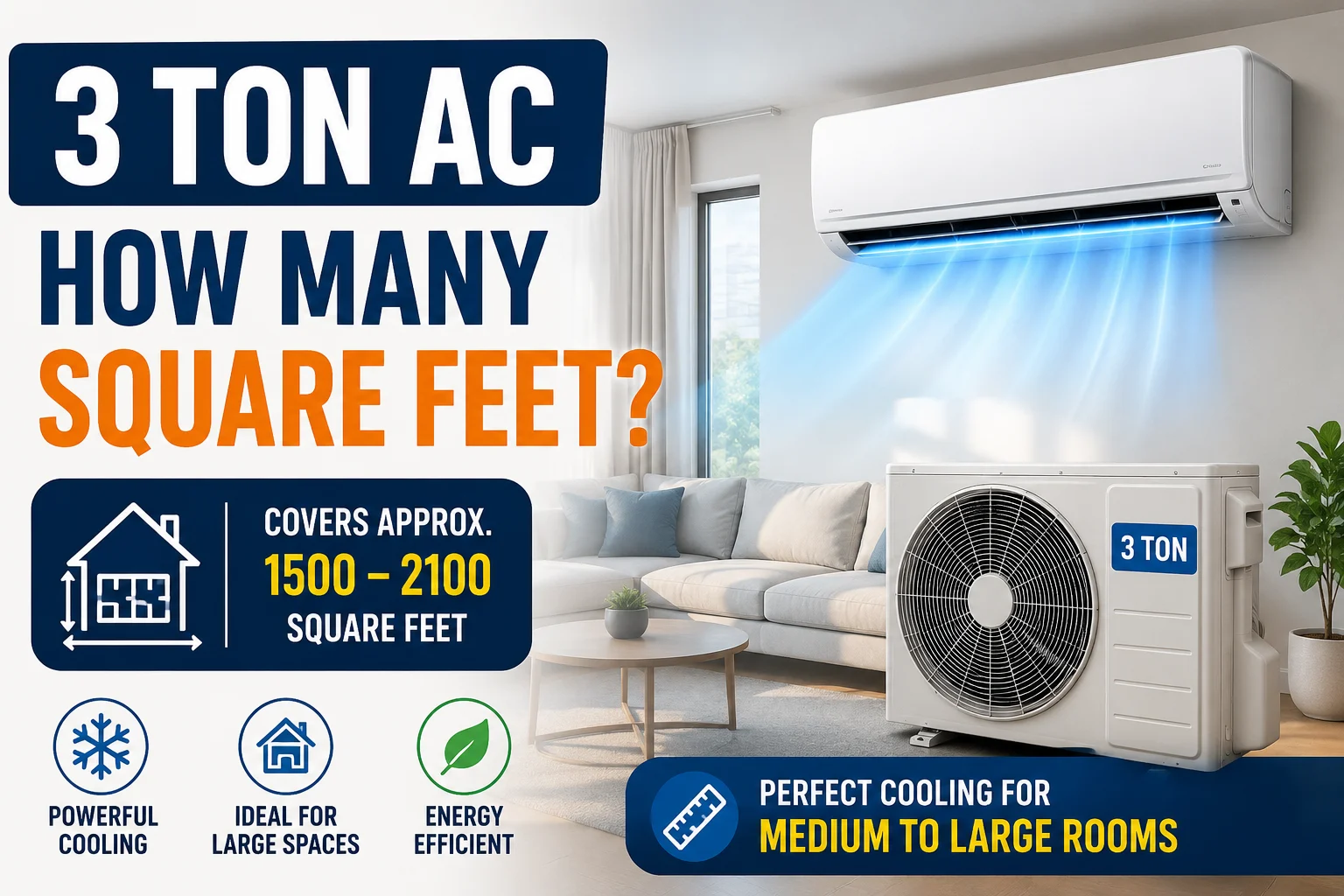
If you are replacing your air conditioner or planning a new HVAC installation, you may be wondering, “A 3 ton AC how many square feet can it cool?”
The short answer is that a 3 ton air conditioner typically cools about 1,500 to 1,800 square feet in an average home. However, the exact coverage depends on several factors, including your climate, insulation quality, ceiling height, windows, and home layout.
A 3 ton AC unit is a popular choice for medium-sized homes because it provides a good balance between cooling power and energy efficiency.
In this guide, you’ll learn what a 3 ton AC means, how much space it can cool, how to compare AC sizes, and how to avoid choosing the wrong system.
Quick Answer
A 3 ton AC usually covers:
1,500–1,800 square feet
3 Ton AC Basic Facts
| Specification | Value |
|---|---|
| Cooling Capacity | 36,000 BTUs |
| Average Coverage | 1,500–1,800 sq ft |
| Best For | Medium-sized homes |
| System Type | Central air conditioning |
A properly sized AC depends on more than square footage alone.
What Does a 3 Ton AC Mean?
The word “ton” in air conditioning does not refer to the physical weight of the unit.
Instead, it measures cooling capacity.
One ton of AC equals:
12,000 BTUs per hour
Therefore:
3 tons × 12,000 BTUs = 36,000 BTUs
A 3 ton AC can remove approximately 36,000 BTUs of heat per hour from your home.
How Many Square Feet Does a 3 Ton AC Cover?
For a typical residential home:
| Home Size | Recommended AC Size |
|---|---|
| 600–1,000 sq ft | 1.5–2 tons |
| 1,000–1,300 sq ft | 2–2.5 tons |
| 1,500–1,800 sq ft | 3 tons |
| 1,800–2,200 sq ft | 3.5–4 tons |
| 2,200–2,600 sq ft | 4–5 tons |
A 3 ton AC works best for homes around 1,500–1,800 square feet with average conditions.
3 Ton AC Coverage Chart
Use this chart as a general estimate.
| Climate Condition | Coverage |
|---|---|
| Very hot climate | 1,200–1,500 sq ft |
| Average climate | 1,500–1,800 sq ft |
| Mild climate | 1,800–2,000 sq ft |
| Excellent insulation | Up to 2,100 sq ft |
Homes in hotter regions often require more cooling power.
Factors That Affect 3 Ton AC Coverage
Square footage is only one part of AC sizing.
Climate
A home in a hot, humid area needs more cooling capacity than a home in a mild climate.
For example:
- Hot desert areas → more BTUs needed
- Mild coastal areas → fewer BTUs needed
Insulation Quality
Good insulation helps keep cool air inside.
Poor insulation causes:
- More heat gain
- Longer AC run times
- Higher energy bills
Ceiling Height
Most AC estimates assume:
- 8-foot ceilings
Rooms with:
- 10-foot ceilings
- Vaulted ceilings
- Open layouts
may require additional cooling capacity.
Windows and Sun Exposure
Large windows facing the sun can increase cooling needs.
Factors include:
- Window size
- Window type
- Shade availability
- Direction the windows face
Home Layout
A closed-floor plan cools differently from an open-concept home.
Airflow problems can make even a correctly sized AC feel insufficient.
Is a 3 Ton AC Right for Your Home?
A 3 ton AC may be a good choice if your home has:
✅ 1,500–1,800 square feet
✅ Average insulation
✅ Standard 8-foot ceilings
✅ Proper ductwork
✅ Moderate climate conditions
It may not be enough if:
❌ The home is poorly insulated
❌ You live in an extremely hot climate
❌ The house has very high ceilings
❌ Large areas receive direct sunlight
3 Ton AC vs Other AC Sizes
| AC Size | BTU Capacity | Approximate Coverage |
|---|---|---|
| 1.5 Ton | 18,000 BTU | 600–1,000 sq ft |
| 2 Ton | 24,000 BTU | 1,000–1,300 sq ft |
| 2.5 Ton | 30,000 BTU | 1,300–1,500 sq ft |
| 3 Ton | 36,000 BTU | 1,500–1,800 sq ft |
| 4 Ton | 48,000 BTU | 2,000–2,400 sq ft |
| 5 Ton | 60,000 BTU | 2,500–3,000 sq ft |
Common AC Sizing Mistakes
Choosing Based Only on Square Feet
Square footage is important, but it is not the only factor.
HVAC professionals use a Manual J load calculation that considers:
- Insulation
- Windows
- Climate
- Occupants
- Heat-producing appliances
Buying a Larger Unit for Faster Cooling
A bigger AC is not always better.
An oversized unit may:
- Cycle on and off too often
- Reduce humidity control
- Waste energy
- Create uneven temperatures
Ignoring Ductwork
Poor duct design can reduce cooling performance even with the correct AC size.
Expert Tips for Choosing a 3 Ton AC
Get a Professional Load Calculation
A proper HVAC assessment gives the most accurate size recommendation.
Improve Insulation First
Better insulation can reduce the AC size needed.
Check Energy Efficiency Ratings
Look for higher SEER ratings for better long-term savings.
Maintain Airflow
Clean filters and properly sized ducts improve performance.
Consider Your Future Needs
Home additions or renovations can change cooling requirements.
Real-World Examples
Example 1: 1,600 Square Foot Home
A well-insulated 1,600 sq ft home in a moderate climate:
Recommended: 3 ton AC
Example 2: 1,800 Square Foot Home
Average insulation and normal ceiling height:
Recommended: 3 ton AC
Example 3: 1,500 Square Foot Home in a Very Hot Climate
High temperatures and poor insulation:
A 3 ton AC may be required or may need additional efficiency improvements.
FAQs
1. How many square feet will a 3 ton AC cool?
A 3 ton AC typically cools 1,500–1,800 square feet under average conditions.
2. How many BTUs is a 3 ton AC?
A 3 ton air conditioner produces 36,000 BTUs per hour of cooling capacity.
3. Can a 3 ton AC cool a 2,000 square foot house?
It depends on climate, insulation, and home design. In some mild climates it may work, but many 2,000 sq ft homes require a larger system.
4. Is a 3 ton AC enough for a 1,500 sq ft house?
Yes. A 3 ton AC is commonly suitable for a 1,500 sq ft home with average insulation and normal ceiling height.
5. What happens if my AC is too large?
An oversized AC may cool quickly but fail to remove humidity properly, causing comfort problems and higher energy use.
Conclusion
If you are asking “3 ton AC how many square feet?”, the general answer is about 1,500 to 1,800 square feet. A 3 ton air conditioner provides 36,000 BTUs of cooling power and is commonly used for medium-sized homes.
However, the best AC size depends on more than just square footage. Climate, insulation, windows, ceiling height, and ductwork all affect cooling performance.
Before purchasing a new AC system, consider getting a professional load calculation to ensure you choose the right size for your home.