
Tire Size Meaning: 225/45R17 Decoded + Load Index and Speed Rating Charts
Tire size meaning explained: 225/45R17 decoded step by step, load index and speed rating charts, overall diameter math,…
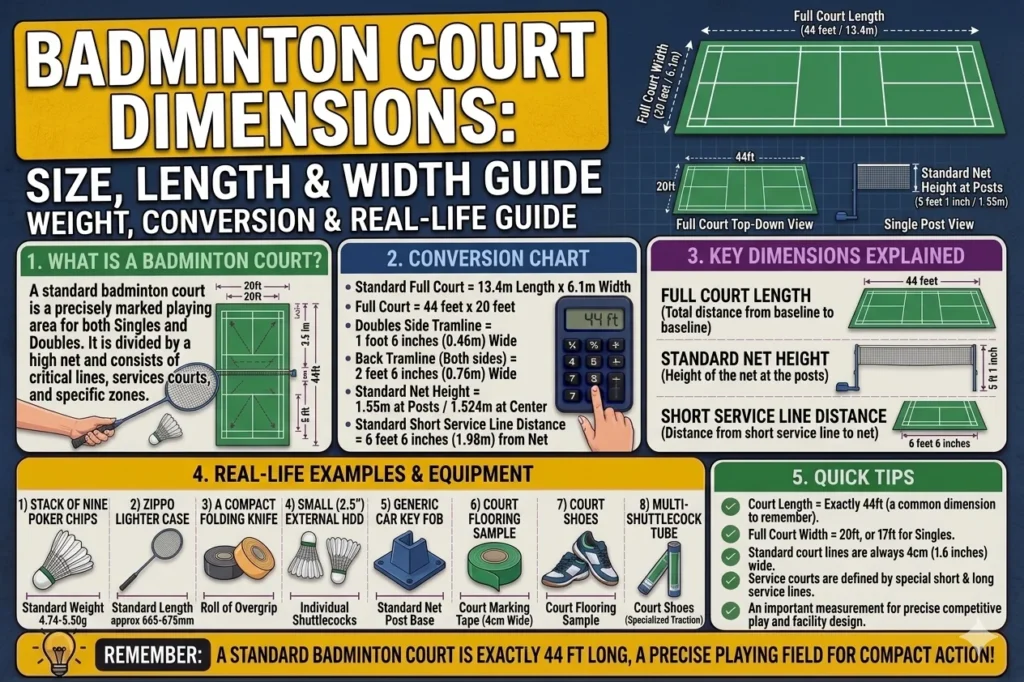
Understanding badminton court dimensions is important for players, coaches, school setups, and sports facility planning. A badminton court has fixed international standards that ensure fair play across all levels.
This guide explains the exact badminton court size, including length, width for singles and doubles, markings, and real-life comparisons.
A standard badminton court is a rectangular indoor playing area designed for singles and doubles matches. The size is regulated internationally to maintain consistency in gameplay.
The standard court length is:
13.4 meters (44 feet)
13.4×3.281=43.9454
The full width for doubles play is:
6.1 meters (20 feet)
6.1×3.281=20.0131
The singles court is narrower:
5.18 meters (17 feet)
5.18×3.281=16.99558
| Area Type | Meters | Feet |
|---|---|---|
| Length | 13.4 m | 44 ft |
| Width (Singles) | 5.18 m | 17 ft |
| Width (Doubles) | 6.1 m | 20 ft |
A badminton court is not just about size—it also includes important boundary lines.
To understand badminton court dimensions, compare it with familiar spaces.
The standard court size is important because:
Incorrect court size affects gameplay.
Standard lines are usually 40 mm wide.
Ceiling height should be at least 7–9 meters indoors.
Both must be clearly marked.
Badminton courts are much smaller.
Many setups wrongly use doubles width for all play.
Wrong service lines affect rules.
Low ceilings can affect shuttle movement.
13.4 m long, 6.1 m wide (doubles), 5.18 m wide (singles)
About 44 ft long and 20 ft wide
Yes, singles uses a narrower width.
Yes, but wind affects shuttle movement.
1.55 meters at the edges and 1.524 meters at the center
Understanding badminton court dimensions helps in building proper courts, improving gameplay, and following international rules. A standard court measures 13.4 meters in length and up to 6.1 meters in width, making it ideal for fast-paced indoor sports.
Whether you’re a player, coach, or planner, knowing the correct court size ensures accurate setup and better performance.
Think of a badminton court as a precisely measured compact arena designed for speed, agility, and controlled gameplay in a small space.
2.5 Inches Explained: Size, Conversion & Real-Life Guide
Tire size meaning explained: 225/45R17 decoded step by step, load index and speed rating charts, overall diameter math,…
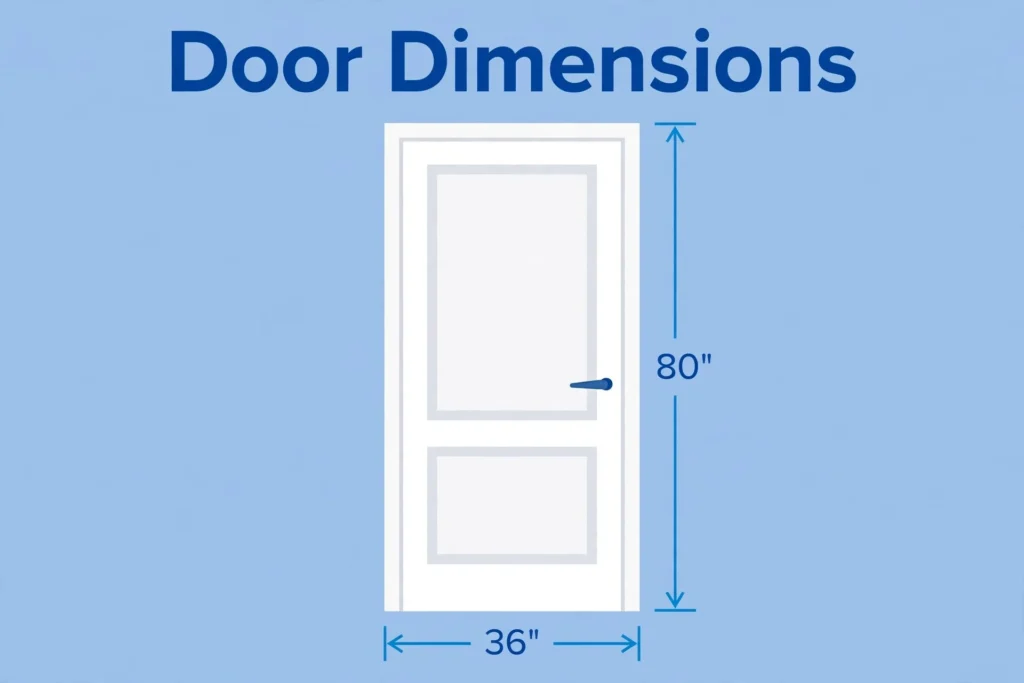
Standard door dimensions: interior 30 or 32 x 80 inches, front door 36 x 80, plus rough opening…

Full paper sizes chart: Letter 8.5x11, Legal, Tabloid, A4 210x297 mm, A3, A5, plus the envelope that fits…