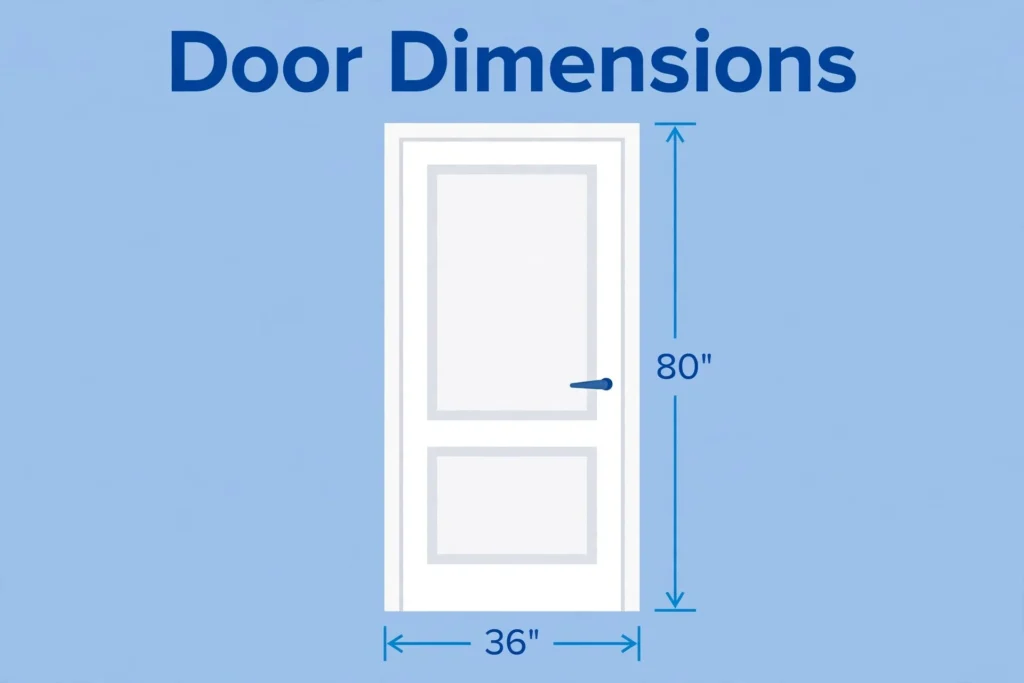
Standard Door Dimensions: Interior, Front, Closet + Rough Opening Chart
Standard door dimensions: interior 30 or 32 x 80 inches, front door 36 x 80, plus rough opening…
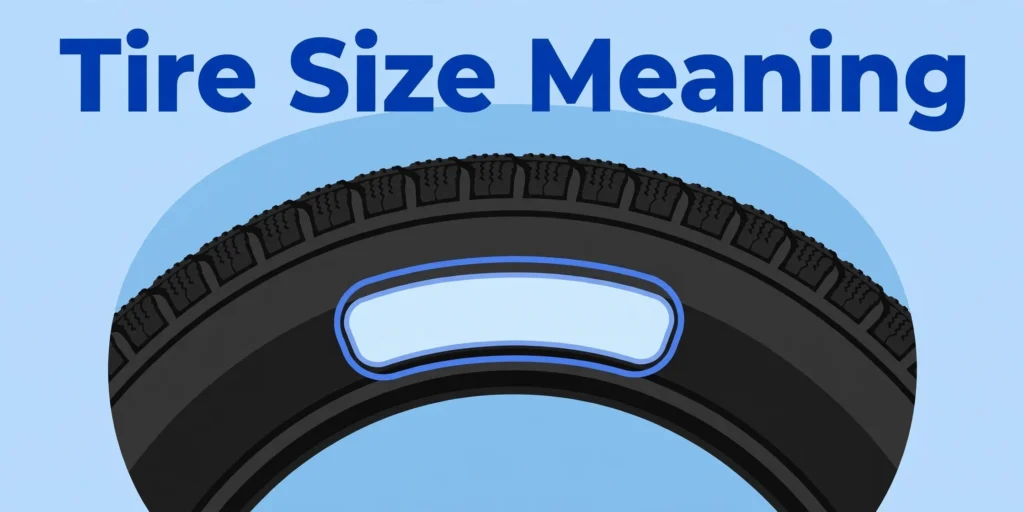
Quick Answer: Take the code 225/45R17 from your tire sidewall. 225 is the tire width in millimetres. 45 is the aspect ratio: the sidewall height is 45% of the width, which is 101.25 mm. R means radial construction. 17 is the wheel rim diameter in inches. The full tire diameter is about 25 inches. The number after the size, such as 91V, is the load index (91 = 615 kg per tire) and the speed rating (V = up to 149 mph).
225/45R17, piece by piece
225
width in mm
45
aspect ratio %
R
radial
17
rim, inches
After the size, 91V means load index 91 (615 kg per tire) and speed rating V (up to 149 mph).
Every tire carries its size on the sidewall in the same format: three digits, a slash, two digits, a letter, and two digits. Using 225/45R17 as the example, the code breaks into four pieces, and each piece answers a different question. How wide is the tire? How tall is the sidewall? How is it built? What wheel does it fit?
The order never changes. Width always comes first, then the aspect ratio, then the construction letter, then the rim diameter. Once you know the order, you can read any tire in seconds, whether it is on your car, on a trailer, or on a car you are thinking of buying.
A common mix-up is the last number. The 17 in 225/45R17 is the rim diameter in inches, not the tire diameter. The whole tire is much bigger than 17 inches, because the sidewall adds height above and below the rim. The full diameter calculation comes later in this guide.
The first number, 225, is the section width in millimetres, measured from one sidewall to the other at the widest point. Wider tires, like 265 or 275, give more grip and a wider contact patch, but they also cost more, wear faster, and can rub the wheel well if they are too wide for the car.
The second number, 45, is the aspect ratio, and it is a percentage, not a measurement. It says the sidewall height is 45% of the width. So for a 225 tyre, the sidewall is 225 x 0.45 = 101.25 mm tall, which is about 4 inches. For a 265 tyre with the same 45 ratio, the sidewall is 119.25 mm, because the same percentage of a bigger width is a bigger number.
This is why two tires with the same aspect ratio can be very different heights, and why two tires with the same width can ride very differently. A 65-series tire has a tall, soft sidewall that soaks up bumps, which is why SUVs and trucks use 60 and 65 ratios. A 45-series tire has a short, stiff sidewall that corners sharply, which is why sports sedans use 40 and 45 ratios. The trade-off is real: short sidewalls handle better but ride harder and are easier to damage on a pothole.
The overall diameter is the full height of the tire, rim included, and it decides whether your speedometer reads correctly. The formula is simple: sidewall height x 2, converted to inches, plus the rim diameter.
For 225/45R17: sidewall 101.25 mm x 2 = 202.5 mm, divided by 25.4 = 7.97 inches, plus 17 inches of rim = 24.97 inches, which rounds to 25 inches. The table below shows the same math for the sizes you will meet most often, so you can compare without doing the arithmetic.
| Tire size | Sidewall height | Overall diameter | Typical vehicle |
|---|---|---|---|
| 205/55R16 | 112.75 mm | 24.88 inches | Compact cars, small sedans |
| 225/45R17 | 101.25 mm | 24.97 inches | Sedans, sports compacts |
| 225/65R17 | 146.25 mm | 28.51 inches | Crossovers, small SUVs |
| 265/65R17 | 172.25 mm | 30.56 inches | Mid-size SUVs, pickups |
| 265/60R18 | 159.00 mm | 30.52 inches | Mid-size SUVs, pickups |
| 275/55R20 | 151.25 mm | 31.91 inches | Full-size trucks, large SUVs |
Notice that 265/65R17 and 265/60R18 end up almost the same overall diameter, about 30.5 inches, even though one sits on a 17-inch rim and the other on an 18-inch rim. The shorter sidewall on the 18-inch wheel cancels out the bigger rim. That is why you can often move up a rim size without changing the speedometer, as long as the overall diameter stays close. If you need to convert any millimetre figure in these tables, our cm to inches converter does it instantly, and the online ruler helps you check a tread or sidewall measurement on screen.
After the size code comes a number like 91, called the load index. It is not a weight in any unit. It is a code that maps to a maximum weight per tire, and the mapping is fixed by international standard. A tire marked 91 can carry 615 kg (1,356 lb). Four of them carry 2,460 kg, which must cover the car plus its passengers and cargo.
| Load index | Max weight per tire | Load index | Max weight per tire |
|---|---|---|---|
| 84 | 500 kg (1,102 lb) | 95 | 690 kg (1,521 lb) |
| 87 | 545 kg (1,201 lb) | 97 | 730 kg (1,609 lb) |
| 88 | 560 kg (1,235 lb) | 99 | 775 kg (1,709 lb) |
| 91 | 615 kg (1,356 lb) | 100 | 800 kg (1,764 lb) |
| 94 | 670 kg (1,477 lb) | 104 | 900 kg (1,984 lb) |
Never fit a tire with a lower load index than your car requires. The required index is on the door jamb placard, and it is a safety limit, not a suggestion. A lower index tire can overheat and fail under a full load. You may fit a higher index, which is common when a tire size is shared between a car and a heavier SUV, but the ride may feel a little firmer. The letters XL after the size mean “extra load,” which is a reinforced version of the same size with a higher index.
The letter after the load index is the speed rating: the top speed the tire is built to sustain. A tire marked V is rated to 149 mph. This is not a target, and it is not about how fast you drive. It is about heat. A tire driven above its rating for a long time builds up heat it cannot shed, and heat is what kills tires.
| Rating | Max speed | Where you see it |
|---|---|---|
| Q | 99 mph (160 km/h) | Winter tires, some off-road tires |
| S | 112 mph (180 km/h) | Older sedans, light trucks |
| T | 118 mph (190 km/h) | Family sedans, minivans |
| H | 130 mph (210 km/h) | Sporty sedans, crossovers |
| V | 149 mph (240 km/h) | Performance sedans, sports cars |
| W | 168 mph (270 km/h) | High-performance cars |
| Y | 186 mph (300 km/h) | Supercars, top performance cars |
Like the load index, the rule is simple: never go below the rating your car requires, and going above is fine. Winter tires often carry a lower rating (Q or S) than the summer tires they replace, which is acceptable because winter driving is slower, but the lower rating is then the limit for the car until the summer tires go back on.
Your car’s correct tire size is on the driver-side door jamb placard, the sticker you see when you open the driver door, and in the owner’s manual. That placard also gives the recommended tire pressure, which is the pressure you should actually use.
The trap is the sidewall itself. The sidewall shows the size of the tire fitted, which may not be the size the car came with, and it shows the maximum pressure, not the recommended pressure. Inflating to the sidewall maximum makes the ride harsh and wears the centre of the tread. Use the door jamb number for pressure, and use the door jamb size when you buy replacements, unless you are deliberately changing sizes with the diameter rule below.
Two more sidewall marks are worth knowing. M+S means mud and snow, a tread pattern for loose surfaces, not a true winter tire. The DOT code ends in a four-digit week and year of manufacture, so “3223” means the 32nd week of 2023. A tire older than six years deserves a close look even if the tread looks fine, because rubber ages whether it is driven or not.
If you change to a different size, keep the overall diameter within 3% of the original. Inside 3%, the speedometer error stays small enough to ignore. Outside it, the speedometer and odometer both read wrong, and the car’s gearing and traction control feel different.
Here is a real example. A car comes with 205/55R16 tires, 24.88 inches in diameter. Switching to 225/45R17 tires, 24.97 inches, is a change of only 0.4%, so the speedometer stays accurate. But switching that same car to 225/65R17 tires, 28.51 inches, is a jump of 14.6%. At a true 60 mph, the speedometer would read about 52 mph, the odometer would under-report miles, and the tires would likely rub the wheel wells.
Tread depth is the last number to watch. A new tire starts near 10/32 of an inch of tread. At 2/32 of an inch, it is legally worn out in most US states. The quick check is a penny: put it upside down in the tread, and if you can see the top of Lincoln’s head, the tire is done. A tire at 2/32 stops far longer in the rain than a new one, which is why the limit exists.
225 is the width in millimetres, 45 is the aspect ratio (sidewall height is 45% of the width, or 101.25 mm), R means radial construction, and 17 is the rim diameter in inches. The whole tire is about 25 inches tall.
On the driver-side door jamb placard and in the owner’s manual. Do not rely on the size of the tires currently fitted, because a previous owner may have changed them.
Yes, if the overall diameter stays within 3% of the original and the load index and speed rating meet or beat the original. Outside 3%, the speedometer reads wrong and the tires may rub.
It is the load index: 91 means each tire can carry up to 615 kg (1,356 lb). Never fit a lower load index than your car requires.
Try it: Try the CM & MM to Inches Converter to switch tire widths between mm and inches. CM & MM to Inches Converter
Standard door dimensions: interior 30 or 32 x 80 inches, front door 36 x 80, plus rough opening…

Full paper sizes chart: Letter 8.5x11, Legal, Tabloid, A4 210x297 mm, A3, A5, plus the envelope that fits…
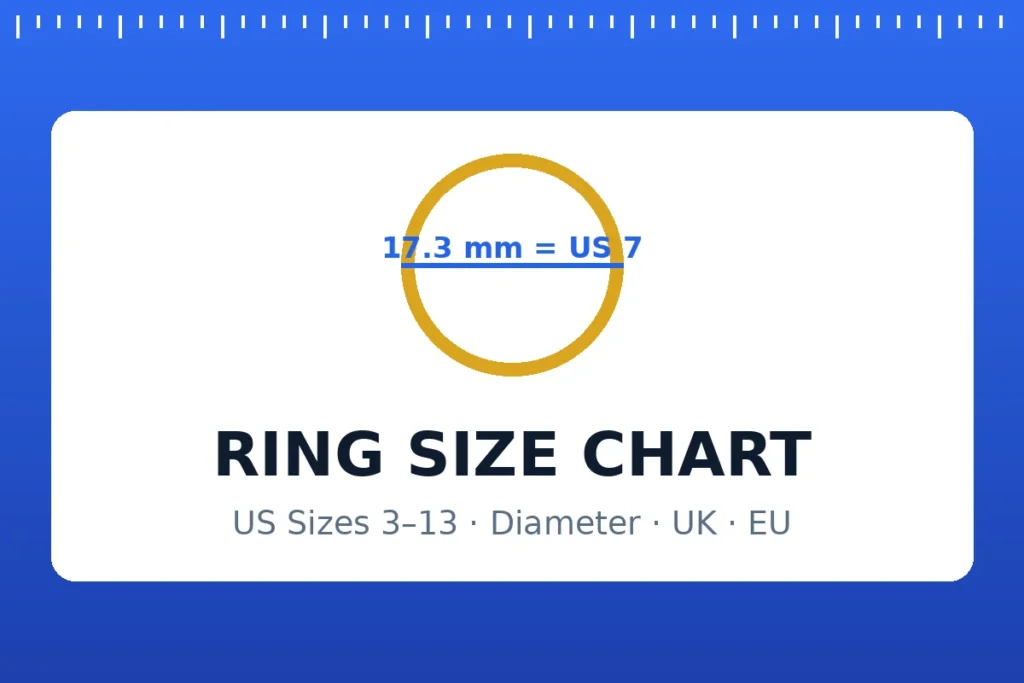
There is a particular kind of panic that only ring shopping produces. The ring is…