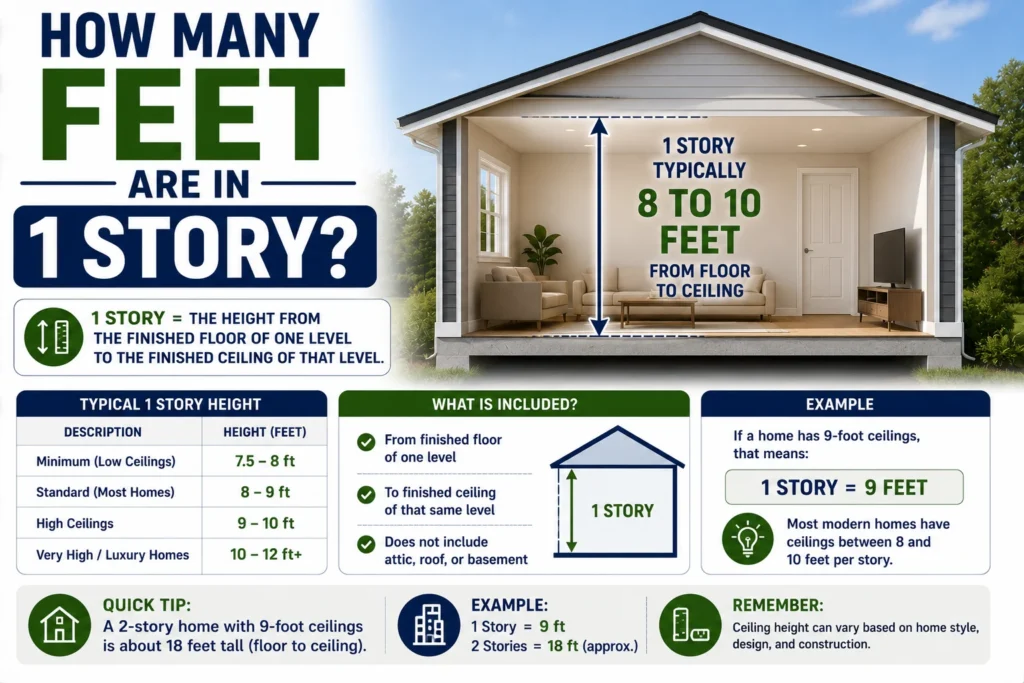
How Many Feet Are in 1 Story? Average Building Height
If you’re wondering how many feet are in 1 story, there isn’t one exact number…

Measurements play an important role in our daily lives. Whether you’re shopping for furniture, measuring a room, planning a construction project, or calculating a person’s height, understanding unit conversions can help you make accurate decisions.
One common question people ask is: How many feet is 90 inches?
Since inches and feet are both part of the Imperial and U.S. customary measurement systems, converting between them is relatively simple. However, understanding the conversion process, practical applications, and real-world examples can make the measurement much easier to visualize.
In this comprehensive guide, you’ll learn exactly how many feet 90 inches equals, how to perform the conversion, practical uses, conversion charts, real-life comparisons, and answers to frequently asked questions.
The exact conversion is:
90 inches = 7.5 feet
When expressed in feet and inches:
90 inches = 7 feet 6 inches
| Inches | Feet |
|---|---|
| 90 inches | 7.5 feet |
| 90 inches | 7 feet 6 inches |
This means that 90 inches is seven and a half feet long.
Before performing conversions, it’s helpful to understand these measurement units.
An inch is a unit of length in the Imperial and U.S. customary systems.
It is commonly used for measuring:
The abbreviation for inch is:
in
Examples:
A foot is a larger unit of measurement.
It is commonly used for measuring:
The abbreviation for foot is:
ft
Examples:
The standard conversion is:
1 foot = 12 inches
This relationship is used for all inch-to-foot conversions.
Converting inches into feet requires a simple calculation.
Feet = Inches ÷ 12
Simply divide the number of inches by 12.
To convert 90 inches into feet:
90 ÷ 12 = 7.5
Result:
90 inches = 7.5 feet
While decimal feet are useful in calculations, many people prefer feet-and-inches format.
90 ÷ 12 = 7 remainder 6
7 feet = 84 inches
90 − 84 = 6 inches
90 inches = 7 feet 6 inches
Written in standard notation:
7’6″
This is the most common way to express the measurement.
A measurement of 90 inches frequently appears in:
Because it equals exactly 7.5 feet, it’s easy to visualize and use in planning projects.
Besides feet, you may need to convert 90 inches into other units.
Since:
1 inch = 2.54 cm
Calculation:
90 × 2.54 = 228.6
Result:
90 inches = 228.6 centimeters
Calculation:
228.6 ÷ 100 = 2.286
Result:
90 inches = 2.29 meters
Since:
1 yard = 36 inches
Calculation:
90 ÷ 36 = 2.5
Result:
90 inches = 2.5 yards
| Unit | Equivalent |
|---|---|
| Feet | 7.5 |
| Feet & Inches | 7’6″ |
| Centimeters | 228.6 cm |
| Meters | 2.29 m |
| Yards | 2.5 yd |
Understanding measurements becomes easier when compared to familiar objects.
Many residential rooms have ceilings around 8 feet high.
At 90 inches (7.5 feet), the measurement is only 6 inches shorter.
Many oversized sectional sofas measure close to 90 inches long.
Some pool tables have dimensions near this measurement.
Large bookshelves often stand between 84 and 96 inches tall.
At 2.29 meters, 90 inches is considerably taller than the average adult.
Here are some real-world examples close to 90 inches.
Many family-sized sofas measure approximately 90 inches long.
Floor-to-ceiling bookshelves often fall within this range.
Extra-long curtain panels can measure around 90 inches.
Certain recreational equipment dimensions are close to 90 inches.
Commercial cabinets and wardrobes may reach this height.
There are several practical reasons.
Feet are easier to visualize when measuring larger spaces.
Knowing both units helps compare product dimensions.
Builders often use feet for larger measurements and inches for precision.
Room layouts frequently combine both units.
Students learn unit conversions as part of mathematics and geometry.
The following chart provides common conversions around 90 inches.
| Inches | Decimal Feet | Feet & Inches |
|---|---|---|
| 72 | 6.00 | 6’0″ |
| 78 | 6.50 | 6’6″ |
| 84 | 7.00 | 7’0″ |
| 86 | 7.17 | 7’2″ |
| 88 | 7.33 | 7’4″ |
| 90 | 7.50 | 7’6″ |
| 92 | 7.67 | 7’8″ |
| 94 | 7.83 | 7’10” |
| 96 | 8.00 | 8’0″ |
This chart makes it easy to compare nearby measurements.
A 90-inch sofa requires sufficient wall space and room clearance.
Builders often encounter measurements around 90 inches when installing cabinets or framing walls.
Designers use this measurement when planning room layouts.
Display shelves and storage systems may use dimensions close to 90 inches.
Curtains, artwork, and shelving often involve measurements in this range.
Extend the tape measure until it reaches:
90 inches
This equals:
7 feet 6 inches
A yardstick measures:
36 inches
You would need:
to reach 90 inches.
Each ruler measures:
12 inches
You would need:
7.5 rulers
placed end-to-end.
Always remember:
Feet = Inches ÷ 12
7.5 feet does not mean 7 feet 5 inches.
Instead:
0.5 foot = 6 inches
Therefore:
7.5 feet = 7 feet 6 inches
Avoid confusing:
Perform the full calculation before rounding.
Remember:
1 foot = 12 inches
For 90 inches:
Therefore:
7 feet 6 inches
Large sofas and room heights provide easy visual references.
Examples:
90 inches equals exactly 7.5 feet.
90 inches equals 7 feet 6 inches.
Yes.
Both measurements represent the same length.
90 inches equals 228.6 centimeters.
90 inches equals approximately 2.29 meters.
Divide the number of inches by 12.
The answer to “How many feet is 90 inches?” is:
90 inches = 7.5 feet
or, in standard feet-and-inches format:
90 inches = 7 feet 6 inches
Using the formula:
Feet = Inches ÷ 12
you can quickly convert any inch measurement into feet.
Whether you’re measuring furniture, planning a renovation, designing a room, or working on a construction project, knowing that 90 inches equals 7 feet 6 inches makes it easier to understand and visualize dimensions.
Understanding these conversions helps you work confidently with measurements in both personal and professional situations.
If you’re wondering how many feet are in 1 story, there isn’t one exact number…

If you’ve ever wondered how many feet do low beam headlights illuminate, the answer depends…
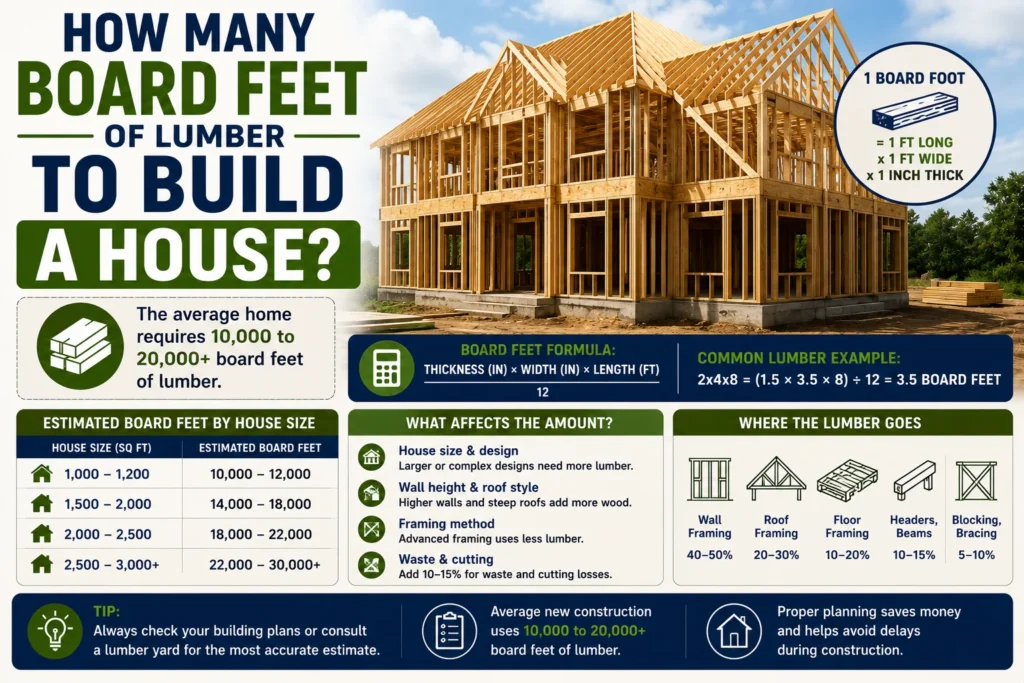
If you’re planning to build a house, one of the most important material questions is…