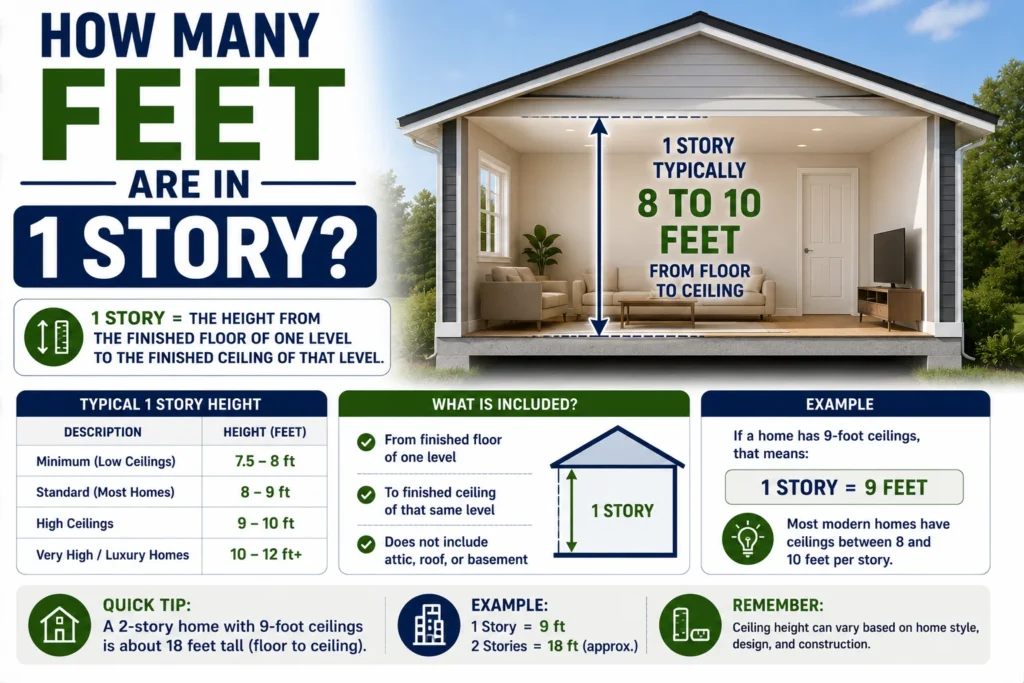
How Many Feet Are in 1 Story? Average Building Height
If you’re wondering how many feet are in 1 story, there isn’t one exact number…
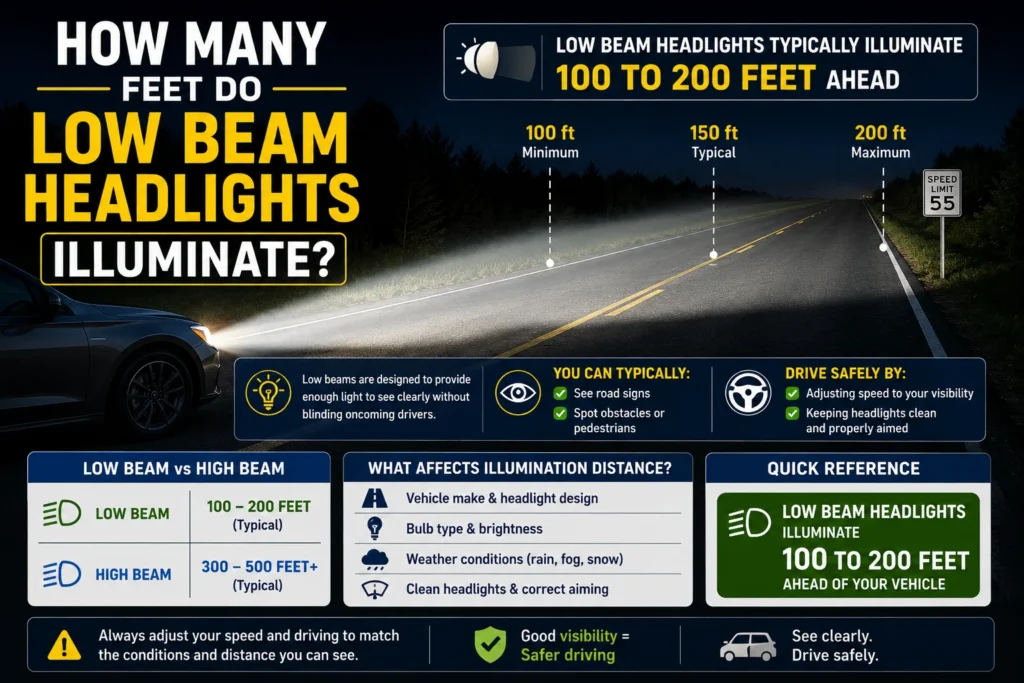
If you’ve ever wondered how many feet do low beam headlights illuminate, the answer depends on the vehicle, headlight design, road conditions, and how the headlights are aimed.
As a general rule, modern low-beam headlights typically provide useful forward illumination over roughly 150 to 250 feet, although the exact distance can vary considerably. Some vehicles and headlight systems can illuminate farther, while poor alignment, weather, road conditions, or dirty lenses can substantially reduce effective visibility.
Low beams are designed primarily for normal nighttime driving when other vehicles are nearby. Their beam pattern points downward and forward to illuminate the road without producing excessive glare for oncoming drivers.
For comparison, high beams generally provide a substantially longer forward view because they project light farther down the road and higher into the distance.
Understanding the difference between illumination distance and the distance you need to stop is especially important. Seeing an obstacle at night isn’t useful if you’re traveling too quickly to react safely.
A practical estimate for low-beam headlights is:
However, this is not a universal specification for every vehicle.
Actual illumination depends on:
Some headlights can illuminate farther than 250 feet under favorable conditions, while poorly aimed or degraded headlights may provide considerably less useful visibility.
Low beam headlights, sometimes called dipped beams, are the headlights normally used for nighttime driving around other vehicles.
Their light pattern is designed to illuminate:
The beam is directed lower than a high beam to reduce the amount of light shining directly into another driver’s eyes.
This makes low beams appropriate when you’re approaching another vehicle or following traffic.
There isn’t one universal number that applies to every vehicle.
The effective range of low beams depends heavily on the optical design of the headlight.
A useful general range is:
| Headlight Type | Approximate Useful Range |
|---|---|
| Older/weak low beams | 100–150 ft |
| Typical low beams | 150–250 ft |
| Strong modern low beams | 200–300+ ft |
| High beams | Often 300–500+ ft |
These are general estimates, not legal specifications. Actual performance can differ significantly between vehicles and lighting systems.
Low beams are intentionally designed to limit glare.
A low-beam pattern generally concentrates illumination closer to the vehicle and toward the road surface.
High beams project light farther and higher.
This creates a basic trade-off:
The purpose of low beams isn’t simply to produce the maximum possible distance. Their design balances visibility with glare control.
| Feature | Low Beam | High Beam |
|---|---|---|
| Typical use | Normal nighttime driving | Dark roads with little traffic |
| Beam direction | Lower | Higher |
| Forward visibility | Moderate | Longer |
| Glare potential | Lower | Higher |
| Oncoming traffic | Appropriate | Usually inappropriate |
| Following another vehicle | Appropriate | Usually inappropriate |
| Road illumination | Near and intermediate distance | Farther down road |
Always follow your local traffic laws regarding when high beams can and cannot be used.
The distance you can see isn’t necessarily the same as the distance your headlights illuminate.
For example, low beams may produce useful light 200 feet ahead, but visibility can be affected by:
A bright object with reflective material may be visible much farther away than a dark pedestrian, animal, or obstacle.
Therefore, “headlight range” isn’t a single fixed visibility distance.
Headlight alignment is one of the most important factors affecting how far low beams illuminate.
If the beams point too far downward:
If the beams point too high:
Proper headlight aiming provides the intended balance between visibility and glare control.
Yes.
Headlight lenses can accumulate:
Cloudy or oxidized plastic lenses can also reduce the amount of useful light reaching the road.
Even powerful bulbs can’t compensate completely for a heavily degraded lens.
Keeping headlight lenses clean and in good condition can improve nighttime visibility.
LED headlights can provide excellent illumination, but LED technology by itself does not guarantee a specific distance.
The actual performance depends on:
A well-designed LED headlight can provide excellent visibility, but a poorly designed system may not perform as well as another technology.
The same principle applies to HID and halogen headlights.
Older halogen systems can provide less illumination than some modern headlight systems, but range isn’t determined by bulb technology alone.
Headlight performance depends on the complete system.
Two vehicles using different technologies can have significantly different:
Therefore, it’s better to evaluate the complete headlight system rather than assuming one bulb technology always provides a specific distance.
Weather can dramatically change how far you can see.
Rain can create reflections and glare, reducing contrast between objects and the road.
Fog can scatter light back toward the driver, sometimes making bright headlights less effective.
Snow can reflect light and reduce contrast.
Dust and airborne particles can scatter light and reduce visibility.
This means a headlight that performs well on a clear, dry night may provide substantially less useful visibility during severe weather.
The road itself also affects what you can see.
A dark asphalt road may absorb significant light, while lane markings and reflective signs can appear much brighter.
Road geometry matters as well.
A headlight’s useful range can be reduced by:
A straight, level road provides much better forward visibility than a winding or hilly road.
If your headlights don’t appear to illuminate far enough, several things could be responsible.
Before replacing headlights with brighter aftermarket equipment, check whether the existing system is properly maintained and aligned.
Safe nighttime driving isn’t based solely on a specific number of illuminated feet.
You should drive at a speed that allows you to:
This is why speed and visibility must be considered together.
For example, if visibility is severely reduced by fog, simply having headlights on doesn’t make it safe to maintain normal highway speed.
This is one of the most important concepts when discussing low-beam illumination.
Your total stopping distance includes:
Perception distance + reaction distance + braking distance
At higher speeds, the vehicle travels farther while the driver is processing a hazard and reacting.
Therefore, if your low beams provide useful visibility only a limited distance ahead, traveling too quickly can create a situation where you don’t have enough time to stop.
The exact stopping distance depends on:
Suppose your low beams provide useful visibility around 200 feet ahead.
That does not mean you automatically have enough visibility to drive safely at any particular speed.
At highway speeds, a vehicle covers a significant distance every second.
For example, at approximately 60 mph, a vehicle travels about 88 feet per second.
At that speed, 200 feet passes in only a little over two seconds.
This demonstrates why nighttime driving requires appropriate speed, following distance, and attention.
High beams can improve visibility on dark roads when there are no nearby road users who could be dazzled.
However, you should switch to low beams when required by local law or when high beams could cause glare for:
The exact legal requirements vary by jurisdiction.
High beams aren’t a replacement for appropriate driving speed and caution.
These terms can be confusing.
The distance at which measurable or useful light from the headlight reaches the road or an object.
The distance at which the driver can actually identify hazards.
These aren’t always identical.
For example, a headlight may technically project light hundreds of feet forward, but glare, weather, road conditions, and contrast may make objects difficult to recognize at the far end of that range.
The height of the headlight assembly can affect the beam’s relationship with the road.
A taller vehicle may have headlights positioned higher than a sedan.
Vehicles such as:
can have different headlight mounting heights and beam characteristics.
Proper aiming remains important regardless of vehicle type.
Automatic headlights primarily control when the lighting system activates.
Some modern vehicles also use advanced systems that can automatically adjust the beam pattern based on:
However, the exact capabilities depend on the vehicle.
Automatic activation doesn’t necessarily mean the headlights illuminate a longer distance.
Some modern vehicles use adaptive lighting systems that can change the direction or distribution of light.
For example, a system may:
These technologies can improve the usefulness of illumination without simply increasing the maximum beam distance.
If your low beams don’t seem effective, consider the following:
Remove dirt and road grime.
Severe oxidation may require professional restoration or replacement.
Incorrect aim can dramatically affect the beam pattern.
A failing bulb or damaged housing can reduce performance.
A dirty windshield can increase glare and reduce contrast.
Headlights cannot overcome severe weather or excessive speed.
When conditions and local laws permit, high beams can provide greater forward visibility.
Some vehicles allow headlight aiming adjustments, but the procedure varies.
Because incorrect adjustment can:
it’s important to follow the vehicle manufacturer’s procedure.
For precise alignment, professional adjustment may be preferable.
On a clear, dark highway, a typical low-beam system may provide useful forward illumination in the approximate range of 150–250 feet, with some systems reaching farther.
However, highway driving often involves higher speeds, which means drivers need to consider:
If visibility is poor, reduce speed accordingly.
There isn’t a reliable fixed number for fog.
Dense fog can reduce effective visibility to far less than the normal range of the headlights.
Using brighter headlights doesn’t necessarily solve the problem because light can scatter off water droplets and produce glare.
In fog, drivers should:
Headlight range varies significantly between vehicles.
Visibility doesn’t automatically equal safe stopping distance.
High beams can create dangerous glare.
A misaligned headlight can dramatically alter the useful beam pattern.
A brighter bulb isn’t necessarily the correct solution.
Rain, fog, snow, and dust can greatly reduce effective visibility.
| Situation | Approximate/General Visibility |
|---|---|
| Typical low beams, clear conditions | 150–250+ ft |
| Strong modern low beams | May exceed 250 ft |
| High beams | Often substantially farther |
| Heavy fog | Can be dramatically reduced |
| Heavy rain | Reduced contrast and visibility |
| Dirty/cloudy lenses | Reduced illumination |
| Misaligned headlights | Reduced useful range |
These values are general guidance rather than guaranteed distances for every vehicle.
Typical low beams provide useful forward illumination of approximately 150–250 feet, although actual performance varies by vehicle and conditions.
High beams generally illuminate substantially farther than low beams, often 300–500 feet or more depending on the vehicle and lighting system.
Possible causes include dirty lenses, cloudy housings, incorrect alignment, aging components, electrical problems, or difficult weather conditions.
Not automatically. Headlight range depends on the complete optical system, beam pattern, intensity, and alignment—not simply whether the light source is LED or halogen.
Low beams are generally preferable to high beams in conditions where high beams would create excessive glare. Follow your local traffic laws and adjust your speed to visibility.
On a clear road, useful visibility may be roughly 150–250 feet or more, but the distance at which you can actually identify hazards depends on contrast, weather, road geometry, and headlight performance.
Yes. Incorrectly aimed headlights can significantly reduce useful forward illumination or create excessive glare for other road users.
So, how many feet do low beam headlights illuminate?
For a general estimate, low-beam headlights typically provide useful forward illumination over approximately:
However, there is no universal distance for every vehicle. Headlight technology, beam pattern, alignment, lens condition, road design, weather, and vehicle type can all affect how far the light effectively reaches.
The most important point is that illumination distance isn’t the same as safe driving distance. At night, drivers need enough time to recognize hazards and stop safely. If visibility is reduced by rain, fog, snow, curves, hills, or glare, reducing speed is often more important than simply trying to increase headlight brightness.
For quick reference, remember:
Low beams: roughly 150–250+ feet
High beams: generally substantially farther
Actual range: varies by vehicle and conditions
Properly maintained, correctly aimed headlights combined with an appropriate nighttime driving speed provide the safest approach.
If you’re wondering how many feet are in 1 story, there isn’t one exact number…

If you’re planning to build a house, one of the most important material questions is…
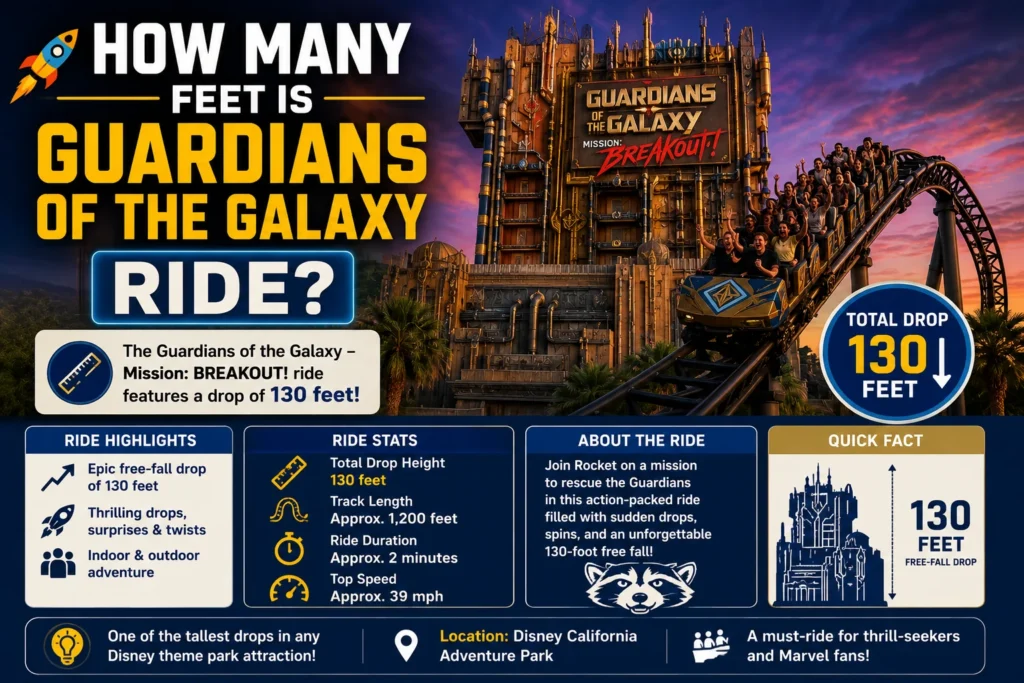
If you’re searching for how many feet the Guardians of the Galaxy ride is, the…