
How Many Feet Are in 1 Story? Average Building Height
If you’re wondering how many feet are in 1 story, there isn’t one exact number…
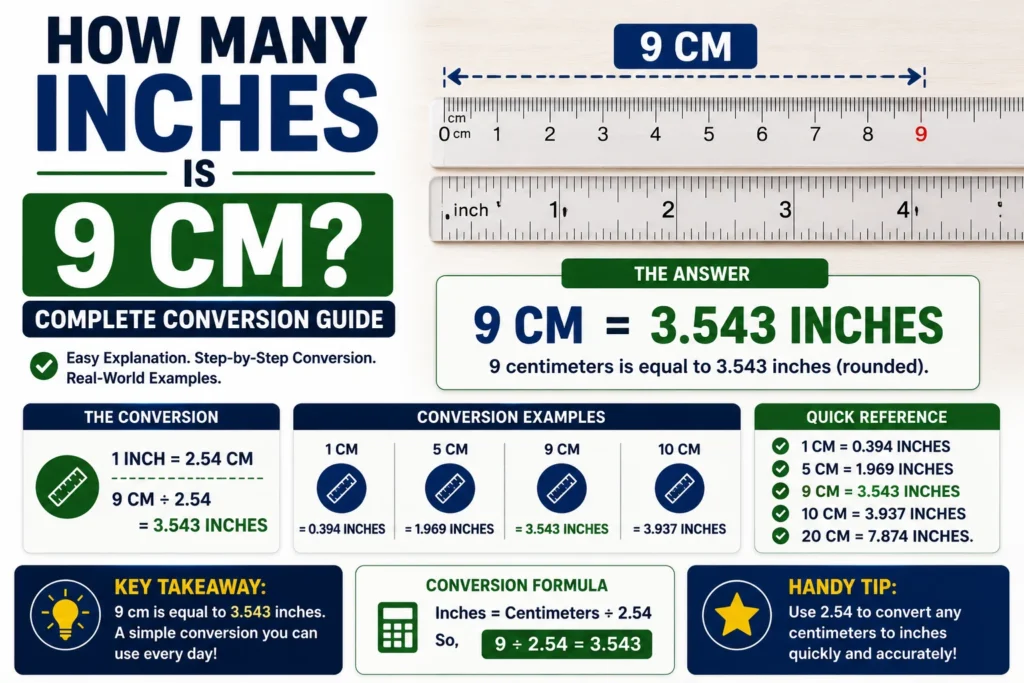
Measurements are an essential part of daily life. Whether you’re shopping online, working on a DIY project, studying mathematics, sewing clothing, or comparing product dimensions, understanding unit conversions can save time and improve accuracy.
One of the most common metric-to-imperial conversion questions is:
How many inches is 9 cm?
Since centimeters and inches belong to different measurement systems, converting between them is a useful skill. Centimeters are commonly used in most countries worldwide, while inches remain popular in the United States and a few other regions.
In this complete guide, you’ll learn exactly how many inches are in 9 centimeters, the conversion formula, practical examples, real-world comparisons, conversion charts, and answers to frequently asked questions.
The exact conversion is:
9 centimeters = 3.5433 inches
Rounded to two decimal places:
9 cm = 3.54 inches
| Centimeters | Inches |
|---|---|
| 9 cm | 3.5433 inches |
| 9 cm | 3.54 inches (rounded) |
Therefore:
9 centimeters equals approximately 3.54 inches.
Before converting measurements, it’s helpful to understand the units involved.
A centimeter is a unit of length in the metric system.
It is commonly used for measuring:
The abbreviation for centimeter is:
cm
Examples:
An inch is a unit of length used in the Imperial and U.S. customary systems.
It is commonly used for:
The abbreviation for inch is:
in
Examples:
The standard conversion factor is:
1 inch = 2.54 centimeters
This means:
1 centimeter = 0.3937 inches
This conversion factor is used worldwide.
Converting centimeters into inches is straightforward.
Inches = Centimeters ÷ 2.54
Alternatively:
Inches = Centimeters × 0.3937
Both methods produce the same result.
To convert 9 centimeters into inches:
9 ÷ 2.54 = 3.5433
Result:
9 cm = 3.5433 inches
Rounded:
9 cm ≈ 3.54 inches
The relationship between centimeters and inches is fixed.
Since:
1 inch = 2.54 cm
Divide 9 by 2.54:
9 ÷ 2.54 = 3.5433
Therefore:
9 centimeters equals approximately 3.54 inches.
Besides inches, you may need to convert 9 cm into other units.
Since:
1 cm = 10 mm
Calculation:
9 × 10 = 90
Result:
9 cm = 90 millimeters
Since:
100 cm = 1 meter
Calculation:
9 ÷ 100 = 0.09
Result:
9 cm = 0.09 meters
Since:
1 foot = 30.48 cm
Calculation:
9 ÷ 30.48 = 0.2953
Result:
9 cm = 0.30 feet
| Unit | Equivalent |
|---|---|
| Inches | 3.54 |
| Millimeters | 90 mm |
| Meters | 0.09 m |
| Feet | 0.30 ft |
Many people find measurements easier to understand when compared with familiar objects.
Many smartphones measure around 7–9 cm in width.
A standard credit card is approximately 8.5 cm long.
Small note pads often measure close to 9 cm.
Many coffee mugs have diameters close to this size.
Several sports-related items fall near this measurement range.
Here are some everyday objects that are approximately 9 centimeters long.
A standard credit card is about 8.56 cm long.
Many square sticky notes measure around 9 cm.
Some phones are close to 9 cm wide.
Certain measuring spoons and kitchen tools measure about 9 cm.
Many cosmetic containers fall within this size range.
There are many situations where conversions are useful.
Products may use different measurement systems depending on the seller.
Different countries use different units.
Projects often require measurements in both systems.
Students frequently learn metric-to-imperial conversions.
Product dimensions may need conversion for international markets.
The following chart provides common conversions near 9 cm.
| Centimeters | Inches |
|---|---|
| 5 cm | 1.97 in |
| 6 cm | 2.36 in |
| 7 cm | 2.76 in |
| 8 cm | 3.15 in |
| 9 cm | 3.54 in |
| 10 cm | 3.94 in |
| 11 cm | 4.33 in |
| 12 cm | 4.72 in |
| 15 cm | 5.91 in |
This chart helps estimate nearby values quickly.
Many small retail products use dimensions around 9 cm.
Patterns and materials often require metric-to-inch conversions.
Notebooks, labels, and accessories frequently use measurements in this range.
Small devices and accessories may measure approximately 9 cm.
Accurate conversions help ensure proper fitting and spacing.
Locate the 9 cm mark on the ruler.
The distance from 0 to 9 cm equals:
9 centimeters
Measure until approximately:
3.54 inches
Most measuring tapes display both centimeters and inches.
Locate either:
Both represent the same distance.
Always remember:
1 inch = 2.54 cm
Perform calculations first, then round the result.
Remember:
Double-check units before calculating.
Remember:
1 inch = 2.54 cm
This single fact allows most conversions.
A rough estimate:
1 cm ≈ 0.4 inches
Therefore:
9 cm ≈ 3.6 inches
The exact answer is 3.54 inches.
Examples:
A simple chart can save time during projects.
9 centimeters equals 3.5433 inches.
9 cm is approximately 3.54 inches.
Yes.
9 cm equals approximately 3.54 inches.
9 cm equals 90 millimeters.
9 cm equals approximately 0.30 feet.
Use:
Inches = Centimeters ÷ 2.54
Here are some similar conversions:
| Centimeters | Inches |
|---|---|
| 5 cm | 1.97 in |
| 6 cm | 2.36 in |
| 7 cm | 2.76 in |
| 8 cm | 3.15 in |
| 9 cm | 3.54 in |
| 10 cm | 3.94 in |
| 15 cm | 5.91 in |
| 20 cm | 7.87 in |
These examples help you identify patterns quickly.
The answer to “How many inches is 9 cm?” is:
9 centimeters = 3.5433 inches
or approximately:
9 cm = 3.54 inches
Using the simple formula:
Inches = Centimeters ÷ 2.54
you can easily convert any centimeter measurement into inches.
Whether you’re shopping online, working on a craft project, measuring household items, studying mathematics, or comparing product dimensions, understanding that 9 cm equals 3.54 inches helps you work confidently with both metric and Imperial measurement systems.
Knowing these conversions makes measurements easier to understand and apply in everyday life.
How Many Inches Is 4 Ft? Complete Conversion Guide
If you’re wondering how many feet are in 1 story, there isn’t one exact number…

If you’ve ever wondered how many feet do low beam headlights illuminate, the answer depends…

If you’re planning to build a house, one of the most important material questions is…