
If you regularly find that shoes feel tight across the toes or the sides of your feet, you may wonder how many people have wide feet and whether wide feet are actually common.
The short answer is that there is no single reliable worldwide percentage of people who have wide feet. Researchers measure foot width in different populations, and shoe manufacturers use different width standards. A foot can also be considered “wide” relative to its length rather than according to one universal measurement.
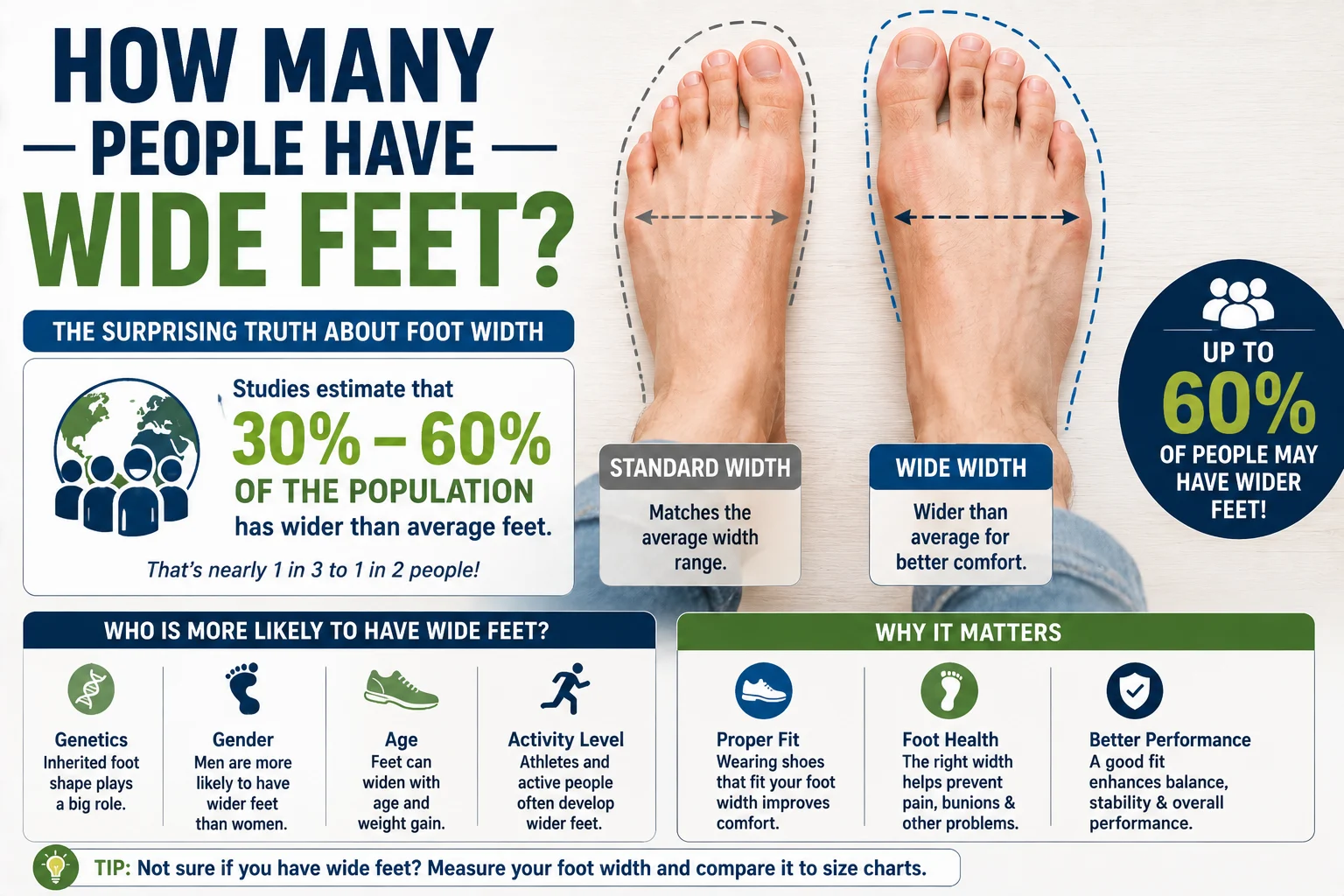
What we do know is that foot width varies naturally from person to person, and poor shoe width is common. A systematic review of footwear-fitting studies found that between 30% and 88% of participants in individual studies were wearing shoes that were too narrow, with a median of about 58% in the studies that reported width-specific results.
That does not mean 58% of people have wide feet. Instead, it shows how frequently footwear fails to accommodate people’s actual foot dimensions.
So, if standard shoes feel too narrow for you, you’re certainly not alone.
Quick Answer: How Many People Have Wide Feet?
There is no universally accepted percentage for how many people have wide feet.
The reason is simple: “wide” depends on several factors, including:
- Foot length
- Foot width
- Sex
- Age
- Population
- Shoe-sizing system
- Measurement method
- Shoe brand
- Whether the foot is measured while standing or sitting
Research consistently shows substantial variation in human foot shape and frequent problems with shoe width. One systematic review found that 30%–88% of participants in individual studies wore footwear that was too narrow for their feet.
Therefore, it would be misleading to claim that a specific percentage of the world’s population has wide feet.
A better answer is:
Wide feet are common, but there is no single global statistic that accurately defines what percentage of people have them.
Why Is There No Exact Percentage of People With Wide Feet?
You might expect researchers to have a simple answer such as “20% of people have wide feet.”
In reality, defining wide feet is more complicated.
Different Definitions of “Wide”
A foot may be considered wide when:
- Its measured width is large for its length.
- It exceeds a shoe manufacturer’s standard width.
- It requires a wide shoe size.
- The toes or forefoot don’t fit comfortably inside standard footwear.
- The foot is wider than the shoe’s internal dimensions.
These definitions don’t always produce the same result.
For example, someone may have a naturally broad forefoot but still fit comfortably into a particular brand’s standard-width shoe.
Another person with the same measured foot width might need a wide shoe because that brand uses a narrower shoe shape.
Foot Width Is Different From Foot Length
One of the biggest mistakes people make is choosing shoes based only on length.
Suppose two people both have feet that measure:
10 inches long
Their widths could still be different.
Person A might have a relatively narrow foot.
Person B might have a broad forefoot.
Both may technically need the same shoe length, but they may need different widths.
This is why shoe sizing commonly includes both length and width.
A proper fit should accommodate the foot’s width as well as its length.
How Common Are Wide-Foot Problems?
Even though we cannot give a universal percentage for people with wide feet, research provides useful information about footwear fit.
A systematic review of 18 studies found that 63% to 72% of participants in several studies were wearing shoes that did not properly accommodate either the length or width of their feet.
Width alone was also a major issue.
Across studies that specifically measured width, between 30% and 88% of participants wore shoes that were too narrow, depending on the population and measurement method.
This tells us something important:
The problem may not always be that someone’s feet are unusually wide. Sometimes the shoes are simply too narrow.
How Do You Know If You Have Wide Feet?
You don’t necessarily need to guess.
There are several signs that your shoes may not provide enough width.
1. Your Toes Feel Squashed
If your toes are pushed together or cannot spread naturally, your shoes may be too narrow.
2. The Sides of Your Feet Bulge Over the Sole
Look at your feet while standing in your shoes.
If the widest part of your foot extends noticeably beyond the shoe’s sole, the shoe may not be wide enough.
3. You Get Pressure Along the Forefoot
Pressure around the ball of your foot can indicate that the shoe doesn’t provide enough room.
4. Your Shoes Feel Tight Even When the Length Is Correct
This is a common clue.
If your toes have enough length but the shoe still feels tight across the sides, you may need a wider width rather than a longer shoe.
5. You Constantly Buy Larger Shoes
Some people with wider feet mistakenly purchase longer shoes to get more width.
That can create another problem because the heel may slip or the shoe may be too long.
A better solution is often finding the correct length and width.
How to Measure Your Foot Width
Measuring your feet can give you a much better idea of your actual dimensions.
You can do this at home with:
- A sheet of paper
- A pencil
- A ruler or measuring tape
- The socks you normally wear
Step 1: Place Your Foot on Paper
Stand naturally with your full weight on the foot.
Weight-bearing measurements are useful because the foot can spread when you stand.
Step 2: Trace or Mark the Foot
Mark the widest points of your forefoot.
Usually, this is around the ball of the foot.
Step 3: Measure the Widest Part
Measure the distance between the widest points.
Record the measurement in inches or centimeters.
Step 4: Measure Both Feet
Feet are not always identical.
Your left foot may be slightly longer or wider than your right.
When purchasing shoes, fit the larger foot.
Step 5: Compare With the Brand’s Chart
Don’t assume that a width labeled “wide” has exactly the same dimensions across every brand.
Check the manufacturer’s sizing information whenever possible.
What Foot Width Is Considered Wide?
There isn’t one universal measurement that makes a foot wide.
Width is usually interpreted in relation to foot length and the shoe-sizing system being used.
In some U.S. shoe-sizing systems, width categories may include:
- Narrow
- Standard or medium
- Wide
- Extra wide
For men’s footwear, D is commonly used as a standard or medium width and wider categories can include 2E, 4E, and beyond.
For women’s footwear, B is commonly used as a standard or medium width, while wider categories can include D and 2E, depending on the manufacturer.
However, these labels aren’t universal across countries and brands.
That’s why the letter printed on the shoe isn’t enough by itself.
Are Wide Feet More Common in Men or Women?
Foot dimensions differ between populations, and men and women tend to have different average foot dimensions.
However, it is difficult to make a simple statement such as “X% of men have wide feet and Y% of women have wide feet.”
The definition of wide varies, and studies use different populations and measurement techniques.
The more useful point for shoppers is that shoe width should be evaluated individually.
Two people of the same sex and shoe length can have very different foot widths.
Does Foot Size Affect Width?
Yes.
Foot length and width are related, but they are not the same measurement.
As overall foot size increases, width often increases as well. However, people don’t all have the same proportions.
For example, two people may both wear the same shoe length but require different widths.
Likewise, someone with a longer foot may have a relatively narrow foot.
This is why footwear manufacturers offer multiple width options.
Why Do Some People Have Wide Feet?
Foot shape is influenced by many factors.
Genetics
Your basic foot structure is strongly influenced by genetics.
If wide feet are common in your family, you may naturally have a broader foot shape.
Body Structure
Foot dimensions vary with overall body structure and proportions.
Age
Feet can change over time.
As people age, changes in soft tissue, ligaments, and foot structure can affect foot dimensions.
Weight-Bearing
The foot spreads when it bears weight.
This is one reason measurements taken while standing can differ from measurements taken while sitting.
Activity
Athletes and people who spend significant amounts of time on their feet may notice changes in foot size or shape during the day.
Can Feet Become Wider?
Yes, foot dimensions can change over a person’s lifetime.
Feet may appear or measure wider because of:
- Normal aging
- Changes in body weight
- Pregnancy
- Changes in arch structure
- Swelling
- Foot deformities
- Prolonged standing
Temporary swelling can also make shoes feel tighter later in the day.
This is one reason trying on shoes at different times can sometimes produce different results.
Wide Feet and Shoe Fit
Having wide feet isn’t automatically a problem.
The main issue is whether your footwear accommodates your natural foot shape.
A systematic review found that poorly fitted footwear is associated with foot pain and certain foot disorders, reinforcing the importance of proper fit.
A shoe that is too narrow can create pressure on the forefoot and toes.
Over time, repeated pressure may contribute to problems such as:
- Corns
- Calluses
- Toe deformities
- Foot discomfort
- Pain during walking
Proper footwear should provide adequate room without being excessively loose.
Why Buying a Longer Shoe Isn’t Always the Answer
Suppose your normal shoe length fits perfectly, but the sides feel tight.
You might think:
“I’ll just buy a larger size.”
That can create a new problem.
A longer shoe gives you more length, but it does not necessarily provide the width you need.
The result can be:
- Heel slipping
- Excess space in front
- Poor stability
- Reduced comfort
- Altered walking mechanics
If length is correct but width is the problem, look for a wider version of the appropriate length.
Wide Feet vs. Wide Shoes
These terms aren’t identical.
Wide Feet
This describes the physical dimensions or shape of your feet.
Wide Shoes
This describes footwear designed with additional width.
A person may have average-width feet but prefer wide shoes because of a roomy toe box.
Likewise, someone may have broad feet but fit a standard-width shoe from one brand because its design provides more forefoot space.
This is why actual fit matters more than the label alone.
What Makes a Good Shoe for Wide Feet?
If you need more room, look for:
A Wide Toe Box
The front of the shoe should allow your toes to sit comfortably.
Adequate Forefoot Width
The widest part of your foot should not be squeezed against the shoe.
Flexible Materials
Materials that can accommodate normal foot movement may improve comfort.
Adjustable Lacing
Laces can help customize the fit around the middle of the foot.
Correct Length
Don’t sacrifice length simply to obtain width.
The shoe should fit both dimensions.
Are Wide Feet Bad?
No.
Wide feet are simply one variation of normal human foot shape.
The problem usually occurs when footwear doesn’t match that shape.
If your feet are naturally wide and your shoes fit correctly, there is no reason to consider width itself a problem.
The goal is not to make your feet narrower.
The goal is to choose footwear that accommodates them.
Wide Feet and Running
Runners often pay close attention to foot width because feet can swell during longer activities.
A shoe that feels comfortable for a short walk may feel different during a long run.
When choosing running shoes, consider:
- Toe-box width
- Forefoot shape
- Heel fit
- Shoe length
- Foot swelling
- Socks
- Running distance
A wider shoe is not automatically better. The shoe should provide enough room without allowing excessive movement.
A Useful Footwear-Fit Statistic
One of the most useful findings from the research is that many people wear shoes that don’t properly match their feet.
The systematic review mentioned earlier found that 63%–72% of participants in several studies had footwear that failed to accommodate their foot dimensions in length or width.
This is important because it changes how we think about the question.
Instead of asking only:
“How many people have wide feet?”
it can also be useful to ask:
“How many people are wearing shoes that are too narrow for their feet?”
Research suggests that this is a substantial issue.
Common Mistakes People With Wide Feet Make
Choosing a Longer Size
A longer shoe does not necessarily solve a width problem.
Ignoring the Toe Box
A shoe can have adequate overall width but still feel cramped around the toes.
Assuming Every Brand Uses the Same Width
Width labels vary between manufacturers.
Buying Shoes Without Measuring
Your foot dimensions can change over time.
Ignoring the Larger Foot
If one foot is larger, choose footwear that accommodates the larger foot.
Assuming Pain Is Normal
Persistent discomfort from footwear is a reason to reassess the fit rather than simply “breaking in” an unsuitable shoe.
Wide Feet: Key Facts at a Glance
| Question | Answer |
|---|---|
| Are wide feet common? | Yes, wide-foot shapes and width-related fit problems are common. |
| Is there a global percentage? | No reliable universal percentage exists. |
| Can wide feet be normal? | Yes. |
| Does shoe length determine width? | No. |
| Can feet change width? | Yes, dimensions can change with age and other factors. |
| Are wide shoes always necessary? | No. The correct choice depends on your actual foot and shoe fit. |
| Should you buy a longer shoe for width? | Usually not if your length is already correct. |
| Is measuring foot width useful? | Yes, especially when standard shoes feel tight. |
FAQs
1. How many people have wide feet?
There is no scientifically established worldwide percentage of people with wide feet because researchers use different definitions and measurement methods. However, studies show that footwear that is too narrow is common. One systematic review found width-related poor fit in 30% to 88% of participants across individual studies.
2. What percentage of people have wide feet?
There is no single reliable percentage that applies to the entire global population. “Wide” depends on foot length, width, sex, population, measurement method, and shoe-sizing system.
3. How can I tell if I have wide feet?
Measure your foot while standing and compare its width and length with the sizing information from the shoe manufacturer. Persistent side pressure, cramped toes, or a foot that extends beyond the shoe’s sole can also indicate a width mismatch.
4. Do wide feet run in families?
Foot shape has a genetic component, so family traits can influence foot dimensions. However, age, body changes, activity, and other factors can also affect foot size and shape.
5. Should I buy a bigger shoe if I have wide feet?
Not necessarily. If your shoe has the correct length but feels tight across the forefoot, choosing a wider width is generally more appropriate than simply buying a longer size. A professional shoe fitting can help when you’re unsure.
Conclusion
So, how many people have wide feet? The most accurate answer is that there is no reliable single percentage for the world’s population. Foot width varies widely, and researchers define and measure “wide” in different ways.
What the research does clearly show is that width-related footwear problems are common. Studies reviewed in the scientific literature found that many participants wore shoes that were too narrow for their feet, with individual studies reporting rates from 30% to 88%.
Having wide feet is not inherently a problem. The key is finding footwear that matches your actual foot dimensions. Measure both feet, pay attention to forefoot and toe-box space, and compare your measurements with the specific brand’s width chart.
If standard shoes consistently feel tight even when the length is correct, don’t assume you need a longer size. You may simply need a wider fit.