

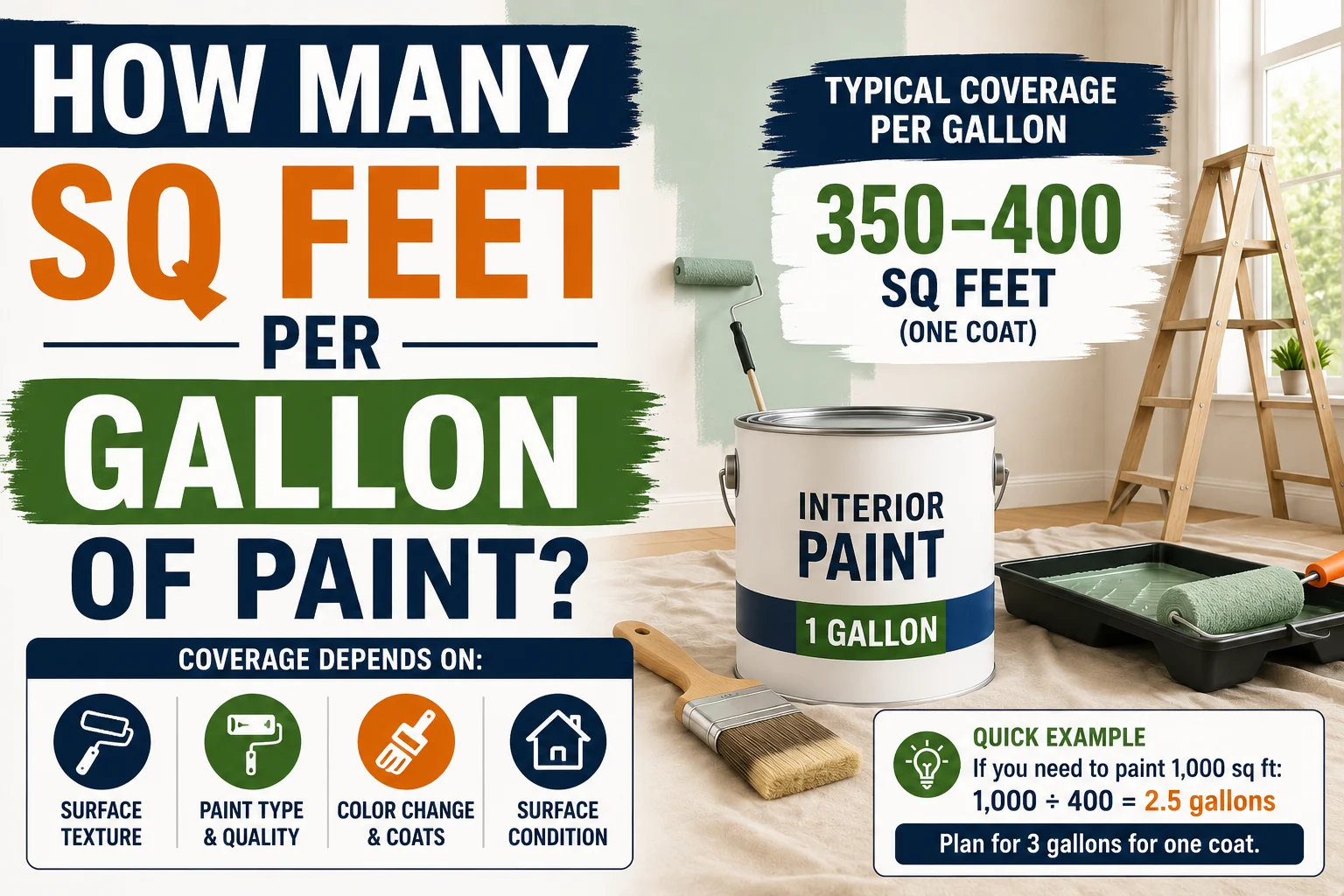
The amount of area covered by a gallon depends on the product and surface.
Many interior paints are designed to cover approximately 350–400 square feet per gallon for one coat.
For example, if your paint covers 400 square feet per gallon and your walls total 800 square feet:
800 ÷ 400 = 2 gallons
You would need approximately 2 gallons for one coat.
For two coats:
800 × 2 = 1,600 square feet of total coverage
Then:
1,600 ÷ 400 = 4 gallons
So you would need approximately 4 gallons.
Paint Coverage by Surface Type
Not every surface uses paint at the same rate.
Interior Walls
Smooth, previously painted interior walls typically provide good coverage.
A common estimate is:
350–400 square feet per gallon per coat
However, dark colors, major color changes, and rough walls may require additional paint.
Ceilings
Ceilings can have similar coverage to walls when they are smooth.
However, textured ceilings can absorb more paint and may require additional material.
Always consider the texture when estimating coverage.
Exterior Surfaces
Exterior paint coverage varies more widely because surfaces may include:
- Wood siding
- Brick
- Stucco
- Concrete
- Masonry
- Previously painted surfaces
Porous surfaces can absorb significantly more paint than smooth surfaces.
Primers
Primer coverage depends on the product and surface.
A porous surface may absorb primer quickly, while a sealed surface may require less.
Primer is especially useful when:
- Painting bare drywall
- Covering stains
- Changing from a dark color to a light color
- Painting new wood
- Sealing porous surfaces
Factors That Affect Paint Coverage
The manufacturer’s coverage estimate is a useful starting point, but several factors can change the actual amount of paint you use.
1. Surface Texture
Smooth drywall generally uses less paint than rough or textured surfaces.
A textured wall has more surface area than it appears to have visually.
2. Surface Porosity
Bare drywall, unfinished wood, concrete, and other porous materials can absorb paint.
This can reduce coverage.
3. Number of Coats
Two coats require roughly twice the paint of one coat.
For example, if one gallon covers 400 square feet for one coat, that same gallon provides approximately 200 square feet of two-coat coverage.
4. Paint Color
Some colors cover better than others.
A light color applied over a similar light color may require fewer coats than a dramatic color change.
5. Application Method
Brushes, rollers, and sprayers can produce different levels of coverage and waste.
6. Paint Quality
Different products have different coverage ratings, so the information printed on the container is important.
How to Calculate How Much Paint You Need
You can estimate your paint requirement using a few simple steps.
Step 1: Calculate Surface Area
For a rectangular wall:
Width × Height = Wall Area
Suppose a wall is 15 feet wide and 8 feet high:
15 × 8 = 120 square feet
If there are four walls with similar dimensions, calculate each wall separately and add them together.
Step 2: Account for Doors and Windows
You don’t normally need to paint the area occupied by large windows and doors.
For example:
Total wall area:
1,000 sq ft
Doors and windows:
150 sq ft
Paintable area:
1,000 − 150 = 850 sq ft
Step 3: Determine Number of Coats
If you plan to apply two coats:
850 × 2 = 1,700 sq ft
You now need enough paint to cover 1,700 square feet.
Step 4: Divide by Paint Coverage
Suppose the paint covers 400 square feet per gallon:
1,700 ÷ 400 = 4.25 gallons
In this example, you’d generally purchase 5 gallons rather than 4.25 gallons.
Paint Coverage Chart
The following chart assumes approximately 400 square feet per gallon per coat:
| Surface Area | 1 Coat | 2 Coats |
|---|---|---|
| 400 sq ft | 1 gallon | 2 gallons |
| 800 sq ft | 2 gallons | 4 gallons |
| 1,000 sq ft | 2.5 gallons | 5 gallons |
| 1,200 sq ft | 3 gallons | 6 gallons |
| 1,500 sq ft | 3.75 gallons | 7.5 gallons |
| 2,000 sq ft | 5 gallons | 10 gallons |
| 2,500 sq ft | 6.25 gallons | 12.5 gallons |
Actual requirements can differ based on the product and surface.
Real-World Examples
Example 1: 500 Square Feet
If you have 500 square feet of paintable surface and the paint covers 400 square feet per gallon:
500 ÷ 400 = 1.25 gallons
For one coat, you’d need about 1.25 gallons.
For two coats:
1.25 × 2 = 2.5 gallons
Example 2: 1,000 Square Feet
For 1,000 square feet:
1,000 ÷ 400 = 2.5 gallons
So approximately 2.5 gallons are needed for one coat.
For two coats:
2.5 × 2 = 5 gallons
Example 3: 1,500 Square Feet
For 1,500 square feet:
1,500 ÷ 400 = 3.75 gallons
You would generally purchase about 4 gallons for one coat, depending on the product and conditions.
For two coats, approximately 7.5 gallons would be required.
Common Paint Estimating Mistakes
Forgetting the Number of Coats
A 400-square-foot coverage rating usually refers to one coat, not two.
Measuring Floor Area Instead of Wall Area
If you’re painting walls, don’t automatically use the home’s floor square footage.
A 1,000-square-foot home can have much more than 1,000 square feet of wall surface.
Ignoring Doors and Windows
Subtracting large openings can improve your estimate.
Not Accounting for Texture
Rough surfaces may use significantly more paint.
Buying Too Little
Running out halfway through a project can create color-matching problems, especially if you purchase paint from different batches.
Tips for Getting Better Paint Coverage
Follow these tips to get more consistent results:
- Clean the surface before painting.
- Repair cracks and holes first.
- Use primer when appropriate.
- Stir the paint thoroughly.
- Use the correct roller nap for the surface.
- Don’t spread paint excessively thin.
- Follow the manufacturer’s recommended application instructions.
- Buy enough paint for the entire project when possible.
- Keep a small amount of leftover paint for future touch-ups.
For major color changes, primer can sometimes reduce the number of finish coats required.
FAQs
1. How many square feet does one gallon of paint cover?
A gallon of paint commonly covers approximately 350–400 square feet per coat, although coverage varies by product and surface.
2. How much paint do I need for 1,000 square feet?
At 400 square feet per gallon, 1,000 square feet requires about 2.5 gallons for one coat or approximately 5 gallons for two coats.
3. Does one gallon of paint cover 400 square feet?
Many paints provide coverage around 350–400 square feet per gallon, but the exact amount depends on the product, surface, application method, and number of coats.
4. How much paint do I need for two coats?
Multiply the paintable surface area by two, then divide by the manufacturer’s coverage per gallon.
For example:
1,000 sq ft × 2 = 2,000 sq ft
At 400 sq ft per gallon:
2,000 ÷ 400 = 5 gallons
5. Should I buy extra paint?
It’s often wise to purchase a small amount more than your calculated requirement, especially for textured surfaces, complicated rooms, or projects involving significant color changes. Leftover paint can also be useful for future touch-ups.
Conclusion
So, how many sq feet per gallon of paint can you expect? A good general estimate is 350–400 square feet per gallon for one coat. However, actual coverage depends on the paint product, surface texture, porosity, application method, and number of coats.
To estimate your needs, calculate the total paintable surface area, subtract large doors and windows, multiply by the number of coats, and divide by the paint’s stated coverage per gallon.
For example, a 1,000-square-foot surface at 400 square feet of coverage per gallon would require about 2.5 gallons for one coat or 5 gallons for two coats.
Before buying paint, check the manufacturer’s coverage rating and add a reasonable allowance for surface conditions and application waste.