

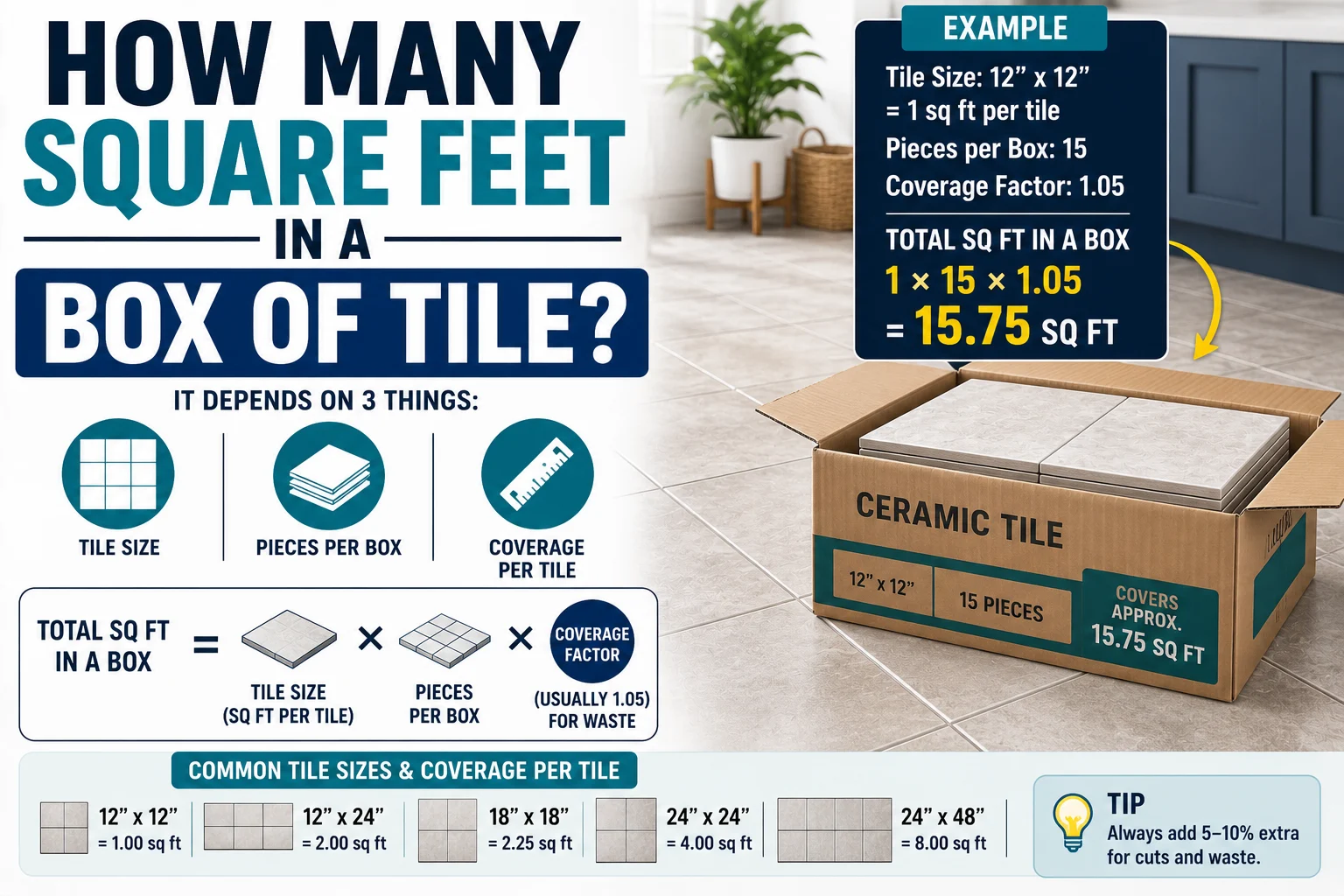
If you’re planning a flooring, backsplash, bathroom, or remodeling project, you may wonder how many square feet in a box of tile. There isn’t one universal answer because tile boxes contain different numbers of tiles and different tile sizes.
As a general estimate, one box of tile commonly covers about 10 to 20 square feet, although some boxes cover less or considerably more. The exact coverage should always be listed on the tile manufacturer’s packaging.
For example, if a box contains eight 12 × 24-inch tiles, each tile covers 2 square feet. The box would therefore cover:
8 × 2 = 16 square feet
So that particular box contains 16 square feet of tile.
Knowing the coverage per box is important because tile is usually sold by the box rather than as individual pieces. Before purchasing, calculate your room’s square footage and compare it with the coverage listed on the box.
Quick Answer
A box of tile commonly covers about 10–20 square feet, but the exact amount depends on the tile size and number of tiles in the box.
Here are some examples:
| Tile Size | Tiles Per Box | Approx. Box Coverage |
|---|---|---|
| 12 × 12 in | 10 | 10 sq ft |
| 12 × 24 in | 8 | 16 sq ft |
| 18 × 18 in | 8 | 18 sq ft |
| 24 × 24 in | 4 | 16 sq ft |
| 6 × 24 in | 16 | 16 sq ft |
These are examples rather than universal packaging standards. Different manufacturers can package the same tile size differently.
How Many Square Feet Does a Box of Tile Cover?
The coverage of a box depends on two main factors:
- The size of each tile
- The number of tiles in the box
A larger tile covers more square feet individually, but manufacturers may put fewer large tiles in a box.
For example:
- One 12 × 12-inch tile covers 1 square foot.
- One 12 × 24-inch tile covers 2 square feet.
- One 24 × 24-inch tile covers 4 square feet.
If a box contains ten 12 × 12-inch tiles:
10 × 1 = 10 square feet
If another box contains four 24 × 24-inch tiles:
4 × 4 = 16 square feet
Therefore, simply knowing the number of tiles in a box isn’t enough. You also need to know the dimensions of each tile.
Why Box Coverage Varies
Tile manufacturers package products in different quantities.
A box may contain:
- 6 large tiles
- 8 medium tiles
- 10 or 12 smaller tiles
- Many small mosaic sheets
The coverage can also vary because of tile thickness, design, collection, manufacturer, and intended application.
That’s why the easiest and most reliable method is to check the square-foot coverage printed on the box.
For example, packaging may say:
Coverage: 15.2 sq. ft. per carton
In that case, you should use 15.2 square feet in your calculations rather than estimating based on the number of tiles.
How to Calculate Tile Coverage Per Box
If the packaging doesn’t clearly state the square footage, you can calculate it yourself.
A=lw
A=6×4=24
4 rows by 6 columns = 24 square units.
w
w
l
l24 square unitsw = 6l = 4
Give feedback
Step 1: Find the Tile Dimensions
Suppose each tile measures:
12 × 24 inches
Step 2: Convert Inches to Feet
There are 12 inches in one foot.
So:
12 inches = 1 foot
24 inches = 2 feet
The tile measures:
1 × 2 feet
Step 3: Calculate Tile Area
Multiply the length by the width:
1 × 2 = 2 square feet
Each tile covers 2 square feet.
Step 4: Multiply by Tiles Per Box
Suppose the box contains eight tiles:
2 × 8 = 16 square feet
Therefore:
One box covers 16 square feet.
Tile Coverage by Common Tile Sizes
Here’s a useful reference for individual tiles:
| Tile Dimensions | Area Per Tile |
|---|---|
| 6 × 6 in | 0.25 sq ft |
| 6 × 12 in | 0.50 sq ft |
| 6 × 24 in | 1 sq ft |
| 8 × 8 in | 0.44 sq ft |
| 10 × 10 in | 0.69 sq ft |
| 12 × 12 in | 1 sq ft |
| 12 × 24 in | 2 sq ft |
| 18 × 18 in | 2.25 sq ft |
| 24 × 24 in | 4 sq ft |
| 24 × 48 in | 8 sq ft |
These figures describe the area of each tile before accounting for grout spacing or installation cuts.
How Many Boxes of Tile Do You Need?
Once you know how many square feet a box covers, you can determine how many boxes to buy.
Use this formula:
Boxes Needed = Total Floor Area ÷ Square Feet Per Box
For example, suppose your floor measures 200 square feet and each box covers 16 square feet:
200 ÷ 16 = 12.5 boxes
Since you can’t normally purchase half a box, you would need at least 13 boxes before accounting for waste.
But you shouldn’t stop there.
Measure the Room
For a rectangular room, calculate the floor area using:
Length × Width = Square Feet
Suppose your room is:
12 feet × 15 feet
Then:
12 × 15 = 180 square feet
The room has 180 square feet of floor area.
If your tile box covers 15 square feet:
180 ÷ 15 = 12 boxes
You would need at least 12 boxes before adding extra material for cuts and breakage.
Add Tile Waste and Overage
It’s generally wise to purchase extra tile rather than ordering exactly the calculated amount.
A common planning allowance is around 10% extra, although the appropriate amount depends on the room shape, tile pattern, tile type, and installation complexity.
For a 180-square-foot room:
180 × 1.10 = 198 square feet
You would therefore want approximately 198 square feet of tile.
If each box covers 15 square feet:
198 ÷ 15 = 13.2 boxes
You would need to purchase 14 boxes.
For complicated layouts or diagonal patterns, more waste may be appropriate.
Tile Waste and Overage
Extra tile helps account for:
- Cutting around corners
- Doorways
- Cabinets
- Irregular walls
- Broken tiles
- Pattern matching
- Mistakes during installation
- Future repairs
Buying extra material is particularly useful if the tile is discontinued later.
However, don’t automatically buy a large amount of excess. Your goal is to purchase enough to cover the project plus a reasonable installation allowance.
Real-World Tile Examples
Example 1: 12 × 12-Inch Tile
A 12 × 12-inch tile measures:
1 × 1 foot
So each tile covers:
1 square foot
If a box contains 10 tiles:
10 × 1 = 10 square feet
The box covers 10 square feet.
Example 2: 12 × 24-Inch Tile
A 12 × 24-inch tile measures:
1 × 2 feet
Each tile covers:
2 square feet
If there are eight tiles:
8 × 2 = 16 square feet
The box covers 16 square feet.
Example 3: 24 × 24-Inch Tile
A 24 × 24-inch tile measures:
2 × 2 feet
Each tile covers:
4 square feet
If a box contains four tiles:
4 × 4 = 16 square feet
Again, the box covers 16 square feet.
How Many Boxes for a 100-Square-Foot Room?
Suppose your room has exactly 100 square feet of floor area.
If each tile box covers 10 square feet:
100 ÷ 10 = 10 boxes
With 10% extra:
100 × 1.10 = 110 square feet
Then:
110 ÷ 10 = 11 boxes
So you would purchase approximately 11 boxes.
How Many Boxes for a 200-Square-Foot Room?
For a 200-square-foot room, assume each box covers 16 square feet.
Without waste:
200 ÷ 16 = 12.5 boxes
You would need at least 13 boxes.
With 10% extra:
200 × 1.10 = 220 square feet
Then:
220 ÷ 16 = 13.75 boxes
You would need 14 boxes.
Common Tile-Buying Mistakes
Buying Based Only on Tile Count
Ten large tiles can cover much more area than ten small tiles.
Always calculate based on square-foot coverage.
Forgetting Waste
Buying exactly the amount calculated for the room leaves no room for cuts or damaged pieces.
Mixing Different Batches
Tiles from different production batches can sometimes have slight color or shade differences.
If possible, purchase enough tile from the same batch for the entire project.
Ignoring the Room Shape
A simple rectangular room usually produces less waste than a room with multiple corners, angles, closets, or unusual features.
Forgetting Future Repairs
Keeping a few leftover tiles can be useful if one becomes damaged later.
Tips for Buying the Right Amount of Tile
Before purchasing, follow these steps:
- Measure the room’s length and width.
- Calculate the total square footage.
- Check the box for square-foot coverage.
- Divide total area by box coverage.
- Add an appropriate waste allowance.
- Round up to the next whole box.
- Keep a few spare tiles for future repairs.
If you’re tiling multiple rooms, calculate each area separately before adding the totals. This can make it easier to account for different layouts and tile patterns.
FAQs
1. How many square feet are in a box of tile?
There is no universal amount. A box commonly covers 10–20 square feet, but the exact coverage depends on the tile dimensions and number of tiles in the box. Always check the packaging.
2. How do I calculate square feet per box of tile?
Calculate the area of one tile and multiply it by the number of tiles in the box.
For example, an 12 × 24-inch tile covers 2 square feet. Eight tiles would cover:
2 × 8 = 16 square feet
3. How many boxes of tile do I need for 100 square feet?
It depends on the box coverage. If each box covers 10 square feet, you need 10 boxes before waste. With 10% extra, you would need approximately 11 boxes.
4. How much extra tile should I buy?
A common starting point is around 10% extra for cuts and breakage. Complex layouts, diagonal installations, and irregular rooms may require more.
5. Does grout change the square footage of a box of tile?
The manufacturer’s stated coverage is normally based on the tiles and packaging specifications. Actual installed coverage can vary slightly because of grout joints, cuts, and layout. For purchasing, use the box’s stated coverage and add an appropriate waste allowance.
Conclusion
So, how many square feet in a box of tile? There is no single answer because every tile box can contain different tile sizes and quantities. However, many boxes cover roughly 10–20 square feet.
The most reliable way to determine coverage is to check the square footage printed on the packaging. If that information isn’t available, calculate the area of one tile and multiply it by the number of tiles in the box.
For example, eight 12 × 24-inch tiles cover:
8 × 2 = 16 square feet
When planning your purchase, measure the entire floor, divide by the box coverage, and add around 10% extra for cuts and breakage. Always round up to a whole box.
This simple approach helps you buy enough tile for the project while reducing the risk of running short during installation.