

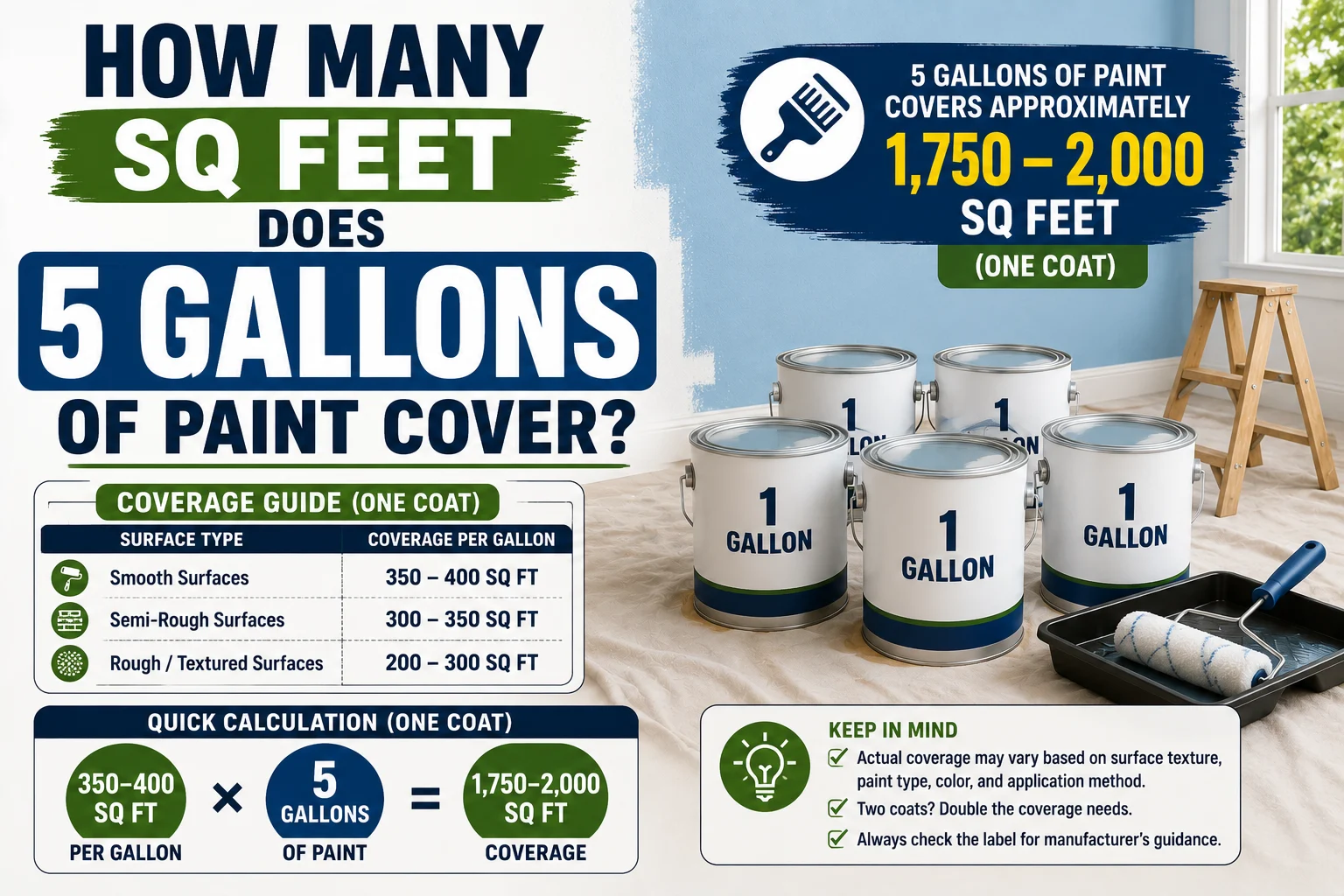
If you’re planning a large painting project, you may be asking how many sq feet does 5 gallons of paint cover. As a general estimate, 5 gallons of paint can cover about 1,750 to 2,000 square feet with one coat when the paint provides approximately 350–400 square feet of coverage per gallon.
At a typical coverage rate of 400 square feet per gallon:
5 gallons × 400 sq ft = 2,000 sq ft
So, 5 gallons of paint can cover approximately 2,000 square feet with one coat.
If you’re applying two coats, the same 5 gallons would cover approximately 875–1,000 square feet of surface area.
Actual coverage can vary based on the paint product, surface texture, porosity, color, application method, and number of coats. For the most accurate estimate, check the coverage information on your specific paint container.
Quick Answer
5 gallons of paint typically covers about 1,750–2,000 square feet for one coat.
If your paint covers 400 square feet per gallon:
5 × 400 = 2,000 square feet
For two coats:
2,000 ÷ 2 = 1,000 square feet
| Paint | Approx. Coverage Per Coat* | Approx. Coverage for 2 Coats |
|---|---|---|
| 1 gallon | 350–400 sq ft | 175–200 sq ft |
| 2 gallons | 700–800 sq ft | 350–400 sq ft |
| 3 gallons | 1,050–1,200 sq ft | 525–600 sq ft |
| 4 gallons | 1,400–1,600 sq ft | 700–800 sq ft |
| 5 gallons | 1,750–2,000 sq ft | 875–1,000 sq ft |
*Actual coverage depends on the product and surface.
How Much Does 5 Gallons of Paint Cover?
The amount of surface that 5 gallons covers depends mainly on the paint’s stated coverage per gallon.
Many paints provide coverage in the range of 350–400 square feet per gallon per coat.
Using those figures:
At 350 sq ft per gallon
5 × 350 = 1,750 square feet
At 400 sq ft per gallon
5 × 400 = 2,000 square feet
Therefore, a reasonable general estimate is:
5 gallons = 1,750–2,000 square feet per coat
However, this is an estimate rather than a guarantee.
One-Coat Coverage
If you’re applying one coat and your paint covers 400 square feet per gallon, five gallons provides:
5 × 400 = 2,000 square feet
So you can expect approximately 2,000 square feet of coverage.
If the paint only covers 350 square feet per gallon:
5 × 350 = 1,750 square feet
The difference between 1,750 and 2,000 square feet shows why checking the manufacturer’s coverage rating matters.
Two-Coat Coverage
Many painting projects require two coats for better color consistency and coverage.
Suppose your paint covers 400 square feet per gallon for one coat.
Five gallons provides:
5 × 400 = 2,000 square feet per coat
For two coats, the effective surface area becomes approximately:
2,000 ÷ 2 = 1,000 square feet
Therefore, five gallons could cover approximately 1,000 square feet with two coats.
At a 350-square-foot-per-gallon coverage rate:
1,750 ÷ 2 = 875 square feet
So the estimated two-coat coverage range is:
875–1,000 square feet
How to Calculate Paint Coverage
You can calculate paint requirements with a simple formula.
Formula for Coverage
Total Coverage = Number of Gallons × Coverage Per Gallon
For five gallons at 400 square feet per gallon:
5 × 400 = 2,000 square feet
Formula for Paint Needed
If you know your surface area:
Gallons Needed = Surface Area ÷ Coverage Per Gallon
For example, if you have 1,600 square feet and the paint covers 400 square feet per gallon:
1,600 ÷ 400 = 4 gallons
For two coats:
4 × 2 = 8 gallons
Paint Coverage Chart for 5 Gallons
Here’s a simple comparison using different coverage rates:
| Coverage Per Gallon | 5-Gallon Coverage |
|---|---|
| 300 sq ft | 1,500 sq ft |
| 325 sq ft | 1,625 sq ft |
| 350 sq ft | 1,750 sq ft |
| 375 sq ft | 1,875 sq ft |
| 400 sq ft | 2,000 sq ft |
| 425 sq ft | 2,125 sq ft |
| 450 sq ft | 2,250 sq ft |
This demonstrates why you should use the manufacturer’s coverage number instead of assuming every gallon covers exactly the same amount.
Factors That Affect Paint Coverage
The actual amount of paint you use can vary significantly.
1. Surface Texture
Smooth drywall generally requires less paint than heavily textured surfaces.
Rough surfaces have more surface area and can absorb or hold more paint.
2. Surface Porosity
New drywall, unfinished wood, concrete, and other porous materials can absorb paint quickly.
Primer can help seal certain surfaces and create a more consistent base.
3. Number of Coats
Two coats require substantially more paint than one.
If five gallons cover 2,000 square feet for one coat, they cover approximately 1,000 square feet for two coats.
4. Color Change
Painting a similar color may require less paint than making a dramatic color change.
For example, covering a dark wall with a very light color may require additional coats or primer.
5. Application Method
Paint applied with a roller, brush, or sprayer may have different coverage and waste rates.
6. Paint Type
Interior wall paint, ceiling paint, exterior paint, primers, and specialty coatings can have different coverage specifications.
Always check the product label.
Examples for Different Room Sizes
Suppose you have five gallons of paint with a coverage rating of 400 square feet per gallon.
That gives you approximately:
2,000 square feet per coat
Here are some examples.
500 Square Feet
2,000 ÷ 500 = 4
Five gallons could theoretically provide four coats over 500 square feet.
1,000 Square Feet
Five gallons could cover:
2,000 ÷ 1,000 = 2 coats
So five gallons may provide approximately two coats on 1,000 square feet.
1,500 Square Feet
Five gallons provide 2,000 square feet per coat.
For one coat, there would be approximately:
2,000 − 1,500 = 500 square feet
of theoretical remaining coverage.
2,000 Square Feet
Five gallons can cover approximately 2,000 square feet for one coat at a 400-square-foot-per-gallon rate.
For two coats, you’d need roughly twice as much paint.
How Much Paint Do You Need for 2,000 Square Feet?
If you need to paint 2,000 square feet, the answer depends on the number of coats and the paint’s coverage rate.
At 400 square feet per gallon:
One Coat
2,000 ÷ 400 = 5 gallons
Two Coats
2,000 × 2 = 4,000 square feet
4,000 ÷ 400 = 10 gallons
Therefore:
- 1 coat: about 5 gallons
- 2 coats: about 10 gallons
These figures assume 400 square feet of coverage per gallon and don’t include additional allowances for difficult surfaces or waste.
Remember: Wall Area Is Not Floor Area
One common mistake is assuming that a 2,000-square-foot house requires enough paint for exactly 2,000 square feet of walls.
That’s usually not correct.
A home’s listed square footage generally refers to floor area, while painting walls requires calculating the surface area of the walls.
For example, a 12 × 14 room has:
12 × 14 = 168 square feet of floor area
But if the ceiling is 8 feet high, its four walls have a much larger combined surface area:
2(12 × 8) + 2(14 × 8) = 416 square feet
Doors and windows would then be subtracted.
This distinction is important when estimating paint.
Common Paint Estimating Mistakes
Buying Based Only on Floor Square Footage
If you’re painting walls, calculate the wall surface rather than relying on the floor area.
Forgetting the Second Coat
A coverage figure normally refers to one coat unless the manufacturer says otherwise.
Ignoring Doors and Windows
Large openings can reduce the amount of paintable wall surface.
Assuming Every Paint Covers 400 Square Feet
Coverage varies between products.
Not Considering Waste
Some paint remains in containers, rollers, brushes, trays, or equipment.
Irregular surfaces can also increase consumption.
Tips to Get Better Paint Coverage
You can improve coverage and reduce waste by preparing the surface properly.
- Clean dirty walls before painting.
- Fill cracks and holes.
- Sand rough repairs.
- Use primer when appropriate.
- Stir paint thoroughly.
- Use the correct roller nap.
- Avoid applying paint excessively thick or thin.
- Follow the manufacturer’s application instructions.
- Maintain a wet edge when rolling large surfaces.
- Buy enough paint from the same product line for the project.
Proper preparation can also improve the final appearance, not just paint coverage.
FAQs
1. How many sq feet does 5 gallons of paint cover?
Five gallons of paint typically covers approximately 1,750–2,000 square feet for one coat, assuming 350–400 square feet of coverage per gallon.
2. How many square feet will 5 gallons cover with two coats?
Five gallons may cover approximately 875–1,000 square feet with two coats, based on a coverage rate of 350–400 square feet per gallon.
3. Is 5 gallons enough to paint a 2,000-square-foot house?
Not necessarily. If you’re painting 2,000 square feet of actual surface area, five gallons may be enough for one coat at a 400-square-foot-per-gallon rate. But a 2,000-square-foot home’s floor area does not equal its total wall area, so more paint may be required.
4. How much paint do I need for 1,000 square feet?
At 400 square feet per gallon, you need approximately 2.5 gallons for one coat or 5 gallons for two coats.
5. Does 5 gallons of paint cover 2,000 square feet?
Yes, if the paint is rated at approximately 400 square feet per gallon, five gallons can cover about 2,000 square feet for one coat. Actual coverage can vary.
Conclusion
So, how many sq feet does 5 gallons of paint cover? A good general estimate is 1,750–2,000 square feet for one coat. If the paint covers 400 square feet per gallon, five gallons can cover approximately 2,000 square feet.
For two coats, that same amount of paint generally covers about 875–1,000 square feet.
The most accurate way to estimate your project is to calculate the actual paintable surface area, determine how many coats you need, and check the coverage rate printed on the paint container. Surface texture, porosity, color changes, and application methods can all affect the final amount.
For a typical project, use 350–400 square feet per gallon as a starting estimate, then adjust based on the specific paint and surface conditions.