
If you’re planning to paint a room, house, garage, fence, or another surface, one of the first questions you’ll probably ask is, how many square feet does a gallon of paint cover?
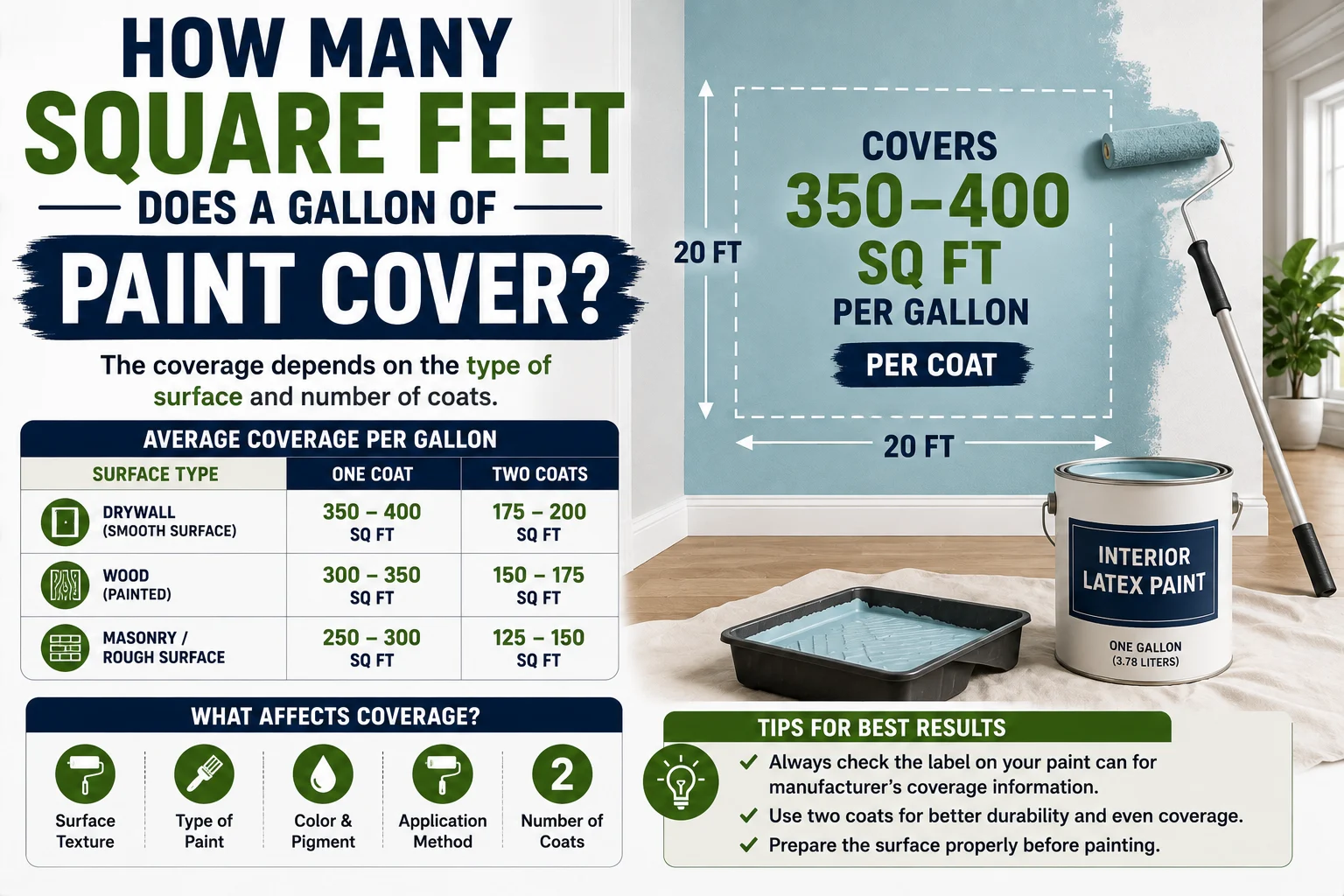
As a general rule, one gallon of paint typically covers approximately 350 to 400 square feet for one coat. However, actual coverage can vary depending on the type of paint, surface condition, application method, color, and whether you’re painting a smooth or porous surface.
Some paints may advertise coverage closer to 400–450 square feet per gallon, while rough or highly absorbent surfaces can require considerably more paint.
For accurate planning, the manufacturer’s coverage information on the paint can should be your primary reference.
If a paint is rated at 400 square feet per gallon, for example, a 1,000-square-foot surface would require:
1,000 ÷ 400 = 2.5 gallons
You would normally round up rather than purchase exactly 2.5 gallons.
Quick Answer: How Many Square Feet Does a Gallon of Paint Cover?
A gallon of paint typically covers about 350–400 square feet for one coat.
A commonly used planning estimate is:
1 gallon ≈ 400 square feet
However, this is only an estimate.
Actual coverage can be affected by:
- Paint type
- Surface texture
- Surface porosity
- Existing color
- New color
- Primer
- Number of coats
- Application method
- Paint quality
- Environmental conditions
Always check the coverage stated by the manufacturer for the specific product you’re using.
A=lw
A=6×4=24
4 rows by 6 columns = 24 square units.
w
w
l
l24 square unitsw = 6l = 4
Give feedback
How Many Square Feet Does 1 Gallon of Paint Cover?
For a typical interior wall with a relatively smooth, properly prepared surface:
1 gallon of paint may cover approximately 350–400 square feet per coat.
For example, if your paint covers 400 square feet per gallon:
- 400 sq ft = about 1 gallon
- 800 sq ft = about 2 gallons
- 1,200 sq ft = about 3 gallons
- 1,600 sq ft = about 4 gallons
- 2,000 sq ft = about 5 gallons
These numbers assume one coat and the stated coverage rate.
If you need two coats, you generally need approximately twice the amount of paint.
Paint Coverage Chart
The following chart uses an assumed coverage rate of 400 square feet per gallon.
| Surface Area | Approx. Paint for 1 Coat | Approx. Paint for 2 Coats |
|---|---|---|
| 100 sq ft | 0.25 gal | 0.50 gal |
| 200 sq ft | 0.50 gal | 1 gal |
| 400 sq ft | 1 gal | 2 gal |
| 500 sq ft | 1.25 gal | 2.5 gal |
| 750 sq ft | 1.88 gal | 3.75 gal |
| 1,000 sq ft | 2.5 gal | 5 gal |
| 1,500 sq ft | 3.75 gal | 7.5 gal |
| 2,000 sq ft | 5 gal | 10 gal |
| 2,500 sq ft | 6.25 gal | 12.5 gal |
| 3,000 sq ft | 7.5 gal | 15 gal |
These are mathematical estimates. Actual paint requirements can differ depending on the product and surface.
How to Calculate How Much Paint You Need
Calculating paint requirements is relatively simple.
Step 1: Determine the surface area
For a rectangular wall:
Length × Height = Square Feet
For example:
15 ft × 8 ft = 120 sq ft
Step 2: Add the areas of all surfaces
If you are painting several walls, calculate each wall separately and add them together.
Step 3: Subtract doors and windows if appropriate
Large doors and windows don’t normally require paint, so subtracting their area can improve your estimate.
Step 4: Check the paint’s coverage
Suppose the manufacturer says one gallon covers 400 square feet.
Step 5: Divide total area by coverage
Total Square Feet ÷ Coverage per Gallon = Gallons Needed
For example:
1,200 ÷ 400 = 3 gallons
That’s approximately three gallons for one coat.
How Much Paint Do I Need for 500 Square Feet?
Assuming coverage of 400 square feet per gallon:
500 ÷ 400 = 1.25 gallons
Therefore, you need approximately:
1.25 gallons for one coat
Because paint is commonly sold in containers such as gallons and quarts, you may need to purchase a combination that provides enough material.
For two coats:
1.25 × 2 = 2.5 gallons
Actual purchasing quantities should be rounded up appropriately.
How Much Paint Do I Need for 1,000 Square Feet?
At 400 square feet per gallon:
1,000 ÷ 400 = 2.5 gallons
Therefore:
About 2.5 gallons for one coat
For two coats:
2.5 × 2 = 5 gallons
So a 1,000-square-foot surface could require approximately 5 gallons for two coats at this coverage rate.
How Much Paint Do I Need for 1,500 Square Feet?
At 400 square feet per gallon:
1,500 ÷ 400 = 3.75 gallons
Therefore:
About 3.75 gallons for one coat
For two coats:
3.75 × 2 = 7.5 gallons
You would generally round up when purchasing.
How Much Paint Do I Need for 2,000 Square Feet?
At 400 square feet per gallon:
2,000 ÷ 400 = 5 gallons
Therefore:
5 gallons for one coat
For two coats:
5 × 2 = 10 gallons
This calculation assumes the entire 2,000 square feet is paintable surface area.
How Much Paint Do I Need for 2,500 Square Feet?
Using 400 square feet per gallon:
2,500 ÷ 400 = 6.25 gallons
Therefore, you need approximately:
6.25 gallons for one coat
For two coats:
6.25 × 2 = 12.5 gallons
You would round up to an appropriate purchasing quantity.
How Much Paint Do I Need for 3,000 Square Feet?
At 400 square feet per gallon:
3,000 ÷ 400 = 7.5 gallons
Therefore:
7.5 gallons for one coat
For two coats:
7.5 × 2 = 15 gallons
Again, actual coverage depends on the product and surface.
Does One Gallon Cover 400 Square Feet?
It can.
Many paints provide coverage in the general range of several hundred square feet per gallon, and 400 square feet per gallon is a useful estimate for planning.
But don’t assume that every paint covers exactly 400 square feet.
A product’s label may specify a different coverage rate.
For example, one product might state 350 square feet per gallon, while another could claim 400 or more.
The manufacturer’s stated coverage should take priority over a generic rule.
Does Paint Coverage Change for Interior and Exterior Paint?
Yes, it can.
Interior and exterior paints are formulated for different environments and surfaces.
Exterior surfaces can be more challenging because they may have:
- Rough textures
- Wood grain
- Masonry
- Stucco
- Weathered surfaces
- Existing coatings
- Greater porosity
As a result, actual coverage can differ substantially.
For exterior projects, calculate based on the product’s stated coverage and the surface you’re painting rather than assuming 400 square feet per gallon.
How Many Square Feet Does a Gallon of Exterior Paint Cover?
Exterior paint coverage varies by product and surface.
A gallon might cover several hundred square feet on a relatively smooth, properly prepared surface, but rough siding, masonry, stucco, or porous wood may consume significantly more paint.
For example, if a particular exterior paint specifies 350 square feet per gallon, then:
700 sq ft ÷ 350 = 2 gallons
for one coat.
Always use the manufacturer’s stated coverage rate for your specific exterior paint.
How Many Square Feet Does a Gallon of Interior Paint Cover?
For many interior wall paints, a gallon commonly covers around 350–400 square feet per coat, although product specifications vary.
A smooth, previously painted wall may provide better coverage than a porous surface.
If your product specifies 400 square feet per gallon, then:
400 square feet = approximately 1 gallon
for one coat.
How Many Coats of Paint Do You Need?
The number of coats depends on the project.
You may need:
One coat
Possible when:
- The existing color is similar
- The surface is in good condition
- The paint has good hiding power
- The manufacturer recommends one coat
Two coats
Often preferred when:
- Changing colors
- Covering a darker color
- Painting a new surface
- Better uniformity is desired
- The product instructions recommend two coats
Some difficult color changes or surfaces may require additional coats.
How Does Surface Condition Affect Paint Coverage?
Surface condition can have a major effect on how much paint you use.
A smooth, sealed wall generally absorbs less paint than an unsealed or highly porous surface.
Surfaces such as:
- Bare drywall
- Unfinished wood
- Concrete
- Brick
- Stucco
can absorb more paint than previously painted smooth surfaces.
Proper preparation and primer can improve the consistency of the finish and may reduce excessive absorption.
Does Paint Color Affect Coverage?
Yes.
Some colors can require more coats to achieve full, uniform coverage.
For example, applying a light color over a very dark color can require additional coats.
Certain bright, deep, or highly saturated colors can also have different hiding characteristics.
If you’re making a dramatic color change, a suitable primer can help create a more uniform base.
Does Primer Affect Paint Coverage?
Primer is not the same as finish paint, but it can play an important role in paint performance.
Primer can help:
- Seal porous surfaces
- Create a more uniform base
- Improve adhesion
- Reduce uneven absorption
- Help cover certain existing colors
If the surface is new, porous, patched, stained, or dramatically different in color, primer may be especially useful.
How Much Paint for a 12 × 12 Room?
A 12 × 12 room has:
12 × 12 = 144 square feet
of floor area.
However, you should not use 144 square feet as the total wall area.
If the room has 8-foot ceilings:
Perimeter:
12 + 12 + 12 + 12 = 48 feet
Wall area:
48 × 8 = 384 square feet
So the four walls have approximately:
384 square feet
before subtracting doors and windows.
At 400 square feet per gallon, one coat would theoretically require:
384 ÷ 400 = 0.96 gallons
So approximately 1 gallon could cover one coat of the four walls, depending on actual coverage and surface conditions.
For two coats, the mathematical estimate would be approximately 1.92 gallons, so you would typically purchase enough to cover at least two gallons.
How Much Paint for a 10 × 10 Room?
A 10 × 10 room has a floor area of:
10 × 10 = 100 square feet
Assuming an 8-foot ceiling, the wall perimeter is:
10 + 10 + 10 + 10 = 40 feet
Wall area:
40 × 8 = 320 square feet
At 400 square feet per gallon:
320 ÷ 400 = 0.8 gallons
So approximately one gallon could cover one coat under ideal conditions.
Two coats would require roughly:
1.6 gallons
before considering waste or variations in coverage.
How Much Paint for a Ceiling?
Ceiling paint is calculated from the ceiling’s surface area.
For a 12 × 12-foot ceiling:
12 × 12 = 144 square feet
Therefore, the ceiling has 144 square feet of surface area.
At 400 square feet per gallon:
144 ÷ 400 = 0.36 gallons
So approximately 0.36 gallons would theoretically cover one coat.
Because paint containers aren’t always available in arbitrary quantities, you would choose a practical container size based on the project.
How Much Paint Does a Quart Cover?
One gallon contains:
4 quarts
If one gallon covers approximately 400 square feet, then a simple mathematical estimate for one quart is:
400 ÷ 4 = 100 square feet
So:
1 quart may cover approximately 100 square feet
at a 400-square-foot-per-gallon coverage rate.
However, actual coverage depends on the paint product.
How Much Paint Does a Pint Cover?
One gallon contains:
8 pints
If one gallon covers 400 square feet:
400 ÷ 8 = 50 square feet
Therefore, a pint could theoretically cover approximately:
50 square feet
at that assumed coverage rate.
Again, this is only a proportional estimate based on 400 square feet per gallon.
How Much Paint Does a 5-Gallon Bucket Cover?
If one gallon covers approximately 400 square feet:
5 × 400 = 2,000 square feet
Therefore:
5 gallons ≈ 2,000 square feet for one coat
At two coats:
2,000 ÷ 2 = 1,000 square feet
So five gallons could theoretically cover approximately 1,000 square feet with two coats at that assumed coverage rate.
Paint Coverage by Container Size
Assuming 400 square feet per gallon:
| Paint Amount | Approx. One-Coat Coverage |
|---|---|
| 1 pint | 50 sq ft |
| 1 quart | 100 sq ft |
| ½ gallon | 200 sq ft |
| 1 gallon | 400 sq ft |
| 2 gallons | 800 sq ft |
| 3 gallons | 1,200 sq ft |
| 4 gallons | 1,600 sq ft |
| 5 gallons | 2,000 sq ft |
These figures are mathematical estimates based on a 400-square-foot-per-gallon coverage rate, not universal product specifications.
How Much Extra Paint Should You Buy?
It’s generally wise to avoid purchasing exactly the calculated minimum.
Reasons include:
- Spills
- Roller absorption
- Brush waste
- Touch-ups
- Uneven surfaces
- Additional coats
- Future repairs
- Differences between theoretical and actual coverage
However, buying a large amount of extra paint can also be wasteful.
A better approach is to calculate carefully, follow the manufacturer’s coverage estimate, and purchase a reasonable amount of additional material when appropriate.
Does a Roller Use More Paint Than a Sprayer?
Application method can affect actual paint consumption.
Roller
Rollers can provide relatively consistent coverage on walls and ceilings but absorb some paint.
Brush
Brushes are useful for edges, trim, corners, and detailed areas but are generally not the primary method for covering large walls.
Sprayer
Sprayers can apply paint quickly over large areas, but overspray and application technique can affect material consumption.
The theoretical coverage printed on the can should still be treated as a starting point rather than a guarantee.
How to Estimate Paint for a House
If you’re painting an entire house, don’t simply use the home’s advertised square footage.
A 2,000-square-foot house does not necessarily have only 2,000 square feet of paintable wall surface.
You need to consider:
- Number of rooms
- Ceiling heights
- Wall lengths
- Doors
- Windows
- Ceilings
- Trim
- Garages
- Exterior surfaces
- Number of coats
Calculate the actual paintable surface area for the most accurate estimate.
Common Paint Calculation Mistakes
Mistake 1: Using the Floor Area as Wall Area
A 1,000-square-foot house does not necessarily have 1,000 square feet of walls.
Wall area depends on room dimensions and ceiling height.
Mistake 2: Forgetting the Number of Coats
If your calculation requires 3 gallons for one coat, two coats could require approximately 6 gallons.
Mistake 3: Ignoring Doors and Windows
Large openings don’t need paint, so they can be subtracted for a more precise calculation.
Mistake 4: Ignoring Surface Porosity
Unpainted or porous surfaces can consume more paint.
Mistake 5: Assuming Every Gallon Covers 400 Square Feet
400 square feet is a useful general estimate, but product specifications vary.
Simple Paint Coverage Formula
The basic formula is:
Gallons Needed = Total Paintable Area ÷ Coverage per Gallon × Number of Coats
For example:
Paintable area:
1,200 sq ft
Coverage:
400 sq ft/gallon
Coats:
2
Calculation:
1,200 ÷ 400 × 2 = 6 gallons
Therefore, the theoretical requirement is:
6 gallons
You may need additional material depending on the surface and actual coverage.
FAQs
1. How many square feet does a gallon of paint cover?
A gallon of paint commonly covers approximately 350–400 square feet for one coat, although the exact coverage depends on the product and surface.
2. Is one gallon of paint enough for a 12 × 12 room?
It depends on what you’re painting. A 12 × 12 room has 144 square feet of floor area, but the walls have more surface area. With 8-foot ceilings, the four walls total approximately 384 square feet before subtracting doors and windows, so one gallon may be enough for one coat with a paint rated at 400 square feet per gallon.
3. How many gallons of paint do I need for 1,000 square feet?
At 400 square feet per gallon, approximately 2.5 gallons are needed for one coat or 5 gallons for two coats.
4. How many square feet does 5 gallons of paint cover?
At 400 square feet per gallon, five gallons would cover approximately 2,000 square feet for one coat.
5. Does one gallon of paint cover 400 square feet?
It can. 400 square feet per gallon is a common planning estimate, but you should check the specific product’s coverage rate.
6. Does two coats of paint require twice as much paint?
Generally, yes. If one coat requires three gallons, two coats could require approximately six gallons, although actual consumption depends on the surface and paint.
7. Does primer count as one coat?
Primer is a separate coating and should generally be calculated separately from the finish paint. Follow the product’s instructions for coverage and application.
8. How can I calculate exactly how much paint I need?
Measure the actual paintable surface area, subtract significant openings, check the manufacturer’s coverage rate, multiply by the number of coats, and round up to a practical purchasing quantity.
Conclusion
So, how many square feet does a gallon of paint cover?
As a general planning estimate:
1 gallon of paint covers approximately 350–400 square feet for one coat.
A commonly used estimate is 400 square feet per gallon, but actual coverage varies by paint product and surface.
To calculate your paint requirements, use:
Gallons Needed = Paintable Area ÷ Coverage per Gallon × Number of Coats
For example, a 1,000-square-foot surface using paint rated at 400 square feet per gallon would require approximately 2.5 gallons for one coat or 5 gallons for two coats.
For the most accurate result, always check the manufacturer’s coverage information and consider surface texture, porosity, color changes, primer, application method, and the number of coats. This approach will help you buy enough paint without unnecessarily overspending.