
If you’re planning a roof replacement or estimating how many shingles you need, you may have come across the term “roofing square.” A roofing square is a standard unit used by roofing professionals to measure roof area.
So, how many square feet are in one square of roofing?
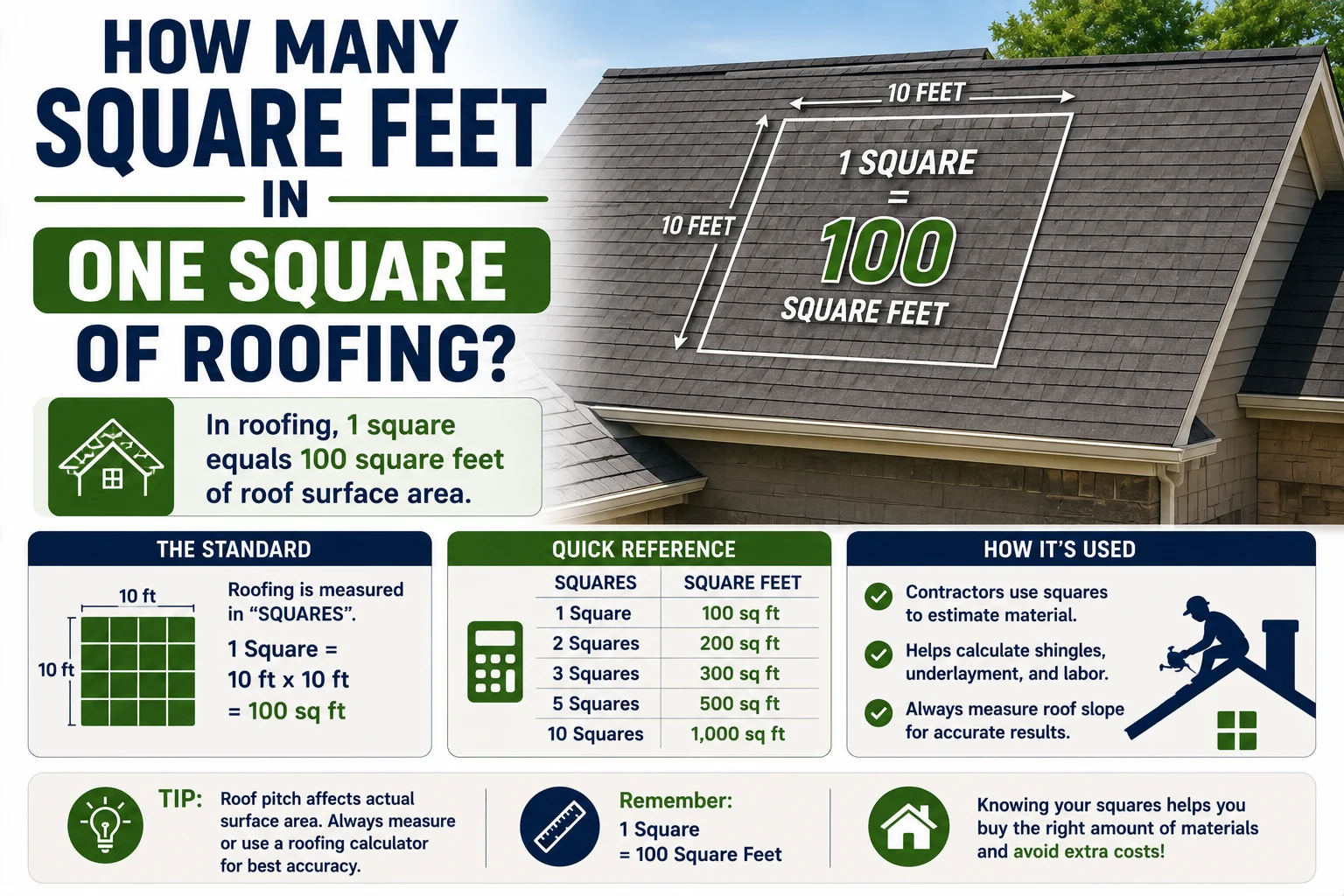
One roofing square equals 100 square feet.
That’s the standard definition used in the roofing industry.
A=s2
A=42=16
4 rows by 4 columns = 16 square units.
s
s16 square unitss = 4s = 4
Give feedback
For example:
- 1 roofing square = 100 sq ft
- 2 roofing squares = 200 sq ft
- 5 roofing squares = 500 sq ft
- 10 roofing squares = 1,000 sq ft
- 20 roofing squares = 2,000 sq ft
The term “square” can be confusing because it doesn’t necessarily mean a physical square-shaped section of roof. Instead, it is simply a measurement of 100 square feet of roof surface.
Quick Answer: How Many Square Feet Is One Roofing Square?
1 roofing square = 100 square feet
This conversion is very simple:
Roofing squares × 100 = square feet
And:
Square feet ÷ 100 = roofing squares
For example, a roof measuring 2,500 square feet would contain:
2,500 ÷ 100 = 25 roofing squares
So a 2,500-square-foot roof has 25 roofing squares before adding extra material for waste.
What Is a Roofing Square?
A roofing square is a unit of measurement equal to 100 square feet of roof area.
Roofers use squares because it makes it easier to estimate large quantities of roofing materials.
Instead of saying:
“This roof has 2,700 square feet.”
A roofing contractor might say:
“This roof is 27 squares.”
Both statements represent the same basic roof area.
27 roofing squares = 2,700 square feet
The measurement is particularly useful when ordering shingles and calculating labor.
Why Do Roofers Use Squares?
Roofing projects can cover thousands of square feet, making large numbers inconvenient to use repeatedly.
For example, saying:
3,400 square feet
is perfectly understandable.
But roofing professionals may find:
34 squares
more convenient when discussing:
- Shingles
- Underlayment
- Starter strips
- Ridge caps
- Labor
- Waste
- Roofing estimates
Using squares provides a standardized way to describe the size of a roofing project.
How to Convert Roofing Squares to Square Feet
The conversion is straightforward.
Formula:
Roofing squares × 100 = square feet
For example, if you have 12 squares:
12 × 100 = 1,200 square feet
Therefore:
12 roofing squares = 1,200 square feet
How to Convert Square Feet to Roofing Squares
If you know the roof’s area in square feet, divide it by 100.
Formula:
Square feet ÷ 100 = roofing squares
For example:
1,800 ÷ 100 = 18
Therefore:
1,800 square feet = 18 roofing squares
This is the basic conversion you’ll use when estimating a roofing project.
Roofing Square Conversion Chart
| Roofing Squares | Square Feet |
|---|---|
| 1 | 100 sq ft |
| 2 | 200 sq ft |
| 3 | 300 sq ft |
| 4 | 400 sq ft |
| 5 | 500 sq ft |
| 6 | 600 sq ft |
| 7 | 700 sq ft |
| 8 | 800 sq ft |
| 9 | 900 sq ft |
| 10 | 1,000 sq ft |
| 15 | 1,500 sq ft |
| 20 | 2,000 sq ft |
| 25 | 2,500 sq ft |
| 30 | 3,000 sq ft |
| 40 | 4,000 sq ft |
| 50 | 5,000 sq ft |
How Many Square Feet Are in 5 Squares of Roofing?
Five roofing squares equal:
5 × 100 = 500 square feet
Therefore:
5 roofing squares = 500 square feet
How Many Square Feet Are in 10 Squares of Roofing?
Ten roofing squares equal:
10 × 100 = 1,000 square feet
Therefore:
10 roofing squares = 1,000 square feet
How Many Square Feet Are in 15 Squares of Roofing?
Fifteen roofing squares equal:
15 × 100 = 1,500 square feet
Therefore:
15 roofing squares = 1,500 square feet
How Many Square Feet Are in 20 Squares of Roofing?
Twenty roofing squares equal:
20 × 100 = 2,000 square feet
Therefore:
20 roofing squares = 2,000 square feet
How Many Square Feet Are in 25 Squares of Roofing?
Twenty-five squares equal:
25 × 100 = 2,500 square feet
Therefore:
25 roofing squares = 2,500 square feet
How Many Square Feet Are in 30 Squares of Roofing?
Thirty squares equal:
30 × 100 = 3,000 square feet
Therefore:
30 roofing squares = 3,000 square feet
Does a Roofing Square Equal 100 Square Feet of House Area?
Not necessarily.
This is one of the most important points to understand.
A roofing square represents 100 square feet of actual roof surface, not necessarily 100 square feet of living space.
For example, a house might have a floor area of 2,000 square feet but a roof area greater than 2,000 square feet because of:
- Roof pitch
- Overhangs
- Multiple roof sections
- Porches
- Dormers
- Garages
- Complex roof designs
Therefore, you should not automatically divide a home’s interior square footage by 100 to determine the number of roofing squares.
Why Roof Area Can Be Larger Than House Square Footage
Suppose a house has a footprint of:
2,000 square feet
If the roof were completely flat with no overhangs, its roof surface could be close to 2,000 square feet.
But a pitched roof has an angled surface.
The actual roof surface is therefore longer than the horizontal footprint.
For example, a roof with a significant pitch can have substantially more surface area than the floor area beneath it.
How Does Roof Pitch Affect Roofing Squares?
Roof pitch is one of the most important factors when determining actual roof area.
A roof’s pitch describes how much it rises vertically compared with how far it extends horizontally.
For example:
- 4:12 pitch
- 6:12 pitch
- 8:12 pitch
- 10:12 pitch
A steeper roof generally has more surface area than a low-slope roof covering the same horizontal footprint.
This means two homes with identical footprints can require different numbers of roofing squares.
How to Calculate Roofing Squares
To estimate roofing squares, first determine the actual roof surface area.
Then:
Roofing Squares = Roof Area in Square Feet ÷ 100
For example, suppose your calculated roof area is:
2,400 square feet
Then:
2,400 ÷ 100 = 24 squares
So the roof contains:
24 roofing squares
You would then account for appropriate waste and additional roofing materials.
Example: Calculating a Simple Roof
Suppose you have a simple rectangular building measuring:
- 40 feet long
- 30 feet wide
Its horizontal footprint is:
40 × 30 = 1,200 square feet
If the roof were flat and had no additional surface area, that would correspond to 12 roofing squares.
But if it’s a pitched roof, the actual roof surface will be larger.
You need to account for the roof pitch before determining the final number of roofing squares.
How to Calculate a Gable Roof
A basic gable roof consists of two sloped roof planes.
One approach is to calculate the area of each roof plane separately and then add them together.
For each roof section:
Length × Sloped Length = Roof Area
Then:
Roof Section 1 + Roof Section 2 = Total Roof Area
Finally:
Total Roof Area ÷ 100 = Roofing Squares
This provides a more accurate estimate than simply using the home’s floor area.
How Many Shingles Are in One Roofing Square?
The answer depends on the shingle manufacturer and product.
For many standard asphalt shingles, three bundles are often designed to cover approximately one roofing square.
However, this is not universal.
Some specialty shingles may require:
- More bundles per square
- Fewer bundles per square
- Different installation methods
Always check the manufacturer’s packaging and coverage specifications.
For example, if a shingle package states that three bundles cover one square:
1 square = 3 bundles
Then:
20 squares × 3 = 60 bundles
But actual requirements can change because of starter shingles, ridge caps, valleys, and waste.
Does One Roofing Square Equal One Bundle of Shingles?
No.
This is a common misconception.
A roofing square measures roof area.
A bundle is a package of roofing material.
Depending on the product, multiple bundles may be required to cover one roofing square.
For many conventional asphalt shingles, three bundles often cover one square, but the exact coverage should always be confirmed from the manufacturer’s specifications.
How Much Shingle Waste Should You Add?
You usually shouldn’t order shingles based solely on the exact calculated roof area.
Some material is lost through:
- Cutting
- Valleys
- Ridges
- Hips
- Roof penetrations
- Starter courses
- Damaged shingles
- Complex roof layouts
A relatively simple roof may require a smaller waste allowance, while a complex roof can require more.
A roofing contractor should determine the appropriate waste factor based on the roof design.
Roofing Squares and Roof Replacement
When getting a roof replacement estimate, you’ll often see the roof size expressed in squares.
For example:
Roof size: 24 squares
This means:
24 × 100 = 2,400 square feet
But the final amount of shingles and other materials will be greater than the bare roof area because the installation requires additional components.
A complete roofing estimate may include:
- Field shingles
- Starter shingles
- Ridge cap
- Underlayment
- Ice and water protection where required
- Flashing
- Ventilation components
- Fasteners
- Drip edge
Roofing Square vs. Square Foot
These terms are related but aren’t the same unit.
Square Foot
A square foot is an area measuring 1 foot × 1 foot.
Roofing Square
A roofing square is 100 square feet of roof area.
Therefore:
1 roofing square = 100 square feet
and:
1 square foot = 0.01 roofing square
How Many Roofing Squares Do I Need for a 1,500-Square-Foot House?
You cannot determine the exact roofing squares from the home’s floor area alone.
If the actual roof surface measures 1,800 square feet, for example:
1,800 ÷ 100 = 18 squares
So the roof would be approximately 18 squares before adding waste.
The roof pitch, overhangs, and design must be considered.
How Many Roofing Squares Do I Need for a 2,000-Square-Foot House?
Again, the home’s 2,000 square feet doesn’t necessarily mean the roof is 20 squares.
If the actual roof surface is 2,300 square feet:
2,300 ÷ 100 = 23 squares
Therefore, the roof would be approximately:
23 roofing squares
The exact figure requires actual roof measurements.
How Many Roofing Squares Do I Need for a 2,500-Square-Foot House?
If the actual roof surface is 2,800 square feet:
2,800 ÷ 100 = 28 squares
So you would have approximately:
28 roofing squares
This example demonstrates why roof surface area should be measured instead of simply using the home’s interior square footage.
How Many Roofing Squares Do I Need for a 3,000-Square-Foot House?
Suppose the actual roof surface is 3,400 square feet.
Then:
3,400 ÷ 100 = 34 squares
So the roof would contain approximately:
34 roofing squares
The final material order would depend on the roofing system and waste requirements.
What Is a Roofing Square Used For?
Roofing squares are commonly used to estimate:
- Shingle quantities
- Roofing labor
- Underlayment
- Roofing waste
- Material costs
- Roof replacement estimates
Because roofing contractors frequently price labor and materials by the square, understanding the measurement makes it easier to compare estimates.
How Many Square Feet Does a Square of Shingles Cover?
A roofing square represents:
100 square feet of roof coverage
However, the amount of product purchased to cover one square can vary.
For example, one manufacturer’s shingles may use three bundles per square, while another product may have a different bundle coverage.
The package label should always be checked.
Roofing Measurement Example
Suppose your roof consists of two rectangular sections.
Section A
40 ft × 20 ft = 800 sq ft
Section B
40 ft × 20 ft = 800 sq ft
Total:
800 + 800 = 1,600 square feet
Convert to roofing squares:
1,600 ÷ 100 = 16 squares
Therefore:
The roof has 16 roofing squares before waste.
This method can also be applied to more complicated roofs by dividing them into measurable sections.
Roofing Squares Conversion Chart
| Roof Area | Roofing Squares |
|---|---|
| 500 sq ft | 5 squares |
| 750 sq ft | 7.5 squares |
| 1,000 sq ft | 10 squares |
| 1,250 sq ft | 12.5 squares |
| 1,500 sq ft | 15 squares |
| 1,750 sq ft | 17.5 squares |
| 2,000 sq ft | 20 squares |
| 2,250 sq ft | 22.5 squares |
| 2,500 sq ft | 25 squares |
| 2,750 sq ft | 27.5 squares |
| 3,000 sq ft | 30 squares |
| 3,500 sq ft | 35 squares |
| 4,000 sq ft | 40 squares |
| 5,000 sq ft | 50 squares |
Common Mistakes When Measuring Roofing Squares
1. Confusing Floor Area With Roof Area
A 2,000-square-foot house doesn’t necessarily have a 2,000-square-foot roof.
2. Ignoring Roof Pitch
A sloped roof has more surface area than its horizontal footprint.
3. Forgetting Overhangs
Roof edges can extend beyond the walls and increase total roof area.
4. Forgetting Waste
Cutting and installation can create material waste.
5. Assuming Every Shingle Bundle Covers the Same Area
Different products have different coverage rates.
6. Ignoring Roof Features
Valleys, dormers, hips, skylights, chimneys, and other features can affect the material calculation.
FAQs
1. How many square feet are in one square of roofing?
There are 100 square feet in one roofing square.
2. How many roofing squares are in 1,000 square feet?
There are 10 roofing squares in 1,000 square feet.
1,000 ÷ 100 = 10
3. How many square feet are in 10 roofing squares?
Ten roofing squares equal 1,000 square feet.
10 × 100 = 1,000
4. How many bundles of shingles are in one roofing square?
For many standard asphalt shingles, approximately three bundles cover one square, but coverage varies by manufacturer and product. Always check the product specifications.
5. Is a roofing square the same as 100 square feet?
Yes. One roofing square is a standardized measurement equal to 100 square feet of roof surface.
6. Does a 2,000-square-foot house have 20 roofing squares?
Not necessarily. The home’s floor area is different from its actual roof surface. Roof pitch, overhangs, and design can increase the roof area.
7. How do I calculate roofing squares?
Measure or calculate the actual roof surface area in square feet, then divide that number by 100.
Roofing squares = Roof square feet ÷ 100
Conclusion
So, how many square feet are in one square of roofing?
The answer is:
1 roofing square = 100 square feet
This is the standard measurement used throughout the roofing industry. To convert square feet into roofing squares, simply divide the roof area by 100. For example, a roof with 2,500 square feet of surface area contains 25 roofing squares before accounting for waste.
Remember that your home’s floor area is not necessarily the same as its roof area. Roof pitch, overhangs, valleys, dormers, hips, and other architectural features can increase the actual surface that must be covered.
For an accurate roofing-material estimate, calculate the actual roof surface, convert it into squares, and then account for the manufacturer’s shingle coverage, installation requirements, and appropriate waste allowance.