
If you’re planning a siding project, one of the first questions you may have is how many square feet in 1 piece of vinyl siding.
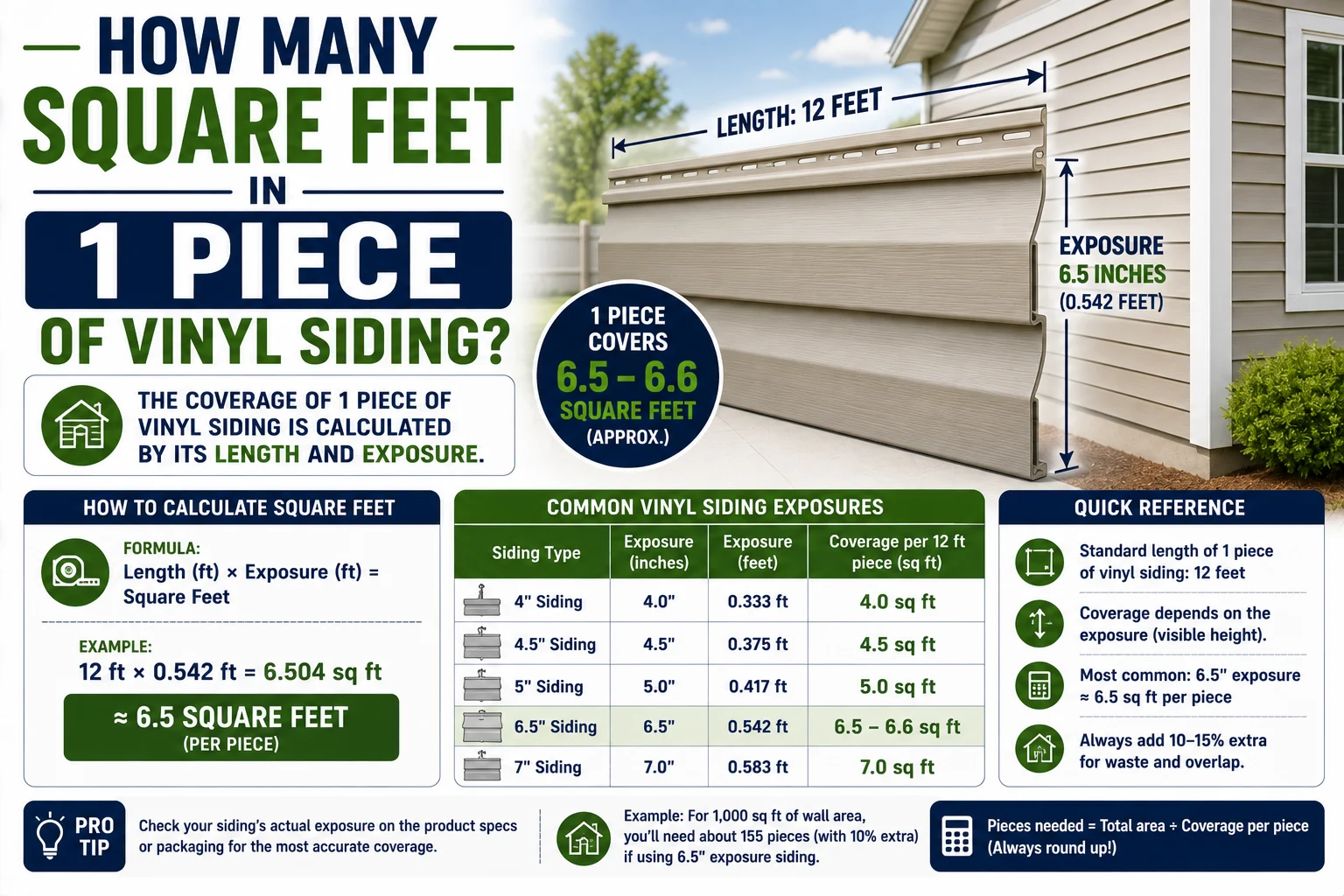
There is no single answer because vinyl siding panels come in different lengths, widths, profiles, and exposure sizes. However, a common 12-foot vinyl siding panel with approximately 4 inches of exposed height covers about 4 square feet.
The key is to calculate the coverage based on the length and exposed height of the panel. The exposed height is important because vinyl siding overlaps during installation. You cannot simply multiply the panel’s total physical height by its length.
For example, a 12-foot panel with a 4-inch exposure covers:
12 × 4/12 = 4 square feet
So, as a quick estimate:
One 12-foot vinyl siding panel with 4-inch exposure covers about 4 square feet.
Larger panels or panels with greater exposure can cover more.
Quick Answer: How Many Square Feet Does One Piece of Vinyl Siding Cover?
A typical 12-foot vinyl siding panel with a 4-inch exposure covers approximately:
4 square feet
However, coverage varies according to the panel dimensions.
For example:
| Panel Length | Exposure | Approximate Coverage |
|---|---|---|
| 10 ft | 4 in | 3.33 sq ft |
| 12 ft | 4 in | 4 sq ft |
| 12 ft | 4.5 in | 4.5 sq ft |
| 12 ft | 5 in | 5 sq ft |
| 12 ft | 6 in | 6 sq ft |
| 16 ft | 4 in | 5.33 sq ft |
| 16 ft | 5 in | 6.67 sq ft |
These are mathematical coverage estimates. Actual product specifications can vary by manufacturer and siding profile.
What Determines the Square Footage of a Vinyl Siding Panel?
Three measurements are especially important:
- Panel length
- Panel exposure
- Number of panels installed
The basic formula is:
Coverage = Panel Length × Exposed Height
Because siding measurements are often given in inches, convert the exposure to feet before calculating.
For example, 4 inches equals:
4 ÷ 12 = 0.333 feet
A 12-foot panel therefore covers:
12 × 0.333 ≈ 4 square feet
This is why two vinyl siding panels with the same length can have different coverage if their exposures are different.
How to Calculate Square Feet Per Piece of Vinyl Siding
Calculating the coverage is straightforward.
Step 1: Find the Panel Length
Look at the product specifications or measure the siding panel.
Suppose the panel is:
12 feet long
Step 2: Find the Exposure
The exposure is the portion of the panel visible after installation.
Suppose the exposure is:
4 inches
Step 3: Convert Inches to Feet
Divide by 12:
4 ÷ 12 = 0.333 feet
Step 4: Multiply Length by Exposure
12 × 0.333 = approximately 4 square feet
Therefore:
One panel covers approximately 4 square feet.
This method works for most rectangular siding panels.
What Is Siding Exposure?
Exposure is the visible portion of a siding panel after it has been installed and overlapped with the panel below it.
This measurement is critical when calculating coverage.
For example, a vinyl siding panel may physically be several inches tall, but some of that height is hidden by the overlapping panel.
If a panel has a 4-inch exposure, you should use 4 inches in your coverage calculation rather than the panel’s full physical height.
This is one of the most common points of confusion when estimating vinyl siding.
Why Doesn’t the Full Panel Height Count?
Vinyl siding is designed to overlap.
The overlapping section:
- Helps keep water away from the wall
- Creates the finished siding appearance
- Locks panels together
- Reduces exposed seams
- Provides weather protection
Because part of each panel is covered by another panel, only the exposed portion contributes to the wall’s finished coverage.
Therefore, using the physical height instead of the exposure can cause you to underestimate how many panels you’ll need.
How Many Square Feet Does a 12-Foot Piece of Vinyl Siding Cover?
A 12-foot siding panel can cover different amounts depending on its exposure.
4-Inch Exposure
12 × 4/12 = 4 square feet
5-Inch Exposure
12 × 5/12 = 5 square feet
6-Inch Exposure
12 × 6/12 = 6 square feet
This makes it easy to see why the panel’s exposure matters.
A 12-foot panel isn’t automatically equal to a fixed number of square feet.
Vinyl Siding Coverage Chart
Here’s a quick reference for a 12-foot panel:
| Exposure | Coverage Per 12-Foot Panel |
| 3 in | 3 sq ft |
| 4 in | 4 sq ft |
| 4.5 in | 4.5 sq ft |
| 5 in | 5 sq ft |
| 5.5 in | 5.5 sq ft |
| 6 in | 6 sq ft |
| 7 in | 7 sq ft |
| 8 in | 8 sq ft |
The values assume the stated exposure is the actual visible coverage.
Always verify the manufacturer’s published coverage for a specific product.
How Many Pieces of Vinyl Siding Are in a Square?
In siding, a square usually refers to 100 square feet of coverage.
If each panel covers 4 square feet:
100 ÷ 4 = 25 panels
Therefore, you would need approximately:
25 pieces per square
for 12-foot panels with 4-inch exposure.
If each panel covers 5 square feet:
100 ÷ 5 = 20 panels
So:
| Coverage Per Panel | Panels Per 100 Sq Ft |
| 3 sq ft | 33.3 |
| 4 sq ft | 25 |
| 4.5 sq ft | 22.2 |
| 5 sq ft | 20 |
| 6 sq ft | 16.7 |
You should round up when purchasing actual panels.
How Many Pieces of Vinyl Siding Do I Need?
To estimate the number of panels needed, first determine the wall’s total square footage.
Use:
Wall Area = Length × Height
For example, suppose one wall is:
30 feet long × 10 feet high
The area is:
30 × 10 = 300 square feet
If your vinyl siding covers 4 square feet per panel:
300 ÷ 4 = 75 panels
You would need approximately:
75 panels
before accounting for waste, cuts, damaged pieces, gables, trim, doors, and windows.
Example: Siding a 1,000-Square-Foot Wall
Suppose the total exterior wall area is:
1,000 square feet
And each panel provides:
4 square feet of coverage
Calculate:
1,000 ÷ 4 = 250 panels
So you would need approximately:
250 panels
before adding a waste allowance.
If you add 10% for waste:
250 × 1.10 = 275 panels
So approximately 275 panels would be a reasonable material estimate.
The actual amount depends on the design and installation details.
How Much Vinyl Siding Do I Need for a House?
Estimating siding for an entire house requires more than multiplying the house’s floor area by a percentage.
You need to calculate the exterior wall area.
A basic process is:
1. Measure Each Wall
Measure the length and height.
2. Calculate Each Wall
Use:
Length × Height = Wall Area
3. Add the Walls Together
This gives the gross wall area.
4. Subtract Large Openings
Subtract major doors and windows when appropriate.
5. Calculate Gables
Triangular areas require a separate calculation.
6. Add Waste
Include additional material for cuts and mistakes.
7. Account for Trim
Corners, windows, doors, starter strips, and other accessories are separate from field siding.
Should You Subtract Windows and Doors?
Yes, large openings can be subtracted when estimating the net siding area.
For example, suppose a wall has:
300 square feet
of gross area.
The wall contains:
- 20 sq ft window
- 18 sq ft window
- 21 sq ft door
Total openings:
20 + 18 + 21 = 59 square feet
Net area:
300 − 59 = 241 square feet
You would then estimate the siding needed for approximately 241 square feet, plus waste.
For small openings, some contractors may not subtract them because the material around the openings creates additional cuts and waste.
How Much Extra Vinyl Siding Should You Buy?
You should normally purchase more siding than the exact calculated coverage.
Why?
Because installation creates waste.
Waste can come from:
- Cutting panels
- Gable slopes
- Windows
- Doors
- Corners
- Damaged panels
- Measurement errors
- Offcuts that cannot be reused
A common planning allowance is around 5% to 10%, although complicated homes may require more.
For a simple rectangular building, 5% may be sufficient.
For a home with many angles, dormers, gables, and openings, 10% or more may be more realistic.
How Many Pieces of Vinyl Siding for 500 Square Feet?
Suppose each panel covers approximately 4 square feet.
Calculate:
500 ÷ 4 = 125 panels
With 10% waste:
125 × 1.10 = 137.5
You would round up to approximately:
138 panels
Again, this is an estimate based on 4 square feet of coverage per panel.
How Many Pieces of Vinyl Siding for 1,000 Square Feet?
For a panel providing 4 square feet:
1,000 ÷ 4 = 250 panels
With 10% waste:
250 × 1.10 = 275 panels
So approximately:
275 panels
would be needed.
If your panels provide 5 square feet each:
1,000 ÷ 5 = 200 panels
With 10% waste:
200 × 1.10 = 220 panels
This demonstrates why knowing the actual panel coverage is important.
How Many Pieces of Vinyl Siding for 2,000 Square Feet?
If each panel covers 4 square feet:
2,000 ÷ 4 = 500 panels
With 10% waste:
500 × 1.10 = 550 panels
So you’d estimate around:
550 panels
However, remember that 2,000 square feet of wall area is different from a house with 2,000 square feet of interior floor space.
A 2,000-square-foot house can have much more or less than 2,000 square feet of exterior siding area depending on its shape and number of stories.
Does a 12-Foot Siding Panel Always Cover 4 Square Feet?
No.
A 12-foot panel covers 4 square feet only when its exposed height is 4 inches.
For example:
- 12 ft × 4 in = 4 sq ft
- 12 ft × 5 in = 5 sq ft
- 12 ft × 6 in = 6 sq ft
Therefore, always check the actual siding exposure before calculating coverage.
Vinyl Siding Panel Lengths
Vinyl siding is available in different lengths.
Common panel lengths may include:
- 10 feet
- 12 feet
- 12.5 feet
- 16 feet
- Other specialty lengths
Longer panels can reduce the number of seams and may improve installation efficiency.
However, longer doesn’t necessarily mean better for every project.
Consider:
- Transportation
- Handling
- Wall dimensions
- Installation crew
- Waste
- Product availability
The manufacturer’s specifications should be used for the final material calculation.
Vinyl Siding vs. Siding Square
A siding square is a unit of area.
1 siding square = 100 square feet
It does not mean one piece of siding.
For example, if one panel covers 4 square feet:
100 ÷ 4 = 25 panels per square
If one panel covers 5 square feet:
100 ÷ 5 = 20 panels per square
Understanding this difference can prevent major ordering mistakes.
Common Mistakes When Estimating Vinyl Siding
Mistake 1: Using the Full Panel Height
Always use the exposure, not the total panel height.
Mistake 2: Assuming Every Panel Covers the Same Area
Different profiles and manufacturers have different dimensions.
Mistake 3: Forgetting Waste
Exact calculations rarely match actual material requirements.
Mistake 4: Confusing House Floor Area With Wall Area
A 2,000-square-foot house doesn’t necessarily have 2,000 square feet of siding.
Mistake 5: Forgetting Gables
Triangular sections can add significant siding area.
Mistake 6: Ignoring Trim
Vinyl siding is only one part of the exterior installation.
Mistake 7: Ordering by Panel Count Alone
Some siding products are sold by cartons or squares rather than individual pieces.
Expert Tips for Buying Vinyl Siding
Check the Product Specifications
Look for:
- Panel length
- Panel exposure
- Coverage per carton
- Panels per carton
- Profile type
- Manufacturer
Calculate Wall Area First
Don’t begin by guessing the number of panels.
Add a Waste Allowance
Plan for cuts and unusable pieces.
Order From the Same Product Line
Color and texture can vary between production batches.
Keep Extra Panels
Saving a few spare pieces can be useful for future repairs.
Don’t Forget Accessories
You may also need:
- Starter strips
- J-channel
- Utility trim
- Inside corners
- Outside corners
- Undersill trim
- Fasteners
The exact components depend on the installation.
Frequently Asked Questions
1. How many square feet is one piece of vinyl siding?
A typical 12-foot panel with 4-inch exposure covers about 4 square feet. Actual coverage varies by panel length and exposure.
2. How many pieces of vinyl siding are in 100 square feet?
If each panel covers 4 square feet, you need approximately 25 panels to cover 100 square feet. Add extra material for waste.
3. How many square feet does a 12-foot piece of vinyl siding cover?
It depends on the exposure. A 12-foot panel with 4-inch exposure covers about 4 square feet, while a 5-inch exposure covers about 5 square feet.
4. What is a square of vinyl siding?
A siding square represents 100 square feet of wall coverage. It is an area measurement, not one physical piece of siding.
5. How much extra vinyl siding should I buy?
A 5% to 10% waste allowance is commonly useful for estimating, although complicated buildings may require more. Follow the product manufacturer’s recommendations and your installer’s estimate.
Conclusion
So, how many square feet in 1 piece of vinyl siding? The answer depends on the panel’s length and exposed height. A common 12-foot vinyl siding panel with a 4-inch exposure covers approximately 4 square feet.
The basic calculation is:
Panel length × exposed height = coverage
For example:
12 feet × 4 inches ÷ 12 = 4 square feet
Remember that the exposure matters because vinyl siding panels overlap during installation. A 12-foot panel with a 5-inch exposure covers about 5 square feet, while a 6-inch exposure covers about 6 square feet.
For a complete siding project, calculate the total exterior wall area, account for windows and doors where appropriate, include gables, and add a reasonable waste allowance. Also remember that a siding square equals 100 square feet, so the number of individual panels per square depends on the coverage of your specific product.
For the most accurate estimate, use the manufacturer’s published coverage and panel dimensions rather than relying only on a general rule.
Quick Reference
- 12-ft panel, 4-in exposure: about 4 sq ft
- 12-ft panel, 5-in exposure: about 5 sq ft
- 12-ft panel, 6-in exposure: about 6 sq ft
- 1 siding square: 100 sq ft
- 25 panels at 4 sq ft each: approximately 1 siding square