
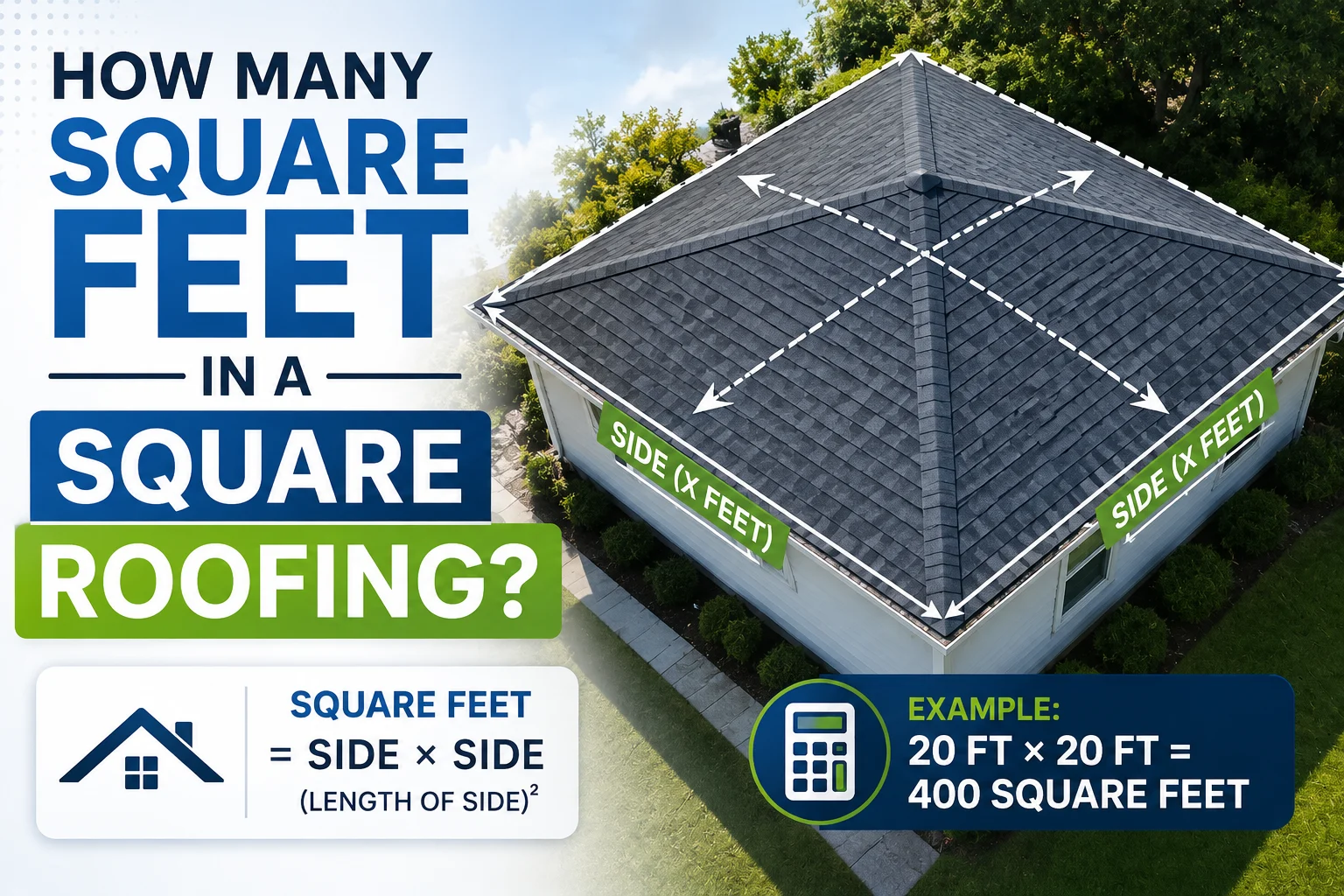
If you’re planning a roof replacement or trying to estimate how many shingles you’ll need, you may be wondering how many square feet in a square roofing. The answer is simple: one roofing square equals 100 square feet of roof area.
The term “square” can be confusing because it doesn’t necessarily describe the shape of the roof. In roofing, a square is a unit of measurement used by contractors and material suppliers. For example, a roof measuring 2,000 square feet contains 20 roofing squares before adding waste.
Understanding this measurement makes it much easier to estimate shingles, underlayment, and other roofing materials.
Quick Answer
1 roofing square = 100 square feet
So:
| Roofing Squares | Square Feet |
|---|---|
| 1 | 100 sq ft |
| 2 | 200 sq ft |
| 5 | 500 sq ft |
| 10 | 1,000 sq ft |
| 15 | 1,500 sq ft |
| 20 | 2,000 sq ft |
| 25 | 2,500 sq ft |
| 30 | 3,000 sq ft |
| 40 | 4,000 sq ft |
| 50 | 5,000 sq ft |
To convert square feet to roofing squares, divide the total roof area by 100.
What Is a Roofing Square?
A roofing square is a standard roofing measurement equal to 100 square feet.
For example:
- 1 square = 100 sq ft
- 5 squares = 500 sq ft
- 10 squares = 1,000 sq ft
- 20 squares = 2,000 sq ft
Roofing professionals commonly use squares when ordering materials and preparing estimates.
Why Roofers Use Squares
Using squares makes roofing estimates easier to communicate.
Instead of saying:
“We need materials for 2,700 square feet.”
A roofer may say:
“The roof is approximately 27 squares.”
Both measurements describe the same basic roof area.
How Many Square Feet Are in One Roofing Square?
There are exactly 100 square feet in one roofing square.
A=s2
A=42=16
4 rows by 4 columns = 16 square units.
s
s16 square unitss = 4s = 4
Give feedback
The important distinction is that a roofing square is not necessarily a 10-foot by 10-foot section physically marked on the roof. It is simply a unit representing 100 square feet of roof surface.
Roofing Squares to Square Feet Chart
Use this chart for quick conversions:
| Roofing Squares | Roof Area |
|---|---|
| 1 | 100 sq ft |
| 3 | 300 sq ft |
| 5 | 500 sq ft |
| 8 | 800 sq ft |
| 10 | 1,000 sq ft |
| 12 | 1,200 sq ft |
| 15 | 1,500 sq ft |
| 18 | 1,800 sq ft |
| 20 | 2,000 sq ft |
| 25 | 2,500 sq ft |
| 30 | 3,000 sq ft |
| 35 | 3,500 sq ft |
| 40 | 4,000 sq ft |
| 50 | 5,000 sq ft |
How to Calculate Roofing Squares
Calculating the number of roofing squares requires determining the actual roof surface area, not simply the home’s floor area.
Step 1: Calculate Roof Area
For a simple rectangular roof section, multiply:
Length × Width = Roof Area
For example, suppose one roof section measures:
- 40 feet long
- 30 feet wide
The area is:
40 × 30 = 1,200 square feet
Step 2: Account for Roof Pitch
The roof’s slope affects the actual surface area.
A house with a pitched roof can have significantly more roof surface than the horizontal footprint of the building.
For a simple roof, you can measure the sloped roof surface directly or use an appropriate pitch multiplier.
For example, a roof with a 6:12 pitch has a different surface area than a flat roof covering the same horizontal footprint.
For accurate material estimates, roof pitch should be included.
Step 3: Convert Square Feet to Roofing Squares
Once you know the actual roof area, divide by 100.
For example:
2,400 square feet ÷ 100 = 24 roofing squares
So the roof contains 24 squares before accounting for waste.
How Many Shingles Are in a Roofing Square?
A roofing square doesn’t mean exactly the same number of individual shingles in every case.
For common asphalt shingles, manufacturers often package shingles so that approximately three bundles cover one roofing square. However, this can vary by shingle design and manufacturer.
Always check the coverage information printed on the shingle package.
For example, if a roof requires 20 squares and the particular shingles require three bundles per square:
20 × 3 = 60 bundles
You would then add an appropriate amount for waste.
Real-World Roofing Examples
Example 1: 1,500-Square-Foot Roof
Suppose the actual roof surface measures 1,500 square feet.
Convert it to squares:
1,500 ÷ 100 = 15 squares
The roof contains 15 roofing squares.
Example 2: 2,000-Square-Foot Roof
A roof with 2,000 square feet of actual surface area contains:
2,000 ÷ 100 = 20 squares
So you have 20 roofing squares before adding waste.
Example 3: 3,000-Square-Foot Roof
For a 3,000-square-foot roof:
3,000 ÷ 100 = 30 squares
You would need materials for approximately 30 squares, plus additional material for waste and cuts.
Why You Should Add Roofing Waste
You generally shouldn’t order materials based on the exact calculated roof area alone.
Extra material may be needed because of:
- Roof valleys
- Hips and ridges
- Gable cuts
- Flashing
- Damaged shingles
- Complex roof shapes
- Installation waste
The appropriate waste allowance depends on the roof’s design and material. A simple roof generally has less waste than a complex roof with many angles and valleys.
Common Roofing Measurement Mistakes
Avoid these errors when calculating roofing squares:
1. Using the Home’s Floor Area
A 2,000-square-foot home doesn’t necessarily have a 2,000-square-foot roof.
Roof pitch and overhangs can increase the actual roof surface.
2. Forgetting Roof Pitch
Ignoring slope can result in ordering too little material.
3. Forgetting Waste
Cuts and installation losses require additional material.
4. Confusing Square Feet With Roofing Squares
Remember:
100 square feet = 1 roofing square
Therefore:
2,500 square feet = 25 roofing squares
Expert Tips for Estimating Roofing Materials
For a more accurate estimate:
- Measure each roof section separately.
- Calculate the actual sloped surface area.
- Convert total square footage into roofing squares.
- Check the manufacturer’s coverage information.
- Account for waste.
- Measure ridges, hips, valleys, and flashing separately.
- For complex roofs, consider having a professional measure the roof.
If you’re ordering a large amount of material, small measurement errors can become expensive.
FAQs
1. How many square feet are in a roofing square?
One roofing square equals 100 square feet.
2. How many roofing squares are in 2,000 square feet?
Divide 2,000 by 100:
2,000 ÷ 100 = 20 squares
So, 2,000 square feet equals 20 roofing squares.
3. Is a roofing square the same as a square foot?
No. A square foot is a unit of area, while a roofing square represents 100 square feet.
4. How many roofing squares do I need for a 2,500-square-foot roof?
A 2,500-square-foot roof contains:
2,500 ÷ 100 = 25 squares
You would typically need additional material for waste.
5. How many bundles of shingles are in one roofing square?
Many standard asphalt shingles require about three bundles per roofing square, but coverage varies by product. Always check the manufacturer’s specifications before ordering.
Conclusion
If you’re asking how many square feet in a square roofing, the answer is 100 square feet. A roofing square is simply a standard industry measurement used to describe 100 square feet of actual roof surface.
To calculate the number of squares, first determine the roof’s actual surface area, account for its pitch and design, and then divide the total square footage by 100. Finally, add an appropriate allowance for waste and installation.
Planning a roof replacement? Start with the 100-square-foot-per-square rule, then use your roof dimensions, pitch, and shingle coverage specifications to create a more accurate material estimate.