

If you’ve ever wondered how many bones in hands and feet humans have, you’re not alone. It’s one of the most common anatomy questions asked by students, healthcare learners, and curious readers.
Although the human body has 206 bones, a surprisingly large number are found in the hands and feet. These small bones work together to provide strength, flexibility, balance, and precise movement. Whether you’re typing on a keyboard, playing a musical instrument, walking, running, or picking up a cup of coffee, these bones make it possible.
In this guide, you’ll learn exactly how many bones are in the hands and feet, their names, functions, interesting facts, and why they are essential to everyday life.
Quick Answer
Here’s the simple answer.
| Body Part | Bones Per Side | Bones Both Sides |
|---|---|---|
| One Hand | 27 | — |
| Both Hands | — | 54 |
| One Foot | 26 | — |
| Both Feet | — | 52 |
| Total Hands + Feet | — | 106 Bones |
Key fact: More than half of the body’s 206 bones are located in the hands and feet.
How Many Bones Are in the Human Hand?
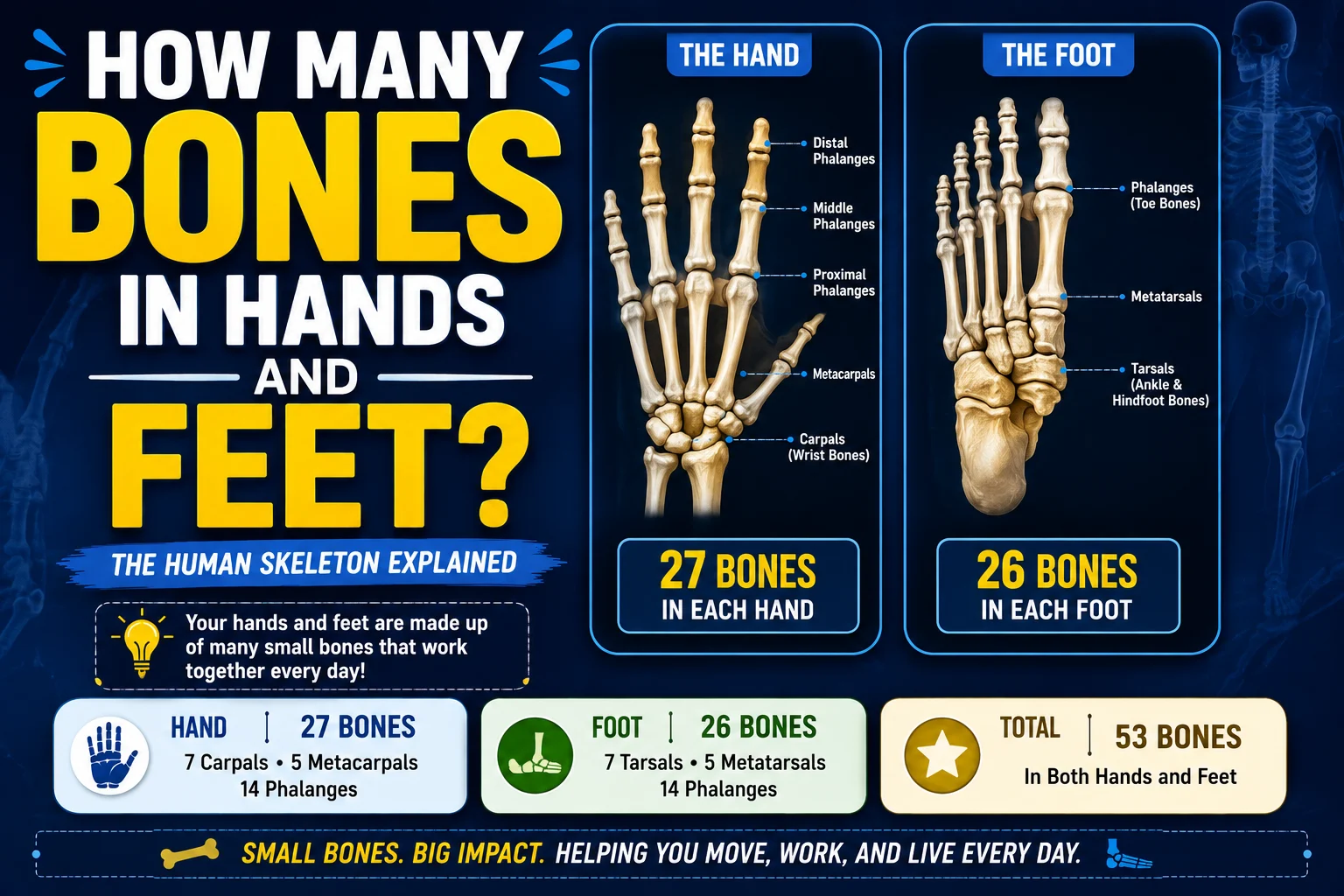
Each human hand contains 27 bones.
These bones are grouped into three main sections.
| Bone Group | Number |
|---|---|
| Carpals | 8 |
| Metacarpals | 5 |
| Phalanges | 14 |
| Total | 27 |
Let’s look at each group.
Wrist Bones (Carpals)
The wrist contains 8 small bones, known as the carpals.
These bones are arranged in two rows and connect the forearm to the hand. Their unique arrangement allows the wrist to bend, rotate, and absorb force.
The eight carpal bones are:
- Scaphoid
- Lunate
- Triquetrum
- Pisiform
- Trapezium
- Trapezoid
- Capitate
- Hamate
Together, they provide flexibility while maintaining stability.
Palm Bones (Metacarpals)
The palm has 5 metacarpal bones.
Each metacarpal connects a wrist bone to one finger.
These long bones help create the shape of your palm and provide leverage for gripping objects.
Whether you’re writing, lifting weights, or shaking hands, your metacarpals are actively involved.
Finger Bones (Phalanges)
There are 14 phalanges in each hand.
Each finger has three bones:
- Proximal phalanx
- Middle phalanx
- Distal phalanx
The thumb is different because it contains only two phalanges instead of three.
This arrangement gives the thumb exceptional mobility and makes precise gripping possible.
How Many Bones Are in the Human Foot?
Each foot contains 26 bones.
These bones support your body weight while allowing walking, running, jumping, and balancing.
The foot bones are divided into three groups.
| Bone Group | Number |
|---|---|
| Tarsals | 7 |
| Metatarsals | 5 |
| Phalanges | 14 |
| Total | 26 |
Tarsal Bones
The ankle and rear foot contain 7 tarsal bones.
These include:
- Talus
- Calcaneus (heel bone)
- Navicular
- Cuboid
- Medial cuneiform
- Intermediate cuneiform
- Lateral cuneiform
The calcaneus is the largest bone in the foot and absorbs much of the impact from walking and running.
Metatarsal Bones
The middle part of the foot contains 5 metatarsal bones.
These connect the ankle region to the toes.
Metatarsals help distribute body weight and provide support during movement.
Athletes often experience stress fractures in these bones due to repetitive impact.
Toe Bones (Phalanges)
Each foot contains 14 toe bones.
Like the fingers:
- Four toes have three bones each.
- The big toe has only two bones.
These bones contribute to balance, walking efficiency, and pushing the body forward with each step.
Hand vs Foot Bone Comparison
| Feature | Hand | Foot |
|---|---|---|
| Total Bones | 27 | 26 |
| Wrist/Ankle Bones | 8 Carpals | 7 Tarsals |
| Middle Bones | 5 Metacarpals | 5 Metatarsals |
| Finger/Toe Bones | 14 Phalanges | 14 Phalanges |
| Main Purpose | Dexterity | Support and Balance |
Although they contain nearly the same number of bones, their jobs are very different. Hands prioritize precision and fine motor skills, while feet focus on stability and weight-bearing.
Why Do Hands and Feet Have So Many Bones?
You might wonder why such small body parts contain over half of the body’s bones.
The answer lies in movement.
Many small bones provide:
- Greater flexibility
- Better shock absorption
- Improved balance
- Stronger grip
- Precise finger movements
- Smooth walking mechanics
Imagine trying to pick up a coin or walk on uneven ground with only a few large bones. Fine control would be impossible.
Nature’s design allows the hands and feet to perform countless complex tasks every day.
How Hands and Feet Work Together
Hands and feet may seem unrelated, but they often work in harmony.
For example:
- Climbers rely on both for gripping surfaces.
- Basketball players coordinate hand control with footwork.
- Musicians use finger precision while maintaining posture through their feet.
- Dancers depend on synchronized movements of both.
The nervous system continuously coordinates these bones, muscles, tendons, and joints to produce smooth movement.
Real-World Examples
Here are a few examples of how these bones function in everyday life.
Writing
Finger bones allow precise pencil control while wrist bones stabilize movement.
Running
Foot bones distribute body weight and absorb impact with every stride.
Playing Guitar
The small finger bones create intricate movements while the thumb provides grip and support.
Hiking
Foot bones adapt to uneven terrain, helping maintain balance and reduce injury risk.
Interesting Facts About Hand and Foot Bones
Here are some fascinating anatomy facts.
- Together, your hands and feet contain 106 bones.
- That’s over 51% of all bones in the adult body.
- Babies have more bones than adults because many bones fuse as they grow.
- The thumb has only two bones.
- The big toe also has only two bones.
- The heel bone is the largest bone in the foot.
- The wrist contains eight uniquely shaped bones that allow remarkable flexibility.
- The human hand can perform thousands of different grip patterns.
Common Injuries Affecting Hand and Foot Bones
Because these bones are used constantly, injuries are common.
Hand Injuries
- Finger fractures
- Wrist fractures
- Thumb injuries
- Metacarpal fractures
- Joint dislocations
Foot Injuries
- Stress fractures
- Broken toes
- Heel fractures
- Metatarsal fractures
- Ankle injuries involving tarsal bones
Symptoms often include:
- Pain
- Swelling
- Bruising
- Difficulty moving
- Trouble bearing weight
Medical evaluation is important if a fracture is suspected.
Tips for Keeping Hand and Foot Bones Healthy
Healthy bones support an active lifestyle.
Here are practical tips:
Eat Bone-Friendly Foods
Include:
- Dairy products
- Leafy greens
- Fish rich in vitamin D
- Nuts and seeds
Exercise Regularly
Weight-bearing activities strengthen bones.
Examples include:
- Walking
- Hiking
- Resistance training
- Dancing
Protect Your Hands
Wear gloves during heavy work and sports.
Wear Proper Footwear
Supportive shoes reduce stress on foot bones and joints.
Maintain Good Posture
Proper body alignment reduces unnecessary pressure on the feet.
Avoid Smoking
Smoking weakens bone health and slows healing after fractures.
Get Enough Calcium and Vitamin D
These nutrients are essential for strong bones throughout life.
Common Misconceptions
Myth: Hands have more than 30 bones.
Fact: Each hand has exactly 27 bones.
Myth: Feet have fewer than 20 bones.
Fact: Each foot contains 26 bones.
Myth: All fingers and toes have three bones.
Fact: The thumb and big toe each have only two phalanges.
Myth: Bones are lifeless.
Fact: Bones are living tissues that continuously remodel and repair themselves.
Why This Knowledge Matters
Understanding hand and foot anatomy is useful for:
- Students studying biology
- Medical professionals
- Physical therapists
- Athletes
- Fitness coaches
- Artists learning anatomy
- Parents teaching children about the human body
Knowing how these bones function can also help you recognize injuries early and appreciate how remarkable the human skeletal system truly is.
FAQs
1. How many bones are in both hands and feet together?
Both hands contain 54 bones, and both feet contain 52 bones, making a total of 106 bones.
2. Why do the hands have more bones than the feet?
Hands have one additional bone per side because each hand has 8 carpal bones, while each foot has 7 tarsal bones.
3. Which finger has the fewest bones?
The thumb has only two phalanges, while all other fingers have three.
4. Which toe has only two bones?
The big toe has only two phalanges, while the remaining toes each have three.
5. Are the number of bones the same in children and adults?
Not exactly. Babies are born with around 270 bones, many of which gradually fuse together, resulting in 206 bones in a healthy adult skeleton.
Conclusion
Understanding how many bones in hands and feet gives you a greater appreciation for the incredible design of the human body. Each hand contains 27 bones, each foot contains 26 bones, and together they account for 106 of the body’s 206 bones. These bones provide the flexibility, strength, balance, and precision needed for everything from writing and typing to walking and running.
Whether you’re studying anatomy, preparing for an exam, or simply satisfying your curiosity, knowing how these bones are organized makes it easier to understand how the skeletal system supports everyday movement.