
Understanding 50 kilograms weight is useful in fitness, travel, shipping, health, and everyday life. Many people hear “50 kilograms” but may not clearly understand how heavy it feels.
This guide explains 50 kilograms in pounds, grams, and real-life comparisons so you can easily visualize the weight.
What Does 50 Kilograms Mean?
A kilogram is a unit of mass in the metric system.
So, 50 kilograms means:
- Fifty units of one kilogram each
- A heavy everyday weight
- Commonly used for body weight, luggage, appliances, and gym equipment
It is a substantial load that many people can lift briefly but not carry comfortably for long.
50 Kilograms in Other Units
Let’s convert 50 kilograms into other measurements.
50 Kilograms in Pounds
Since 1 kilogram = 2.20462 pounds:
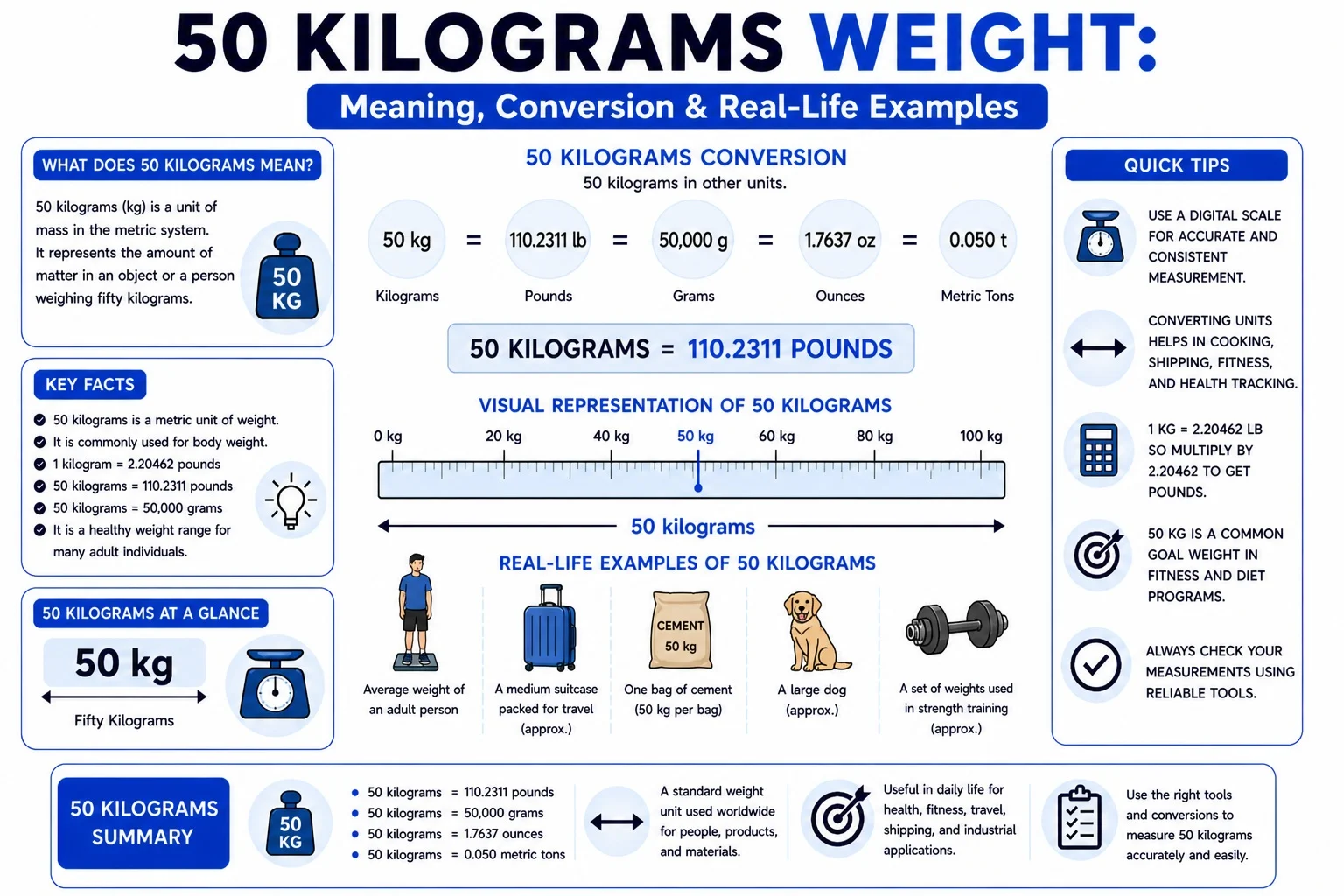
50 kilograms ≈ 110.23 pounds
50×2.20462=110.23
50 Kilograms in Grams
Since 1 kilogram = 1000 grams:
50 kilograms = 50,000 grams
50×1000=50000
Quick Conversion Table
| Unit | 50 Kilograms Equals |
|---|---|
| Pounds | 110.23 lb |
| Grams | 50,000 g |
| Ounces | 1,763.70 oz |
How Heavy Is 50 Kilograms in Real Life?
To understand 50 kilograms, compare it with common objects.
Human & Household Examples
| Item | Approximate Weight |
|---|---|
| Smaller adult person | Around 50 kg |
| Large bag of cement | Close to this weight |
| Heavy washing machine part | Similar range |
| Two full large suitcases combined | Comparable |
| Large dog breed | Around this weight |
👉 50 kilograms is a serious load for lifting or carrying.
Fitness & Industrial Comparisons
- Loaded barbell in a gym
- Heavy kettlebell combinations
- Warehouse shipment box
- Construction material sack
Common Uses of 50 Kilograms Measurement
1. Health & Fitness
- Body weight reference
- Strength training loads
- Progress tracking
2. Travel & Moving
- Combined luggage
- Heavy boxes
- Household moving items
3. Construction & Industry
- Material bags
- Equipment parts
- Bulk shipments
4. Education
- Mass conversion examples
- Physics calculations
Why 50 Kilograms Is Important
The 50 kilograms measurement is common because:
- Useful body-weight benchmark
- Common heavy load reference
- Popular gym training target
- Important shipping category
- Easy conversion to pounds (~110 lb)
Expert Tips to Visualize 50 Kilograms
1. Think in Pounds
50 kg ≈ 110 pounds.
2. Cement Bag Method
A large cement or material bag can weigh near this amount.
3. Gym Reference
Equivalent to a moderately loaded barbell.
4. Lift Test
Heavy enough to require care and technique.
50×2.20462=110.23
Common Mistakes People Make
❌ Confusing kg With Pounds
50 kilograms is heavier than 50 pounds.
❌ Underestimating the Load
This is heavy for many people.
❌ Poor Lifting Posture
Use legs and core, not just your back.
❌ Ignoring Shape of Object
Bulky objects feel heavier to carry.
Practical Importance of 50 Kilograms Measurement
Understanding 50 kilograms helps in:
- Safe lifting decisions
- Fitness training goals
- Shipping estimates
- Product comparisons
- Health and body-weight context
FAQs
1. How many pounds is 50 kilograms?
50 kilograms ≈ 110.23 pounds
2. Is 50 kilograms heavy?
Yes, it is a heavy everyday load.
3. What items weigh 50 kilograms?
Adults, cement bags, gym loads, and large boxes.
4. Can one person lift 50 kilograms?
Some people can, depending on strength and technique.
5. How do I visualize 50 kilograms?
Think of a large cement bag or 110-pound load.
Conclusion
Understanding 50 kilograms weight becomes easier when compared with real-life examples like cement bags, adults, and gym equipment. It equals 110.23 pounds or 50,000 grams, making it a common heavy benchmark in fitness, moving, and shipping.
Whether you’re training, relocating, or comparing products, knowing what 50 kilograms feels like helps you make smarter decisions.
👉 Final Tip
Next time you hear “50 kilograms,” just imagine a heavy cement bag or a 110-pound load—that’s your easiest real-world reference.
Discover More Articles
10 Kilograms Weight: Meaning, Conversion & Real-Life Examples
40 Kilograms Weight: Meaning, Conversion & Real-Life Examples
500 Feet Measurement: Length, Conversion & Real-Life Examples