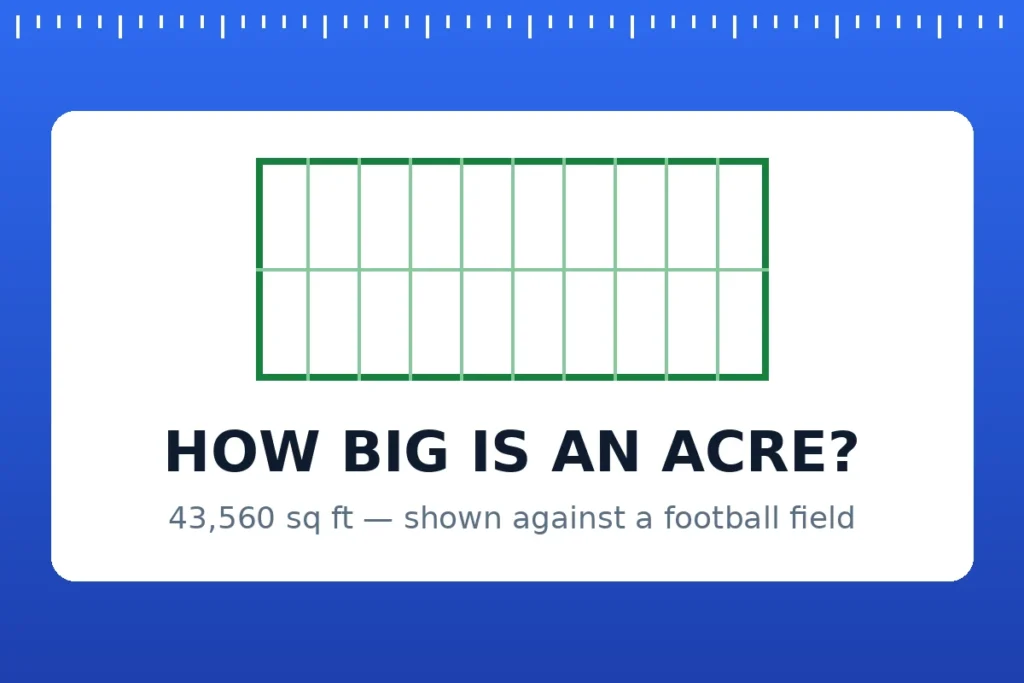
How Big Is an Acre? Visual Guide with Comparisons
Every property listing uses the same phrase: “set on a one-acre lot.” It sounds generous…
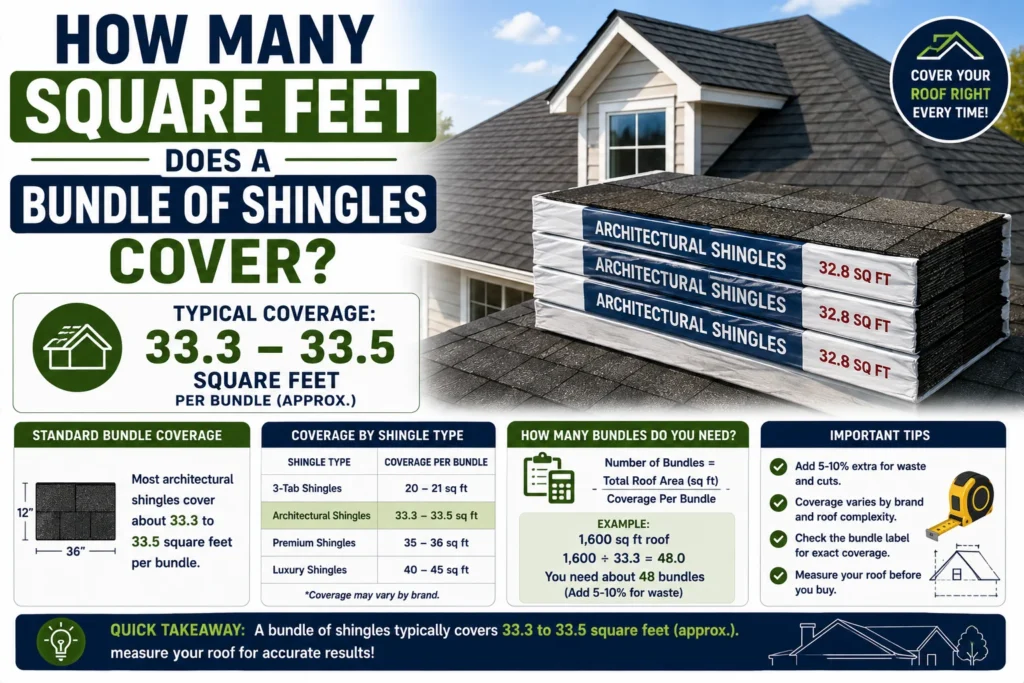
If you’re planning a roof replacement or trying to estimate roofing materials, one of the most important questions is, how many square feet does a bundle of shingles cover?
For standard asphalt roofing shingles, one bundle typically covers about 33.3 square feet of roof area when three bundles are used to make one roofing square.
However, coverage varies by shingle type and manufacturer. Some architectural shingles are packaged differently and may cover approximately 20 to 33 square feet per bundle, while specialty products can have different coverage requirements.
The most important number to check is the coverage listed on the shingle package.
A standard roofing square covers 100 square feet, so if a product requires three bundles per square, the calculation is:
100 ÷ 3 = 33.33 square feet per bundle
That means three standard bundles generally cover approximately 100 square feet before accounting for cutting and installation waste.
This is based on the common roofing standard:
Therefore:
100 ÷ 3 ≈ 33.3 square feet
However, don’t assume every bundle covers exactly 33.3 square feet. Always check the manufacturer’s packaging because shingle dimensions, exposure, weight, and packaging can differ.
A roofing square is a standard unit used by roofing professionals.
This doesn’t mean the roof has to be 10 feet by 10 feet. It simply refers to 100 square feet of roof surface area.
For example:
If a shingle product requires three bundles per square, then:
3 bundles × 33.3 sq ft ≈ 100 sq ft
A=lw
A=6×4=24
4 rows by 6 columns = 24 square units.
w
w
l
l24 square unitsw = 6l = 4
Give feedback
For many standard asphalt shingles:
Since one roofing square equals 100 square feet:
3 bundles ≈ 100 square feet
Therefore, one bundle covers approximately:
100 ÷ 3 = 33.3 square feet
But this is a common packaging arrangement, not a universal rule.
Some shingles may require more or fewer bundles per square.
Always check the manufacturer’s coverage information.
To estimate how many bundles you’ll need, start with your roof’s total surface area.
For a simple rectangular roof section:
Length × Width = Roof Area
For example:
40 feet × 30 feet = 1,200 square feet
1,200 ÷ 100 = 12 roofing squares
If the shingles require three bundles per square:
12 × 3 = 36 bundles
You may need additional material for:
For a simple roof, a waste allowance of around 10% is commonly used as a planning estimate, while complex roofs may require more.
A simple formula is:
For a 2,000-square-foot roof and 33.3 square feet of coverage per bundle:
2,000 ÷ 33.3 ≈ 60 bundles
Then add an allowance for waste.
Using a 10% allowance:
60 × 1.10 = 66 bundles
So you might plan for approximately 66 bundles for this simplified example.
The exact quantity should be based on the manufacturer’s coverage and the actual roof design.
Assuming one bundle covers approximately 33.3 square feet:
1,000 ÷ 33.3 ≈ 30 bundles
Therefore, approximately:
Before purchasing, you should account for waste and verify the manufacturer’s coverage.
With a 10% allowance:
30 × 1.10 = 33 bundles
So approximately 33 bundles could be planned for a simple 1,000-square-foot roof under these assumptions.
Using 33.3 square feet per bundle:
1,500 ÷ 33.3 ≈ 45 bundles
So approximately:
For a 10% waste allowance:
45 × 1.10 = 49.5
You would round up, giving approximately:
Again, actual requirements depend on the roof’s shape and the specific shingles.
At approximately 33.3 square feet per bundle:
2,000 ÷ 33.3 ≈ 60 bundles
So a 2,000-square-foot roof would require approximately:
With a 10% allowance:
60 × 1.10 = 66 bundles
Therefore, a practical estimate might be around:
for a relatively straightforward roof using a product with three bundles per roofing square.
Using approximately 33.3 square feet per bundle:
2,500 ÷ 33.3 ≈ 75 bundles
So:
With a 10% allowance:
75 × 1.10 = 82.5
You would round up to approximately:
for planning purposes.
At 33.3 square feet per bundle:
3,000 ÷ 33.3 ≈ 90 bundles
Therefore:
With a 10% allowance:
90 × 1.10 = 99 bundles
So you might plan for approximately:
on a relatively straightforward roof.
The following estimates assume approximately 33.3 square feet per bundle.
| Roof Area | Approx. Bundles Before Waste | With 10% Allowance |
|---|---|---|
| 500 sq ft | 15 | 17 |
| 750 sq ft | 23 | 25 |
| 1,000 sq ft | 30 | 33 |
| 1,250 sq ft | 38 | 42 |
| 1,500 sq ft | 45 | 50 |
| 2,000 sq ft | 60 | 66 |
| 2,500 sq ft | 75 | 83 |
| 3,000 sq ft | 90 | 99 |
| 3,500 sq ft | 105 | 116 |
| 4,000 sq ft | 120 | 132 |
These are estimates. The actual number of bundles should be calculated from the specific product’s coverage information.
Although three bundles per roofing square is common for asphalt shingles, manufacturers don’t necessarily package every product the same way.
Coverage can depend on:
For that reason, bundle count alone isn’t enough to determine coverage.
The package should tell you the approximate coverage or number of bundles required per roofing square.
Different asphalt shingle products can have different packaging and installation requirements.
Traditional 3-tab shingles commonly use approximately:
This corresponds to roughly:
Architectural or dimensional shingles can have different bundle coverage depending on the product.
Some may still use approximately three bundles per square, while others may require a different number.
Don’t assume that every architectural shingle bundle covers 33.3 square feet.
Check the product specifications before ordering.
This is an important point.
The square footage of the house’s floor or footprint is not necessarily the square footage of the roof.
A sloped roof has a larger surface area than the horizontal footprint beneath it.
For example, a house with a 1,500-square-foot footprint may have more than 1,500 square feet of actual roofing surface depending on:
That’s why roofing estimates should be based on the actual roof surface area, not simply the home’s floor area.
The steeper the roof, the greater the actual surface area can be compared with its horizontal footprint.
For example, a roof with a low slope and a roof with a steep pitch could cover the same building footprint but require different amounts of shingles.
Roof pitch is typically expressed as the number of inches the roof rises for every 12 inches of horizontal run.
Examples include:
A professional roofer can use the roof pitch and dimensions to determine the actual roof surface area.
Roofing waste varies considerably.
A simple gable roof may have relatively little waste, while a complex roof with multiple valleys, hips, dormers, and penetrations can produce substantially more waste.
A common planning allowance is around:
But this isn’t appropriate for every roof.
You may need more material when the roof has:
The roofer should determine an appropriate waste allowance for the specific project.
The shingles covering the main roof surface aren’t the only roofing materials required.
A complete roofing project may also require:
Some products are sold separately, while certain roofing systems may include specialized components.
Therefore, don’t calculate your entire roofing-material purchase using only the number of field-shingle bundles.
Starter shingles serve a different purpose from standard field shingles.
They are installed along roof edges and help provide proper sealing and protection.
Their quantity depends on the length of the roof edges rather than simply the total square footage.
Therefore, starter materials should be calculated separately.
Not always.
Ridge caps are installed along roof ridges and hips and may be packaged separately.
Their quantity depends on the linear feet of ridge and hip areas, not simply the total roof square footage.
This is why a complete roofing estimate involves more than calculating the number of field-shingle bundles.
A 10 × 10-foot roof area contains:
10 × 10 = 100 square feet
If one bundle covers approximately 33.3 square feet, you would need:
100 ÷ 33.3 ≈ 3 bundles
So approximately three bundles would be required for one roofing square before considering waste.
This illustrates why roofing professionals commonly describe materials in terms of squares.
There is no universal number.
The number of individual shingles in a bundle depends on:
Two different products can contain different numbers of shingles while still being designed to cover a similar roof area.
For this reason, coverage per bundle is more useful than simply counting individual shingles.
Roofing shingles are sometimes sold or transported based on weight, but weight alone isn’t a reliable way to determine coverage.
Different shingle products can have different weights and coverage.
For an accurate estimate, use the manufacturer’s stated:
When a roofing product says 3 bundles per square, it means approximately three bundles are required to cover one roofing square.
Since:
1 roofing square = 100 square feet
then:
3 bundles ≈ 100 square feet
and:
1 bundle ≈ 33.3 square feet
This is one of the easiest ways to understand standard asphalt shingle packaging.
A roofing square is not a physical square-shaped piece of material.
It is simply a measurement of roof area.
For example:
15 squares = 1,500 square feet
20 squares = 2,000 square feet
30 squares = 3,000 square feet
If a product requires three bundles per square:
20 squares × 3 = 60 bundles
To convert square feet to roofing squares:
For 1,000 square feet:
1,000 ÷ 100 = 10 squares
Therefore:
If three bundles are required per square:
10 × 3 = 30 bundles
2,000 ÷ 100 = 20 roofing squares
Therefore:
At three bundles per square:
20 × 3 = 60 bundles
before waste.
3,000 ÷ 100 = 30 squares
Therefore:
At three bundles per square:
30 × 3 = 90 bundles
before accounting for waste.
One of the biggest mistakes homeowners make is assuming that a 2,000-square-foot house requires shingles for exactly 2,000 square feet.
That’s not necessarily true.
A 2,000-square-foot home can have a roof surface larger than 2,000 square feet because of:
The actual roof area should be measured before purchasing shingles.
For a reliable estimate:
For a complicated roof, professional measurement is generally preferable to relying on a simple house-footprint calculation.
A typical bundle of asphalt shingles covers approximately 33.3 square feet when three bundles are required to cover one 100-square-foot roofing square. Actual coverage varies by product.
For many standard asphalt shingles, three bundles make one roofing square, which covers 100 square feet.
One roofing square contains exactly 100 square feet of roof area.
If each bundle covers approximately 33.3 square feet, you’ll need about 30 bundles before waste. With a 10% allowance, the estimate would be approximately 33 bundles.
At approximately 33.3 square feet per bundle, you’d need about 60 bundles before waste. With a 10% allowance, that’s approximately 66 bundles.
Yes. Roof pitch affects the actual surface area of a sloped roof. A roof’s horizontal footprint should not automatically be treated as its actual roofing area.
Usually, yes. Cutting and installation can create waste, and complicated roofs may require more material than simple roofs. A common planning allowance is around 10%, but the appropriate amount depends on the roof design.
Not necessarily. Starter materials and ridge caps may need to be calculated separately based on the roof’s edges, hips, and ridges.
So, how many square feet does a bundle of shingles cover?
For many standard asphalt roofing shingles:
This is based on the common roofing standard:
3 bundles = 1 roofing square
and:
1 roofing square = 100 square feet
Therefore:
100 ÷ 3 ≈ 33.3 square feet per bundle
However, 33.3 square feet is only a general estimate. Shingle coverage varies by manufacturer and product, so always check the package specifications before purchasing.
For a roofing project, remember to account for the actual roof surface area, roof pitch, cutting waste, valleys, hips, ridges, starter shingles, and other roofing materials. For a simple roof, you can start with the number of roofing squares and multiply by the manufacturer’s stated bundles-per-square requirement.
Every property listing uses the same phrase: “set on a one-acre lot.” It sounds generous…
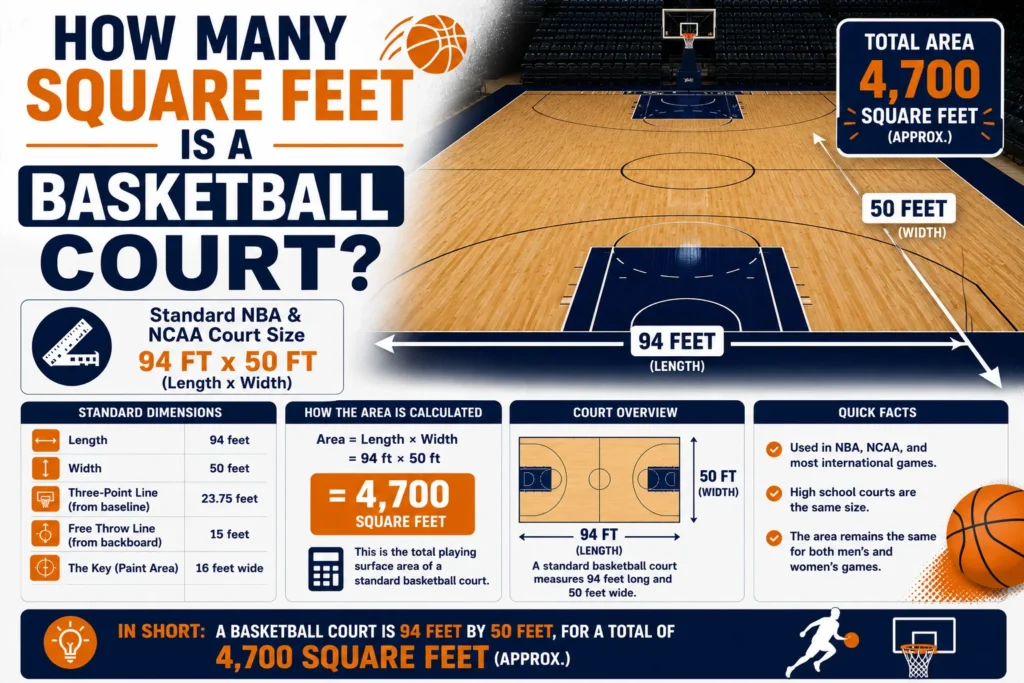
If you’re planning to build a basketball court, comparing gym sizes, estimating flooring requirements, or…
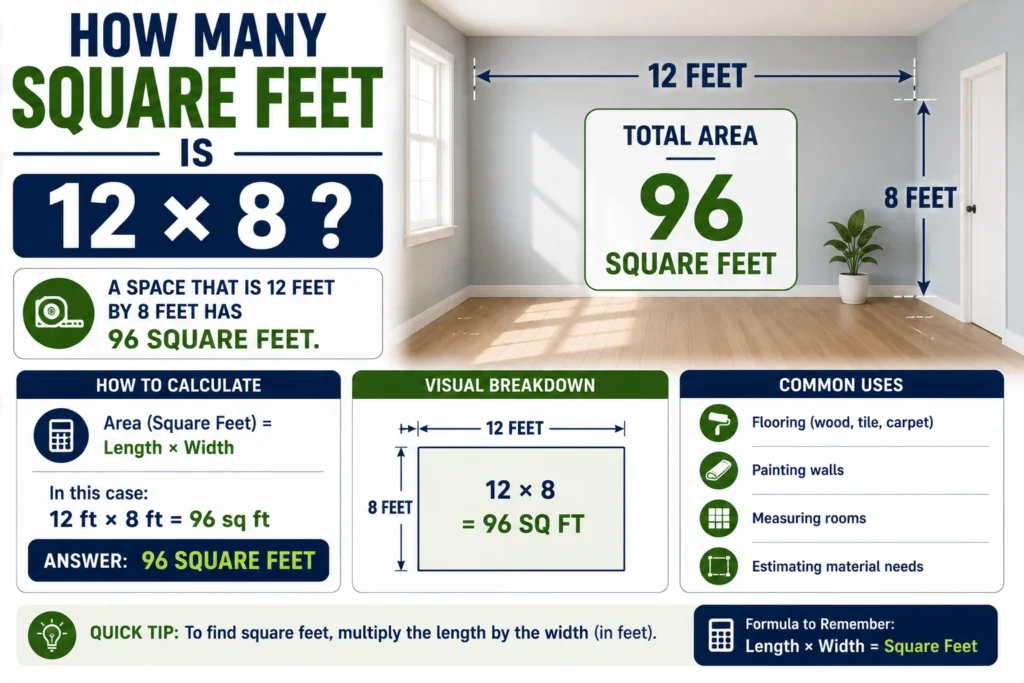
If you’re trying to determine how many square feet is 12 × 8, the calculation…