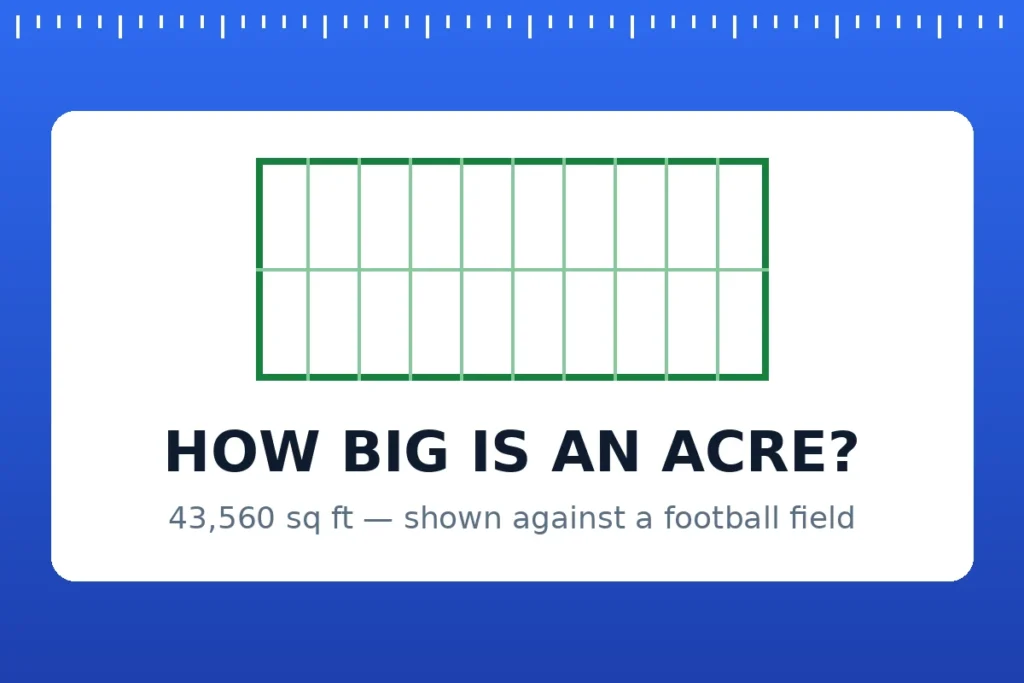
How Big Is an Acre? Visual Guide with Comparisons
Every property listing uses the same phrase: “set on a one-acre lot.” It sounds generous…
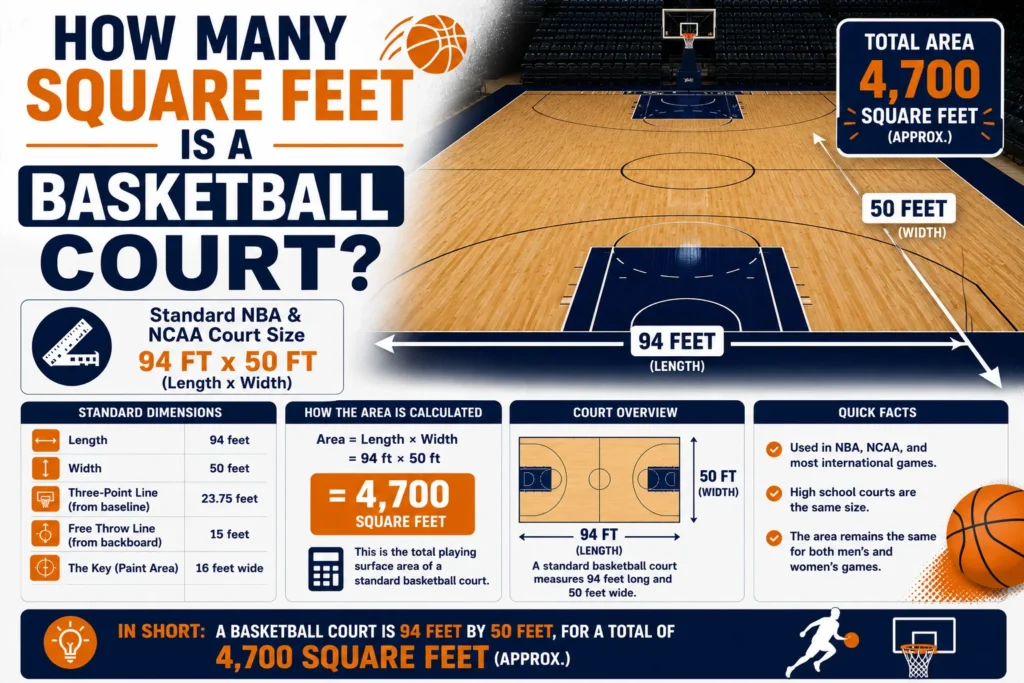
If you’re planning to build a basketball court, comparing gym sizes, estimating flooring requirements, or simply wondering how much space basketball requires, you may ask: how many square feet is a basketball court?
The answer depends on the level of basketball being played. NBA, college, high school, and international FIBA courts aren’t all exactly the same size.
An NBA basketball court is 94 feet long and 50 feet wide, giving it a playing area of:
The calculation is simple:
94 feet × 50 feet = 4,700 square feet
The NBA confirms that its court measures 94 feet long by 50 feet wide.
International FIBA courts are smaller. A standard FIBA playing court measures 28 meters by 15 meters, which is approximately 91.86 feet by 49.21 feet. That produces approximately 4,520.8 square feet of playing area.
So, if you’re looking for a quick answer, an official full-size basketball court generally covers about 4,500–4,700 square feet, depending on the governing organization.
It depends on the type of court:
| Basketball Court Type | Dimensions | Approx. Square Feet |
|---|---|---|
| NBA | 94 × 50 ft | 4,700 sq ft |
| FIBA | 28 × 15 m | 4,521 sq ft |
| High School | 84 × 50 ft* | 4,200 sq ft |
| Typical recreational court | Varies | Varies |
*High-school dimensions can be subject to the applicable rules and facility standards.
The most commonly referenced professional U.S. court is the NBA court, which is 4,700 square feet.
A basketball court is essentially a rectangle, so you can calculate its area using:
For an NBA court:
Area = 94 × 50
Area = 4,700 square feet
Therefore:
The same formula works for other court sizes.
For example, if a court measures 84 feet by 50 feet:
84 × 50 = 4,200 square feet
So the playing surface would be 4,200 square feet.
An official NBA basketball court measures:
The NBA’s own specifications identify the court as 94 feet by 50 feet.
Multiply the two dimensions:
94 × 50 = 4,700
This refers to the rectangular playing court itself, not the entire arena floor, seating area, benches, scorer’s table, aisles, or other surrounding space.
FIBA, the international governing body for basketball, uses a court measuring:
FIBA’s venue guide identifies the inner playing area as 28 meters long and 15 meters wide.
The area in metric units is:
28 × 15 = 420 square meters
To convert square meters to square feet:
420 × 10.7639 ≈ 4,520.8 square feet
Therefore:
This is smaller than the NBA court.
NBA:
4,700 sq ft
FIBA:
≈4,521 sq ft
The difference is approximately:
4,700 − 4,520.8 = 179.2 square feet
Although the two courts look similar, there is a measurable difference.
| Feature | NBA | FIBA |
|---|---|---|
| Length | 94 ft | 28 m ≈ 91.86 ft |
| Width | 50 ft | 15 m ≈ 49.21 ft |
| Area | 4,700 sq ft | ≈4,521 sq ft |
| Difference | — | ≈179 sq ft smaller |
The NBA itself notes that international basketball uses a smaller court than the NBA’s 94-by-50-foot court.
College basketball uses a court that is generally 94 feet long and 50 feet wide for NCAA play.
That produces:
94 × 50 = 4,700 square feet
The NCAA provides current basketball rules and full-court diagrams through its official rules resources.
Therefore, for a full-size NCAA court, you can use the same basic area calculation as an NBA court.
A common full-size U.S. high school basketball court measures approximately:
The area is:
84 × 50 = 4,200 square feet
The National Federation of State High School Associations (NFHS) maintains the rules and basketball court resources for U.S. high school competition.
Because school facilities and local rules can vary, check the applicable NFHS/state specifications when planning an official court.
Here’s a useful comparison:
| Court | Length | Width | Square Feet |
|---|---|---|---|
| NBA | 94 ft | 50 ft | 4,700 |
| NCAA | 94 ft | 50 ft | 4,700 |
| FIBA | 91.86 ft | 49.21 ft | ≈4,521 |
| High School | 84 ft | 50 ft | 4,200 |
| Half court, NBA dimensions | 47 ft | 50 ft | 2,350 |
These figures describe the rectangular playing surface.
If you divide an NBA court in half lengthwise:
94 ÷ 2 = 47 feet
A half court would therefore measure approximately:
47 × 50 feet
Calculate:
47 × 50 = 2,350 square feet
This doesn’t necessarily mean a home or recreational half court needs exactly 2,350 square feet of total property space. You also need room around the playing area for safety and movement.
If you’re asking about the actual playing surface, the answer depends on the court’s dimensions.
For example:
94 × 50 = 4,700 sq ft
84 × 50 = 4,200 sq ft
28 × 15 = 420 sq m ≈ 4,521 sq ft
Therefore, a standard full-size basketball court generally occupies somewhere around 4,200 to 4,700 square feet of playing surface, depending on the standard being followed.
The playing surface isn’t the only space required for a functional basketball facility.
A regulation court needs additional space around the boundaries for:
For example, FIBA’s venue guidance calls for a minimum 2-meter surrounding boundary area around the 28-by-15-meter inner playing area for the relevant facility configuration.
The NBA rule diagram also specifies minimum clearances around the court.
Therefore, don’t assume a 4,700-square-foot room is automatically large enough to build a regulation NBA court.
This distinction is important when planning a gymnasium.
The actual rectangular playing surface.
For an NBA court:
4,700 square feet
The court plus:
The total building can therefore be much larger than 4,700 square feet.
If you’re designing a facility, use the applicable governing body’s facility requirements rather than simply multiplying 94 by 50.
If you’re purchasing flooring for only the rectangular playing surface, an NBA court has:
However, you normally shouldn’t order exactly 4,700 square feet of flooring without considering:
For a real construction project, the flooring supplier or contractor should determine the final quantity.
An NBA court covers 4,700 square feet.
Since:
1 acre = 43,560 square feet
divide:
4,700 ÷ 43,560 ≈ 0.1079 acres
Therefore:
In other words, the playing surface is slightly more than one-tenth of an acre.
Using an NBA court:
43,560 ÷ 4,700 ≈ 9.27
So, based strictly on rectangular playing-surface area:
However, you could not realistically construct 9 complete courts on one acre because each court requires surrounding clearance and other facility space.
This calculation is useful only for comparing areas.
An NBA court measures:
94 feet × 50 feet
The area is:
4,700 square feet
To convert square feet to square meters:
4,700 × 0.092903 ≈ 436.64 square meters
Therefore:
For comparison, a FIBA court is exactly:
28 × 15 = 420 square meters
So the NBA court is approximately 16.6 square meters larger.
School basketball courts can vary.
A full-size high school court is commonly around:
based on 84 × 50 feet.
College courts are generally:
based on 94 × 50 feet.
Some school gyms may have courts that don’t exactly match competition dimensions, especially when the facility is designed for recreational use or multiple sports.
A basketball court is substantially larger than a standard tennis singles playing area but has different dimensions and purposes.
A full NBA basketball court is:
4,700 square feet
A regulation tennis court, including doubles playing lines, is approximately:
78 × 36 = 2,808 square feet
However, these are only the marked playing areas. Safety clearances around both courts require additional space.
A full American football field, including end zones, is:
120 yards × 53⅓ yards
That’s much larger than a basketball court.
An NBA basketball court is:
94 × 50 = 4,700 square feet
This comparison helps explain why basketball can be played in relatively compact indoor facilities while football requires a much larger playing area.
Besides the overall 94-by-50-foot dimensions, an NBA court contains numerous specific markings.
These include:
The NBA’s current rulebook provides the official court diagram and measurements.
The NBA also lists the free-throw line as 15 feet from the rim and provides specifications for the three-point arc.
No.
When calculating the area of the rectangular court, you simply use:
Length × Width
The basket, backboard, painted lines, free-throw circle, three-point arc, and other markings don’t change the basic rectangular area calculation.
The hoop is part of the equipment installed around the playing surface.
You don’t have to memorize every court size.
If you know the length and width, use:
For a 90-foot × 50-foot court:
90 × 50 = 4,500 square feet
For an 80-foot × 40-foot court:
80 × 40 = 3,200 square feet
For a 94-foot × 50-foot court:
94 × 50 = 4,700 square feet
This makes it easy to calculate the area of a custom recreational court.
That’s the NBA size, but not every basketball court follows NBA dimensions.
FIBA, high school, youth, and recreational courts can be different.
A 4,700-square-foot court doesn’t mean you need exactly a 4,700-square-foot building.
You’ll need additional clearance and facility space.
FIBA dimensions are given in meters, so you must convert square meters to square feet when comparing them with U.S. measurements.
When calculating a regulation court, use the specified playing-court dimensions rather than an unrelated wall-to-wall measurement.
A full-size basketball court typically covers about 4,200–4,700 square feet, depending on the standard. An NBA court is 4,700 square feet.
An NBA court is 94 feet × 50 feet, which equals 4,700 square feet.
A FIBA court measures 28 × 15 meters, or 420 square meters, which is approximately 4,521 square feet.
A full-size NCAA court is generally 94 × 50 feet, giving an area of 4,700 square feet. NCAA provides current full-court diagrams through its official basketball rules resources.
A common full-size high school court is 84 × 50 feet, which equals 4,200 square feet. Always verify the applicable state and NFHS specifications for an official facility.
Half of an NBA-style court is approximately 2,350 square feet.
An NBA court covers approximately 0.108 acre.
Based purely on playing-surface area, approximately 9.27 NBA courts equal one acre. Actual construction requires considerably more land because of safety clearances and other facility requirements.
So, how many square feet is a basketball court?
The answer depends on which basketball standard you’re talking about.
A regulation NBA court measures 94 feet by 50 feet, giving it:
A FIBA international court measures 28 by 15 meters, or approximately 4,521 square feet.
A common full-size high school court is approximately 4,200 square feet, while a full-size NCAA court is generally 4,700 square feet.
The basic calculation is always:
Length × Width = Square Feet
Remember that these figures describe the playing court itself. A complete gymnasium requires additional space around the court for player safety, seating, benches, officials, equipment, and other facility requirements. Therefore, anyone planning to build or renovate a basketball facility should use the applicable official specifications rather than relying solely on the court’s square footage.
Every property listing uses the same phrase: “set on a one-acre lot.” It sounds generous…
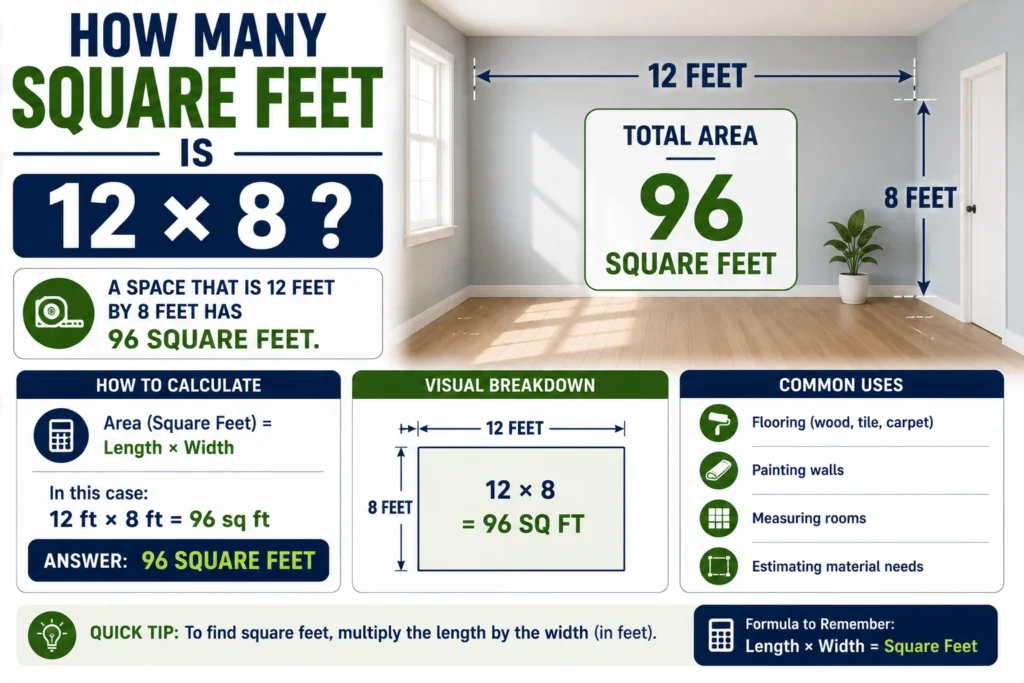
If you’re trying to determine how many square feet is 12 × 8, the calculation…
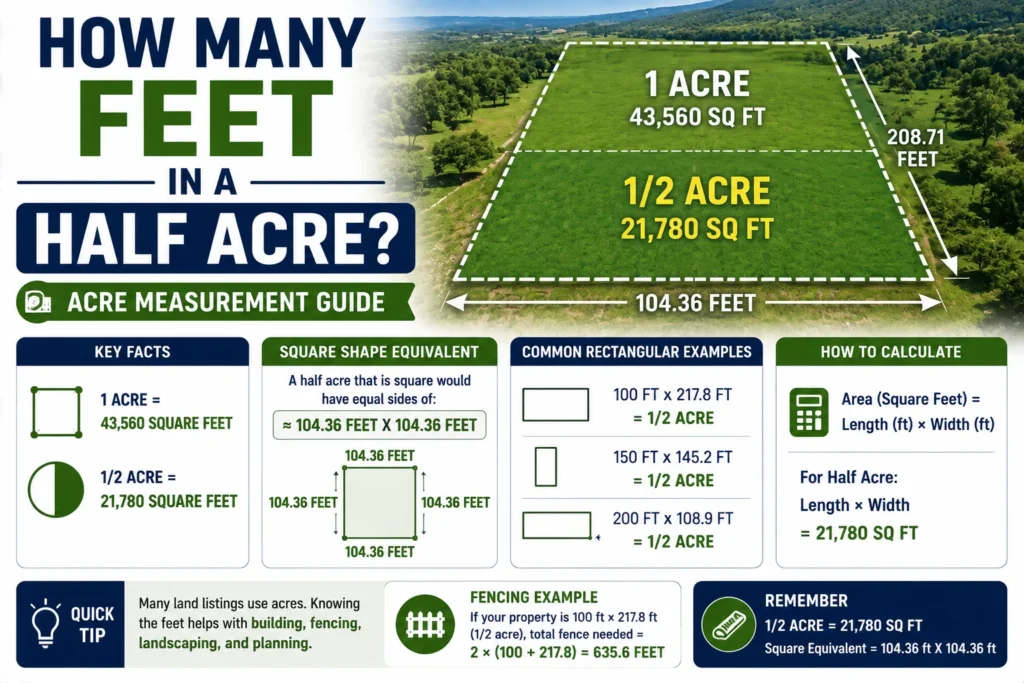
If you’re trying to determine how many feet in a half an acre, there’s an…