
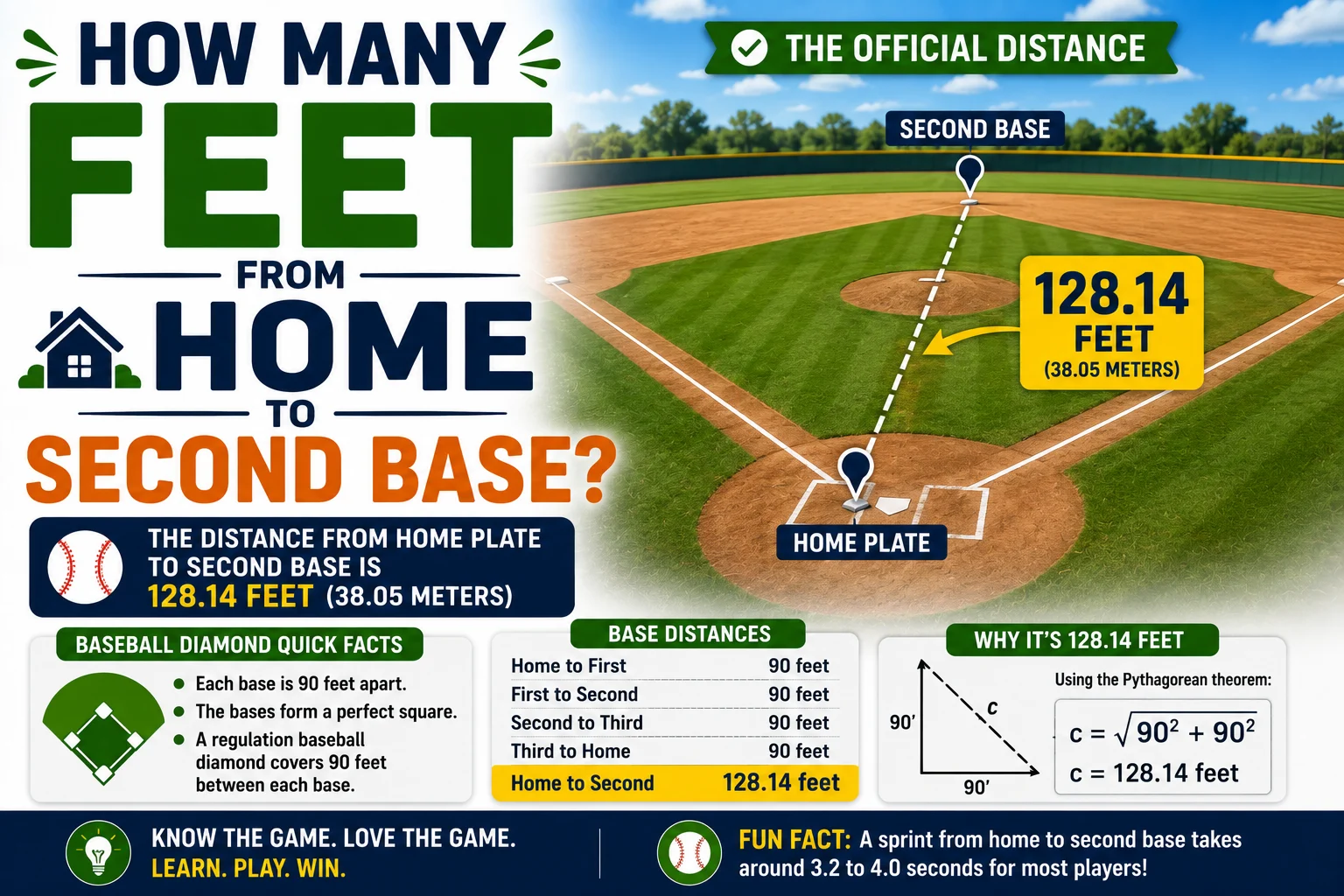
If you’ve ever watched a baseball game or helped set up a field, you may have wondered, “How many feet from home to second base?” It’s a common question among players, coaches, parents, and fans.
Unlike the distance between first and second base, which is measured along the base path, the distance from home plate to second base is measured diagonally across the infield. Because of this, the answer isn’t simply 180 feet.
On a Major League Baseball (MLB) field with 90-foot base paths, the distance from home plate to the center of second base is approximately 127 feet 3⅜ inches (127.28 feet).
In this guide, you’ll learn how this distance is calculated, how it changes across different leagues, and why it matters.
Quick Answer
For a regulation baseball field:
- Distance between bases: 90 feet
- Distance from home plate to second base: 127 feet 3⅜ inches (127.28 feet)
Quick Reference
| Measurement | Distance |
|---|---|
| Home to First | 90 ft |
| First to Second | 90 ft |
| Second to Third | 90 ft |
| Third to Home | 90 ft |
| Home to Second (Diagonal) | 127 ft 3⅜ in |
Why Isn’t the Distance 180 Feet?
Many people assume that because there are two 90-foot base paths between home plate and second base, the total distance is 180 feet. However, that’s only if you run from home to first and then to second.
The straight-line distance from home plate to second base crosses the baseball diamond diagonally.
Since the infield is a square, the diagonal is calculated using the Pythagorean theorem:
Diagonal = Side × √2
For a 90-foot baseball diamond:
90 × 1.4142 ≈ 127.28 feet
That equals 127 feet 3⅜ inches, the official MLB measurement.
Baseball Field Dimensions Explained
A regulation baseball diamond is a square with four bases.
Standard MLB Measurements
| Field Component | Distance |
|---|---|
| Home to First | 90 ft |
| First to Second | 90 ft |
| Second to Third | 90 ft |
| Third to Home | 90 ft |
| Pitcher’s Rubber to Home Plate | 60 ft 6 in |
| Home to Second | 127 ft 3⅜ in |
These dimensions are used in Major League Baseball, college baseball, and most high school leagues.
How to Calculate the Distance
The home-to-second measurement is based on geometry.
Formula
Diagonal = Side × √2
Where:
- Side = 90 feet
- √2 ≈ 1.4142
Calculation:
90 × 1.4142 = 127.28 feet
This formula works for any square baseball or softball field.
Distances by League
Different leagues use different base path lengths, so the home-to-second distance also changes.
| League | Base Path | Home to Second |
|---|---|---|
| MLB | 90 ft | 127 ft 3⅜ in |
| High School | 90 ft | 127 ft 3⅜ in |
| College | 90 ft | 127 ft 3⅜ in |
| Little League (Majors) | 60 ft | 84 ft 10 in |
| Pony Baseball | 70 ft | 98 ft 11 in |
As the base path increases, the diagonal distance increases proportionally.
Baseball vs. Softball
Softball fields are smaller than baseball fields.
Common Fastpitch Softball Dimensions
| Level | Base Path | Home to Second |
|---|---|---|
| Youth | 60 ft | 84 ft 10 in |
| High School | 60 ft | 84 ft 10 in |
| NCAA | 60 ft | 84 ft 10 in |
Because softball uses 60-foot base paths, the diagonal is approximately 84 feet 10 inches.
Why This Distance Matters
Knowing the distance from home plate to second base is important for:
Field Construction
Accurate measurements ensure the field meets league regulations.
Player Development
Coaches use field dimensions when teaching baserunning, throwing, and defensive positioning.
Groundskeeping
Maintenance crews rely on official measurements when laying out new fields.
Rules Compliance
Tournament and league play require correctly measured fields.
Real-World Example
Suppose you’re building a backyard baseball field with standard 90-foot base paths.
To place second base correctly:
- Measure 90 feet from home plate to first base.
- Measure 90 feet from first base to second.
- Or, measure 127 feet 3⅜ inches diagonally from home plate to second base.
Using the diagonal helps verify that your infield is perfectly square.
Common Mistakes
Confusing Running Distance with Straight-Line Distance
Running from home to first and then to second is 180 feet, but the direct diagonal from home to second is 127 feet 3⅜ inches.
Measuring to the Wrong Part of the Base
Official measurements are taken to the center of second base, not the front or back edge.
Using the Wrong Base Path
Little League and softball fields have shorter base paths, resulting in a shorter home-to-second distance.
Expert Tips
- Use a long measuring tape or surveyor’s tape for accuracy.
- Double-check diagonal measurements to ensure the infield is square.
- Follow your league’s official field dimensions.
- Replace worn bases regularly to maintain proper positioning.
- Use field layout guides when building a new diamond.
Fun Fact
The square shape of a baseball diamond means the diagonal is always √2 times longer than one side. This geometric relationship is why the home-to-second distance changes automatically whenever the base paths are lengthened or shortened.
FAQs
1. How many feet from home to second base in MLB?
The official distance is 127 feet 3⅜ inches (127.28 feet).
2. Why isn’t the distance 180 feet?
Because the official measurement is a straight-line diagonal across the infield, not the running path around first base.
3. How far is home to second base in Little League?
With 60-foot base paths, the distance is approximately 84 feet 10 inches.
4. Is the home-to-second distance the same in softball?
No. Most softball fields use 60-foot base paths, resulting in a home-to-second distance of about 84 feet 10 inches.
5. How do you calculate the distance from home to second base?
Multiply the base path by √2 (1.4142). For a 90-foot baseball field:
90 × 1.4142 = 127.28 feet.
Conclusion
If you’re asking how many feet from home to second base, the official answer for a regulation baseball field is 127 feet 3⅜ inches (127.28 feet). This measurement is based on the diagonal of a square with 90-foot base paths. Smaller leagues, such as Little League and most softball organizations, use shorter base paths, so the home-to-second distance is also shorter.
Whether you’re building a field, coaching a team, or simply curious about baseball dimensions, understanding these measurements ensures accuracy and a better appreciation of the game.