
How Many Feet Are in 1 Story? Average Building Height
If you’re wondering how many feet are in 1 story, there isn’t one exact number…
If you’re planning a trip to Ecuador or simply curious about one of South America’s most famous cities, you may be wondering:
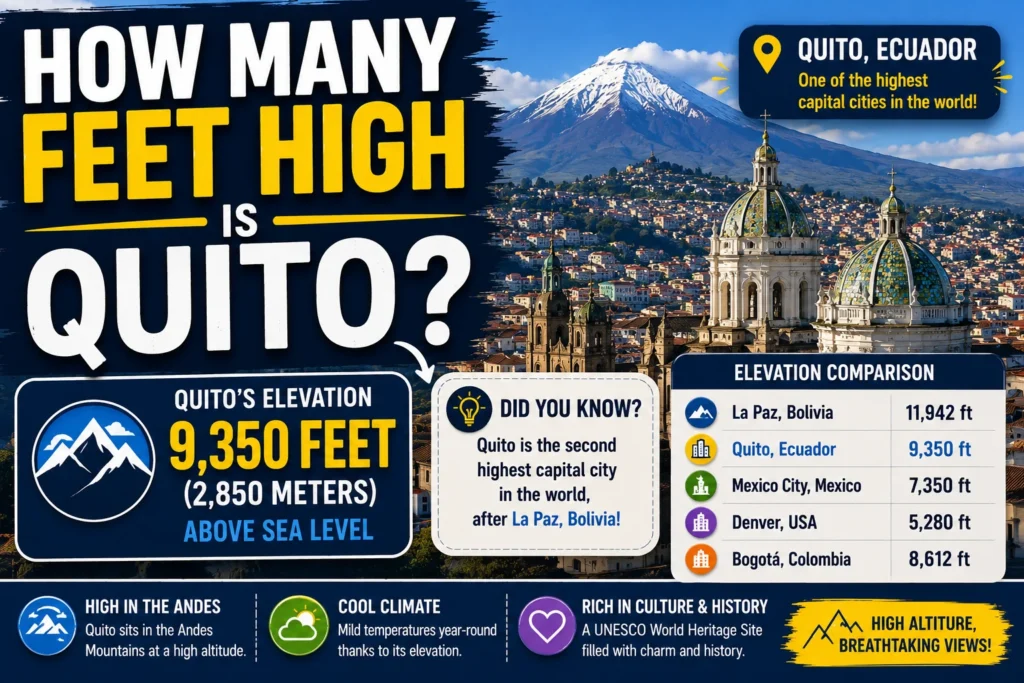
How many feet high is Quito?
Quito sits at an elevation of approximately:
9,350 feet (2,850 meters) above sea level.
Its remarkable altitude makes it one of the highest capital cities in the world. Because of its elevation, visitors often experience cooler temperatures, breathtaking mountain views, and thinner air than they would at sea level.
| Measurement | Elevation |
|---|---|
| Feet | 9,350 ft |
| Meters | 2,850 m |
Since Quito stretches across valleys and hills in the Andes Mountains, elevations vary slightly across different neighborhoods. However, 9,350 feet (2,850 meters) is the widely accepted average elevation.
Quito is the capital of Ecuador, located in northwestern South America.
The city sits within the Andes Mountain Range, one of the world’s longest mountain chains, and lies just south of the Equator.
Its unique location gives Quito:
Quito was built in a mountain valley surrounded by volcanic peaks.
Nearby mountains include:
These towering peaks contribute to the city’s dramatic scenery and high altitude.
Quito ranks among the world’s highest national capitals.
Here’s how it compares:
| Capital City | Approximate Elevation |
| La Paz, Bolivia (administrative capital) | 11,975 ft |
| Quito, Ecuador | 9,350 ft |
| Bogotá, Colombia | 8,660 ft |
| Thimphu, Bhutan | 7,650 ft |
Quito is widely recognized as the highest official constitutional capital city in the world.
At over 9,000 feet above sea level:
Many visitors notice:
Most healthy travelers adjust within a day or two.
Yes.
Because Quito sits at 9,350 feet, some visitors develop acute mountain sickness (AMS) shortly after arrival.
Common symptoms include:
Most cases are mild and improve as the body acclimates.
To reduce the effects of high altitude:
If symptoms become severe or worsen, seek medical attention promptly.
Although Quito is located near the Equator, its high elevation keeps temperatures comfortable throughout the year.
Typical temperatures include:
| Time | Temperature |
| Daytime | 60–70°F (16–21°C) |
| Night | 45–50°F (7–10°C) |
This pleasant weather has earned Quito the nickname:
“The City of Eternal Spring.”
Understanding Quito’s elevation is easier when compared with familiar cities.
| City | Elevation |
| Denver, Colorado | 5,280 ft |
| Mexico City | 7,350 ft |
| Bogotá | 8,660 ft |
| Quito | 9,350 ft |
| Cusco, Peru | 11,150 ft |
Quito is significantly higher than both Denver and Mexico City.
Visitors often explore:
A UNESCO World Heritage Site known for its colonial architecture and historic churches.
This cable car climbs to over 13,000 feet, offering panoramic views of the city and surrounding volcanoes.
A hilltop monument overlooking Quito.
The famous Equator monument located just north of the city.
The surrounding Andean region is home to:
Quito is an excellent base for hiking, birdwatching, and exploring Ecuador’s natural beauty.
If you’re visiting Quito:
These simple precautions can make your visit much more enjoyable.
Quito sits at approximately 9,350 feet (2,850 meters) above sea level.
Yes.
Quito is roughly 4,000 feet higher than Denver, Colorado.
Quito is one of the world’s highest capital cities and is widely recognized as the highest constitutional national capital.
Yes.
Some visitors experience mild altitude sickness, particularly during their first day.
Most people acclimate within 24 to 48 hours.
Its high elevation offsets its tropical latitude, creating mild temperatures throughout the year.
Yes.
The surrounding Andes Mountains offer excellent hiking opportunities, but visitors should acclimate before attempting strenuous climbs.
Fact: Days are generally mild, while mornings and evenings are cool.
Fact: Many visitors experience little or no discomfort, especially if they acclimate gradually.
Fact: Many cities are higher, but Quito is among the highest national capitals.
At 9,350 feet (2,850 meters) above sea level, Quito is one of the world’s highest capital cities. Its remarkable elevation contributes to its cool climate, spectacular mountain scenery, and unique travel experience. Whether you’re visiting the historic Old Town, riding the TelefériQo, or exploring nearby volcanoes, understanding Quito’s altitude will help you prepare for a safe, comfortable, and memorable trip.
If you’re wondering how many feet are in 1 story, there isn’t one exact number…
If you’ve ever wondered how many feet do low beam headlights illuminate, the answer depends…

If you’re planning to build a house, one of the most important material questions is…