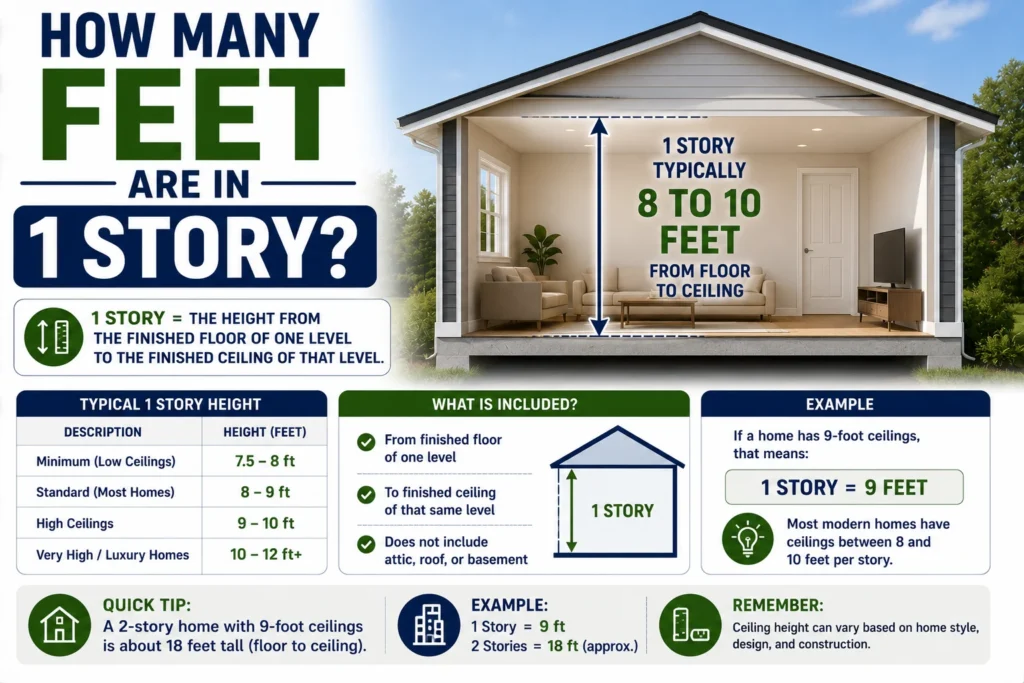
How Many Feet Are in 1 Story? Average Building Height
If you’re wondering how many feet are in 1 story, there isn’t one exact number…

Measurements are used every day, whether you’re measuring furniture, determining a person’s height, planning a home improvement project, or completing a school assignment. In the United States and other countries that use the Imperial system, inches and feet are among the most common units of length.
A frequently asked question is: How many feet is 42 inches?
While the answer is simple, understanding the conversion process can help you quickly convert other measurements as well. Knowing how inches and feet relate is useful for construction, interior design, education, sports, and everyday tasks.
In this comprehensive guide, you’ll learn exactly how many feet 42 inches equals, how to convert inches into feet, practical examples, real-world comparisons, conversion charts, and answers to frequently asked questions.
The exact conversion is:
42 inches = 3.5 feet
When expressed in feet and inches:
42 inches = 3 feet 6 inches
| Inches | Feet |
|---|---|
| 42 inches | 3.5 feet |
| 42 inches | 3 feet 6 inches |
This means that 42 inches is equal to three and a half feet.
Before converting measurements, it’s helpful to understand these units.
An inch is a unit of length in the Imperial and U.S. customary systems.
It is commonly used for measuring:
The abbreviation for inch is:
in
Examples:
A foot is a larger unit of length.
It is commonly used for measuring:
The abbreviation for foot is:
ft
Examples:
The standard conversion is:
1 foot = 12 inches
This simple relationship is the foundation of all inch-to-foot conversions.
Converting inches into feet is easy.
Feet = Inches ÷ 12
Simply divide the number of inches by 12.
To convert 42 inches into feet:
42 ÷ 12 = 3.5
Result:
42 inches = 3.5 feet
Many people prefer expressing measurements in feet and inches rather than decimal feet.
42 ÷ 12 = 3 remainder 6
3 feet = 36 inches
42 − 36 = 6
42 inches = 3 feet 6 inches
Written in standard format:
3’6″
This is often used for height and furniture dimensions.
A length of 42 inches appears frequently in homes, schools, and workplaces.
Examples include:
Because it equals exactly 3.5 feet, it is a convenient measurement to visualize.
Besides feet, you may need to convert 42 inches into other units.
Since:
1 inch = 2.54 cm
Calculation:
42 × 2.54 = 106.68
Result:
42 inches = 106.68 centimeters
Calculation:
106.68 ÷ 100 = 1.0668
Result:
42 inches = 1.07 meters
Since:
1 yard = 36 inches
Calculation:
42 ÷ 36 = 1.1667
Result:
42 inches = 1.17 yards
| Unit | Equivalent |
|---|---|
| Feet | 3.5 |
| Feet & Inches | 3’6″ |
| Centimeters | 106.68 |
| Meters | 1.07 |
| Yards | 1.17 |
Many people find measurements easier to understand when compared to familiar objects.
Many children between three and five years old are around 42 inches tall.
Many coffee tables and side tables are approximately 42 inches long.
Some office desks measure around 42 inches wide.
Many guitars are close to 42 inches in overall length.
At 106.68 cm, 42 inches is just over one meter.
Here are some everyday items that measure approximately 42 inches.
Many coffee tables are close to this length.
Compact desks often measure around 42 inches wide.
Several guitar models are approximately 42 inches long.
Many preschool-aged children are around 42 inches tall.
Certain television models have widths close to 42 inches.
There are many practical reasons.
People commonly express height in feet and inches.
Builders frequently convert inches into feet for easier planning.
Furniture dimensions are often easier to understand in feet.
Room layouts frequently use both inches and feet.
Students learn unit conversions as part of mathematics curricula.
The following chart provides common conversions near 42 inches.
| Inches | Decimal Feet | Feet & Inches |
|---|---|---|
| 36 | 3.0 | 3’0″ |
| 38 | 3.17 | 3’2″ |
| 40 | 3.33 | 3’4″ |
| 42 | 3.5 | 3’6″ |
| 44 | 3.67 | 3’8″ |
| 48 | 4.0 | 4’0″ |
| 54 | 4.5 | 4’6″ |
| 60 | 5.0 | 5’0″ |
This chart provides quick reference values for common measurements.
Shelves, cabinets, and furniture often use dimensions close to 42 inches.
Designers frequently work with measurements in both inches and feet.
Teachers use examples like 42 inches to demonstrate measurement conversions.
Product dimensions are often listed in inches and converted into feet for planning.
Consumers frequently compare dimensions when purchasing furniture or appliances.
Extend the tape measure until it reaches:
42 inches
This equals:
3 feet 6 inches
A yardstick measures:
36 inches
Add:
6 more inches
to reach 42 inches.
Each ruler measures:
12 inches
You would need:
3.5 rulers
to equal 42 inches.
Always remember:
Feet = Inches ÷ 12
3.5 feet does not mean 3 feet 5 inches.
Instead:
0.5 foot = 6 inches
Therefore:
3.5 feet = 3 feet 6 inches
Avoid confusing:
Complete calculations before rounding values.
Remember:
1 foot = 12 inches
Since:
6 inches = 0.5 foot
42 inches becomes:
3 feet + 6 inches
or
3.5 feet.
Coffee tables and guitars provide useful visual references.
Examples:
Regular practice improves conversion skills.
42 inches equals exactly 3.5 feet.
42 inches equals 3 feet 6 inches.
Yes.
42 inches equals exactly 3.5 feet.
42 inches equals 106.68 centimeters.
42 inches equals approximately 1.07 meters.
Divide the number of inches by 12.
The answer to “How many feet is 42 inches?” is:
42 inches = 3.5 feet
or, in standard feet-and-inches format:
42 inches = 3 feet 6 inches
Using the formula:
Feet = Inches ÷ 12
you can quickly convert any inch measurement into feet.
Whether you’re measuring furniture, checking a child’s height, planning a renovation project, shopping for household items, or studying mathematics, understanding that 42 inches equals 3.5 feet provides a useful and practical reference.
Knowing these conversions makes it easier to work confidently with measurements in everyday life.
If you’re wondering how many feet are in 1 story, there isn’t one exact number…

If you’ve ever wondered how many feet do low beam headlights illuminate, the answer depends…
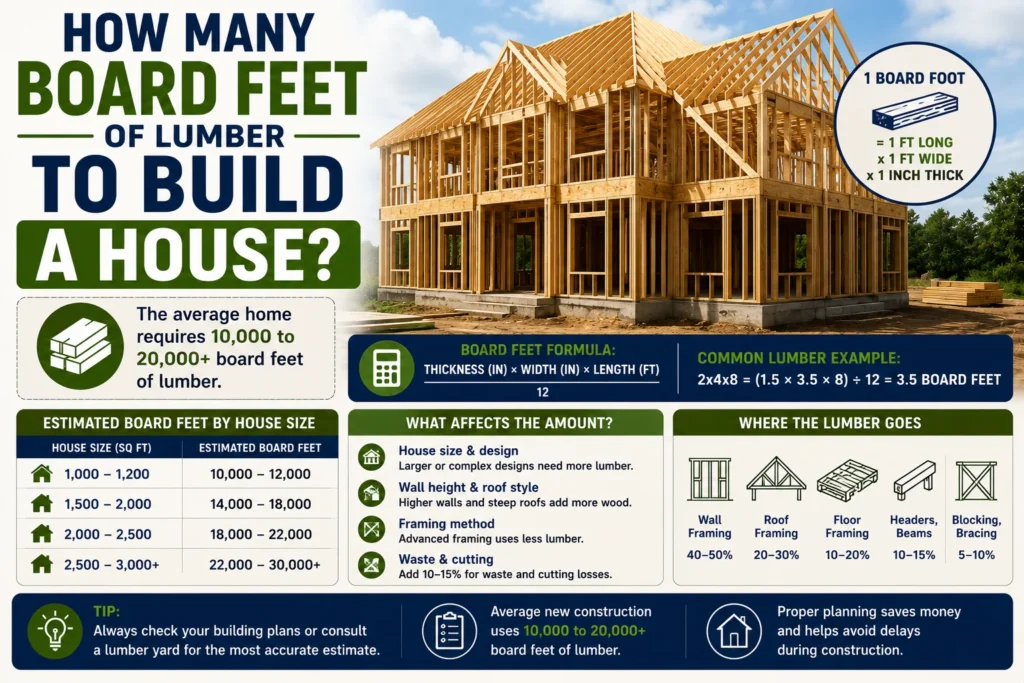
If you’re planning to build a house, one of the most important material questions is…