
How Many Feet Are in 1 Story? Average Building Height
If you’re wondering how many feet are in 1 story, there isn’t one exact number…
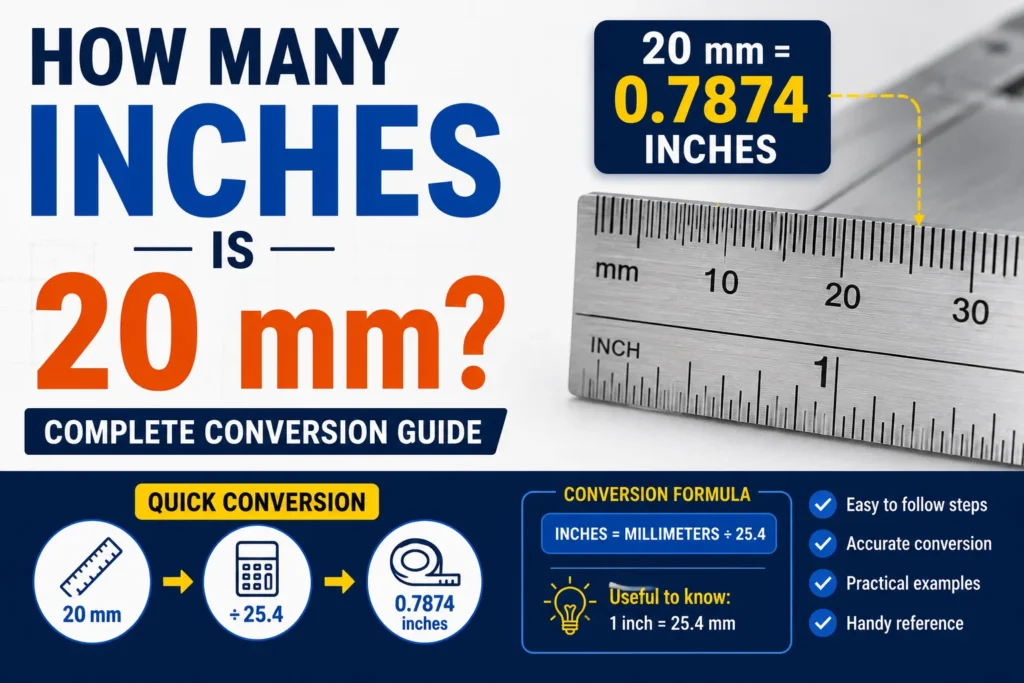
Here’s a myth worth busting right away: 20 mm is not “about an inch.” People round it up all the time, order the wrong drill bit or the wrong watch strap, and only find out when the part doesn’t fit. An inch is 25.4 mm, so 20 mm falls noticeably short of it. How short, exactly? Let’s pin it down properly — with coins, of all things.
Quick Answer: 20 mm equals 0.7874 inches — about 0.79 in, or roughly 25/32 of an inch. It’s also exactly 2 cm.
Coins are brilliant for this because their sizes are exact and you probably have one within reach. A US dime is 17.91 mm across, so 20 mm is just a touch wider than a dime. A US quarter is 24.26 mm across, which makes 20 mm a bit smaller than a quarter. So the picture is simple: bigger than a dime, smaller than a quarter, sitting much closer to the quarter.
Your own hand gives you a second reference. An adult thumbnail is roughly 20 mm wide — hold yours up and you’re looking at almost exactly this measurement. And for length rather than width: a AAA battery is 44.5 mm long, so 20 mm is a little under half of one.
Each bar below is drawn in proportion, on a 25 mm scale:
That small gap between the blue bar and the quarter is exactly the gap that catches people out when they guess “about an inch.”
One inch is defined as exactly 25.4 mm. So to turn any millimeter value into inches, you divide by 25.4:
20 ÷ 25.4 = 0.7874 inches
If decimals feel unfriendly, the fraction version is handy in a workshop: 0.7874 in is very close to 25/32 in (which is 0.78125 in) and a shade under 13/16 in (0.8125 in). For tape-measure work, most people round to “just over 3/4 of an inch” and then check the fit, because 3/4 in is 19.05 mm — close, but about a millimeter short.
| Millimeters | Inches (decimal) | Nearest fraction | Centimeters |
|---|---|---|---|
| 5 mm | 0.1969 in | 3/16 in | 0.5 cm |
| 10 mm | 0.3937 in | 13/32 in | 1 cm |
| 15 mm | 0.5906 in | 19/32 in | 1.5 cm |
| 20 mm | 0.7874 in | 25/32 in | 2 cm |
| 25 mm | 0.9843 in | 63/64 in | 2.5 cm |
| 30 mm | 1.1811 in | 1 3/16 in | 3 cm |
Converting a size just below or above this one? We have the same treatment for how many inches 15 mm is and for how many inches 25 mm is — that last one really is nearly an inch, which is why 20 mm confuses people by comparison.
Watch straps are the classic case. Many watches use a 20 mm lug width, and a strap that’s 2 mm off simply won’t sit right between the lugs. Jewelry is another: 20 mm is a common pendant and hoop size, where the difference between 20 and 25 mm is clearly visible on the neck. In DIY, 20 mm appears on drill bits, dowels, pipe fittings and cable glands — all places where “close enough” leaks, wobbles or won’t thread.
Tiny measurements reward the same care. Our guide to the 2 mm size shows how much difference a few millimeters make at the small end of the scale, and if you convert sizes often, the converter on the MeasurScale homepage handles mm, cm and inches in one place. For more conversions like this, browse the Length & Inches guides.
If you’re measuring a small part at home, a ruler’s millimeter marks are fine, but read them carefully: line the zero up with one edge, keep your eye directly above the mark, and read the far edge without guessing between lines. For bolts, beads or watch lugs, cheap digital calipers are far better — they read to a tenth of a millimeter and remove the squinting entirely.
One practical tip: if a listing gives a size in inches and your part is metric, convert the part, not just the listing. A hole drilled at 13/16 in (20.64 mm) gives a 20 mm dowel a loose, sloppy fit. That half-millimeter of play is invisible on paper and obvious in your hands.
Yes, slightly. 3/4 inch is 19.05 mm, so 20 mm is about 0.95 mm — roughly a millimeter — bigger. For rough work they’re interchangeable; for fitted parts, they’re not.
Exactly 2 cm. Move the decimal one place: millimeters divided by 10 gives centimeters.
Between US coins, the quarter (24.26 mm) is too big and the dime (17.91 mm) is too small — 20 mm sits between them, nearer the quarter. If you need a quick visual, your thumbnail is the closest everyday match.
Yes. 0.7874 inches is the exact conversion, so a strap sold as 20 mm and one sold as roughly 0.79 in are the same size. Just don’t substitute a 22 mm strap — that 2 mm difference will not squeeze into 20 mm lugs.
If you’re wondering how many feet are in 1 story, there isn’t one exact number…

If you’ve ever wondered how many feet do low beam headlights illuminate, the answer depends…

If you’re planning to build a house, one of the most important material questions is…