
How Many Feet Are in 1 Story? Average Building Height
If you’re wondering how many feet are in 1 story, there isn’t one exact number…
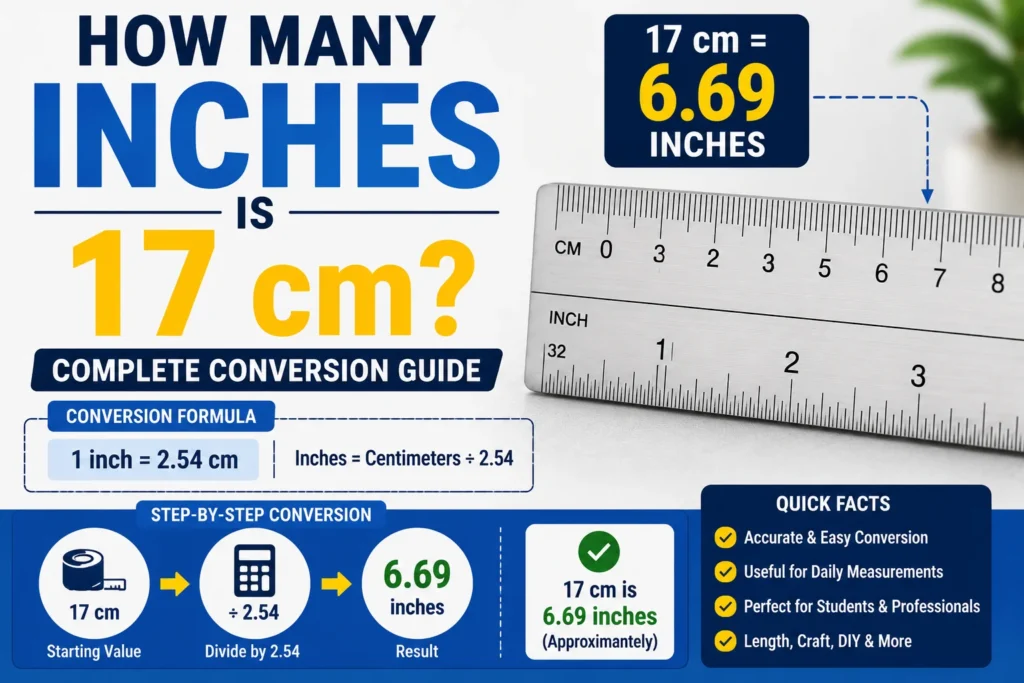
Measurements are used in countless everyday situations, from shopping online and decorating your home to completing school assignments and working on DIY projects. Since different countries use different measurement systems, understanding how to convert between centimeters and inches can be extremely useful.
One common question people ask is: How many inches is 17 cm?
Whether you’re measuring a product, comparing dimensions, or simply satisfying your curiosity, knowing the exact conversion helps you make accurate decisions. In this comprehensive guide, you’ll learn how to convert 17 centimeters into inches, understand the formula behind the calculation, explore real-life examples, and discover practical applications of this measurement.
The exact conversion is:
17 cm = 6.6929 inches
Rounded to two decimal places:
17 cm = 6.69 inches
For quick estimates:
17 cm ≈ 6.7 inches
| Centimeters | Inches |
|---|---|
| 17 cm | 6.6929 inches |
| 17 cm | 6.69 inches (rounded) |
| 17 cm | About 6.7 inches |
This means that 17 centimeters is slightly longer than 6½ inches and just under 7 inches.
Before performing conversions, it’s helpful to understand these two measurement units.
A centimeter (cm) is a metric unit of length.
It is commonly used for measuring:
Metric relationships include:
Most countries use the metric system as their standard measurement system.
An inch is a unit of length in the Imperial and U.S. customary systems.
It is commonly used for measuring:
Imperial relationships include:
The United States primarily uses inches and feet for everyday measurements.
Converting centimeters into inches is straightforward.
Inches = Centimeters ÷ 2.54
This formula works because:
1 inch = exactly 2.54 centimeters
To convert 17 cm into inches:
17 ÷ 2.54 = 6.6929
Result:
17 cm = 6.6929 inches
Rounded:
17 cm = 6.69 inches
The conversion factor of 2.54 is internationally recognized.
By official definition:
1 inch = exactly 2.54 centimeters
This standard is used worldwide in:
Because the value is exact, centimeter-to-inch conversions are highly accurate.
Besides inches, you may need to convert 17 centimeters into other units.
Since:
1 cm = 10 mm
Calculation:
17 × 10 = 170
Result:
17 cm = 170 millimeters
Since:
100 cm = 1 meter
Calculation:
17 ÷ 100 = 0.17
Result:
17 cm = 0.17 meters
Since:
1 foot = 30.48 cm
Calculation:
17 ÷ 30.48 = 0.5577
Result:
17 cm ≈ 0.56 feet
Since:
1 yard = 91.44 cm
Calculation:
17 ÷ 91.44 = 0.186
Result:
17 cm ≈ 0.19 yards
| Unit | Equivalent |
|---|---|
| Inches | 6.69 |
| Millimeters | 170 |
| Meters | 0.17 |
| Feet | 0.56 |
| Yards | 0.19 |
Many people understand measurements more easily when compared to familiar objects.
Many modern smartphones are between 15 and 17 cm long.
Numerous television remotes measure around 17 cm in length.
Some cooking utensils have handles approximately this long.
Certain compact tablets have dimensions close to 17 cm.
Since 17 cm equals approximately 6.69 inches, it is just under 7 inches long.
Here are some everyday objects that are approximately 17 centimeters long.
Many remote controls fall within the 15–18 cm range.
Larger smartphone models often measure around 17 cm in height.
Cooking spoons and spatulas may be close to this length.
Many pocket notebooks have dimensions near 17 cm.
Certain travel-sized hairbrushes measure around 17 cm long.
There are many practical reasons.
Products from different countries often use different measurement systems.
Converting dimensions helps ensure furniture fits properly.
DIY and renovation projects often involve both metric and imperial measurements.
Students frequently encounter measurement conversions in mathematics and science.
Conversions make it easier to compare products sold globally.
The following chart provides common conversions near 17 cm.
| Centimeters | Inches |
|---|---|
| 10 cm | 3.94 in |
| 12 cm | 4.72 in |
| 14 cm | 5.51 in |
| 15 cm | 5.91 in |
| 16 cm | 6.30 in |
| 17 cm | 6.69 in |
| 18 cm | 7.09 in |
| 19 cm | 7.48 in |
| 20 cm | 7.87 in |
| 25 cm | 9.84 in |
This chart provides quick reference values without requiring calculations.
Many electronic accessories measure around 17 cm.
Examples include:
Craft projects often involve measurements near this size.
Product packaging frequently uses dimensions around 17 cm.
Students regularly measure objects within this range.
Many household items list dimensions in centimeters, making conversions useful.
Always remember:
Inches = Centimeters ÷ 2.54
Do not multiply by 2.54 when converting centimeters into inches.
Complete the calculation before rounding the final answer.
Avoid confusing:
Although 17 cm is approximately 6.69 inches, the exact value is 6.6929 inches.
Remember:
1 inch = 2.54 cm
This forms the foundation of all centimeter-to-inch conversions.
This estimate is useful for quick mental calculations.
Many measuring tapes include both centimeters and inches.
These tools make conversions easy.
Examples:
Regular practice improves measurement skills.
17 cm equals exactly 6.6929 inches.
Not exactly. It is slightly less than 7 inches.
Divide the number of centimeters by 2.54.
17 cm equals 170 millimeters.
Yes. It is slightly longer than 6.5 inches.
Because one inch is officially defined as exactly 2.54 centimeters.
The answer to “How many inches is 17 cm?” is:
17 cm = 6.6929 inches
or approximately:
17 cm = 6.69 inches
For quick estimates, you can think of 17 centimeters as about 6.7 inches long or just under 7 inches.
By remembering the formula:
Inches = Centimeters ÷ 2.54
you can quickly convert centimeters into inches whenever needed.
Whether you’re measuring household items, shopping online, comparing product dimensions, working on a DIY project, or studying measurement systems, understanding that 17 cm equals approximately 6.69 inches provides a practical reference for everyday situations.
If you’re wondering how many feet are in 1 story, there isn’t one exact number…

If you’ve ever wondered how many feet do low beam headlights illuminate, the answer depends…

If you’re planning to build a house, one of the most important material questions is…