

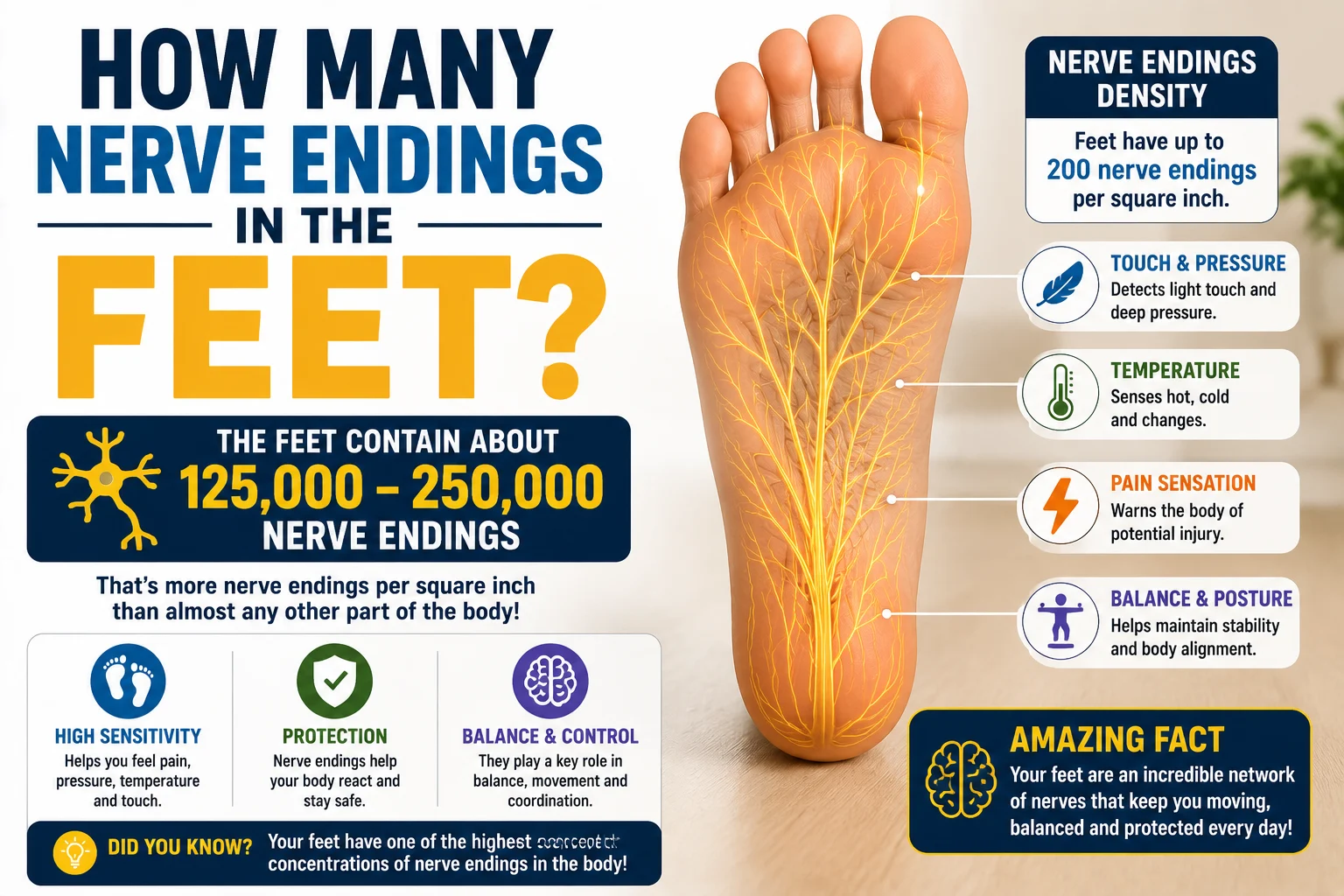
The human feet are remarkably sensitive. They help us feel the ground beneath us, recognize pressure and texture, maintain balance, and quickly respond when something is hot, cold, sharp, or painful. This leads to a common question: how many nerve endings in the feet are there?
The important answer is that there is no scientifically established exact number of individual nerve endings in the human feet.
The feet contain an extensive network of sensory nerves and specialized receptors, but researchers do not generally describe the foot as having one fixed number of nerve endings. The number and density of sensory receptors vary by location, receptor type, individual anatomy, age, and other factors.
You may encounter claims online that the feet contain a specific number of nerve endings. Such numbers should be treated cautiously unless they come from a specific anatomical study using a clearly defined measurement method.
Instead of focusing on one exact number, it is more useful to understand what these sensory nerves do, where they are concentrated, and why the feet can be so sensitive.
Quick Answer
There is no universally accepted exact number of nerve endings in the human feet.
The feet contain numerous sensory nerve fibers and specialized sensory receptors that allow you to detect:
- Touch
- Pressure
- Vibration
- Pain
- Temperature
- Stretch
- Movement
- Changes in position
The soles and toes are especially important for sensory feedback because they constantly interact with the ground and help the nervous system control posture and movement.
Why Is There No Exact Number?
The phrase “nerve endings” can refer to several different anatomical structures.
A nerve is not simply a cable with a fixed number of endpoints. Sensory nerves branch throughout tissues and connect with different types of receptors and nerve terminals.
For this reason, counting every individual nerve ending in a living human foot would be extremely difficult.
Several factors make an exact count impractical:
Different Types of Receptors
The foot contains multiple types of sensory receptors. Some detect mechanical forces, while others respond to temperature or potentially damaging stimuli.
Different Locations
The density of sensory receptors isn’t identical throughout the foot.
The sole, toes, heel, and top of the foot have different sensory roles.
Individual Differences
Human anatomy varies from person to person.
Different Measurement Methods
A study counting nerve fibers, receptor structures, or microscopic nerve terminals would not necessarily produce the same result.
Because of these differences, saying that every human foot contains exactly a particular number of nerve endings can be misleading.
What Nerve Endings Do in the Feet
The sensory system in your feet provides your brain with constant information about the environment.
Touch and Pressure
When your bare foot touches the floor, sensory receptors detect mechanical forces.
They help you determine whether you’re standing on:
- Carpet
- Tile
- Grass
- Sand
- Concrete
- A soft surface
- A hard surface
These signals allow the brain to understand what is happening beneath your feet.
Temperature
Sensory nerve endings also help detect changes in temperature.
For example, when you step into warm water, sensory receptors respond to the temperature and send information through peripheral nerves toward the nervous system.
This helps you distinguish between comfortable and potentially harmful temperatures.
Pain
Specialized sensory nerve endings called nociceptors respond to potentially damaging stimuli.
If you accidentally step on something sharp, these receptors can generate signals that travel through nerves toward the spinal cord and brain.
The resulting pain sensation encourages you to remove your foot quickly.
This is an important protective function.
Position and Movement
Your feet also provide information about body position and movement.
This sensory feedback is often called proprioception.
It helps your nervous system understand things such as:
- Where your foot is positioned
- How your ankle is moving
- How much pressure you’re putting on your foot
- Whether your body is shifting forward or backward
This information is important for walking, running, standing, and maintaining balance.
Why Are the Feet So Sensitive?
The feet have a demanding sensory job.
Every time you walk, your nervous system receives information from the soles and other parts of the feet.
Your brain uses these signals to make rapid adjustments.
For example, walking over an uneven surface requires your body to constantly adapt.
The sensory system helps detect:
- Changes in pressure
- Changes in surface angle
- Movement of the ankle and toes
- Distribution of body weight
- Contact with the ground
This information contributes to balance and coordinated movement.
Where Are Nerve Endings Concentrated?
Sensory receptor density varies across the foot.
Soles of the Feet
The sole plays a major role in detecting contact with the ground.
It receives information about pressure, texture, vibration, and movement.
This is one reason the soles can be highly sensitive to certain types of touch.
Toes
The toes also provide important sensory information.
They contribute to balance and help detect contact with surfaces.
The tips of the toes can be particularly sensitive to pressure and pain.
Heels
The heel experiences substantial mechanical loading when walking and standing.
Sensory feedback from this area helps the nervous system understand how weight is being distributed through the foot.
Top of the Foot
The top of the foot also contains sensory nerves, although its sensory role differs from that of the weight-bearing sole.
Touch or pressure in this area can still be detected clearly.
Types of Sensory Receptors in the Feet
Different receptors perform different jobs.
| Receptor / Sensory Structure | Main Function |
|---|---|
| Mechanoreceptors | Detect touch, pressure, stretch, and vibration |
| Nociceptors | Detect potentially damaging stimuli and contribute to pain |
| Thermoreceptors | Detect temperature changes |
| Proprioceptive receptors | Provide information about position and movement |
| Free nerve endings | Involved in several sensory functions, including pain and temperature |
These receptors don’t all work in the same way.
Together, they create a detailed sensory picture of what is happening around and within the foot.
How Foot Nerves Send Signals to the Brain
The process can be simplified into several steps.
Step 1: A Stimulus Occurs
You step on a surface, touch something hot, or place pressure on your foot.
Step 2: Sensory Receptors Respond
Specialized receptors detect the stimulus.
Step 3: Nerve Signals Travel
Electrical signals travel along sensory nerve fibers.
Step 4: Signals Reach the Central Nervous System
Information travels through peripheral nerves toward the spinal cord and brain.
Step 5: The Brain Interprets the Signal
Your brain identifies the sensation.
You may perceive:
- Pressure
- Touch
- Heat
- Cold
- Pain
- Vibration
- Position
This happens rapidly, allowing your body to respond to changes in the environment.
Factors That Affect Foot Sensitivity
Not everyone experiences foot sensations in exactly the same way.
Several factors can influence sensitivity.
Age
Sensory function can change with age.
Skin Thickness
The thickness and condition of the skin can influence how certain stimuli are perceived.
Temperature
Cold can alter the way nerves and tissues respond to sensory input.
Pressure
Repeated pressure can temporarily change sensation.
Footwear
Shoes can reduce direct sensory feedback from the ground.
Walking barefoot usually provides different sensory information than walking in thick-soled footwear.
Individual Anatomy
People naturally differ in nerve distribution, skin characteristics, and sensory perception.
Common Myths About Foot Nerve Endings
Myth 1: Every Foot Has an Exact Number
There isn’t a universally accepted number that applies to every person.
Nerve distribution and receptor density vary.
Myth 2: All Nerve Endings Detect Pain
Not all sensory receptors perform the same function.
Some specialize in mechanical stimuli, while others respond to temperature or potentially damaging stimuli.
Myth 3: More Nerve Endings Always Mean More Pain
Sensitivity isn’t determined by receptor count alone.
The type of receptor, stimulus, nervous-system processing, and individual factors all matter.
Myth 4: The Sole Is the Only Sensitive Part
The sole is highly important for sensory feedback, but sensory nerves are distributed throughout the foot.
Why Foot Sensation Matters for Balance
Your feet act as an important source of information about your relationship with the ground.
When standing, your body makes small adjustments constantly.
Sensory information from the feet contributes to these adjustments.
For example, if your weight shifts toward one side, sensory signals can help the nervous system detect the change.
Your brain can then coordinate muscles to help maintain stability.
This is one reason foot sensation is important for:
- Walking
- Running
- Standing
- Climbing stairs
- Changing direction
- Maintaining balance
When Changes in Foot Sensation May Matter
A temporary change in sensation can occur for many ordinary reasons, such as sitting in a position that places pressure on a nerve.
However, persistent or unexplained changes in foot sensation can have many possible causes and may deserve professional evaluation.
Examples of changes include:
- Persistent numbness
- Ongoing tingling
- Burning sensations
- Unusual sensitivity
- Reduced ability to feel temperature
- Loss of sensation
- Persistent pain
The cause cannot be determined from symptoms alone. If sensory changes are persistent, worsening, or concerning, a qualified healthcare professional can assess them appropriately.
FAQs
1. How many nerve endings are in the feet?
There is no universally accepted exact number of nerve endings in the human feet. The feet contain extensive sensory nerve networks and many different types of receptors.
2. Do feet have a lot of nerve endings?
Yes. The feet contain numerous sensory nerves and receptors that help detect touch, pressure, vibration, temperature, pain, and position.
3. Why are the bottoms of the feet so sensitive?
The soles provide important sensory information about contact with the ground. Their sensory receptors help detect pressure, texture, vibration, and other mechanical changes.
4. Do the toes have nerve endings?
Yes. The toes contain sensory nerves and receptors that help detect touch, pressure, temperature, and potentially painful stimuli.
5. Are there more nerve endings in the feet than in other body parts?
Sensitivity and nerve-receptor density vary considerably across the body. It is not accurate to rank body regions simply by claiming that one has a specific number of nerve endings without defining what is being counted and how it is measured.
Conclusion
So, how many nerve endings in the feet are there? There is no scientifically established single number that accurately represents every human foot.
Instead, the feet contain a complex network of sensory nerves and specialized receptors that work together to detect touch, pressure, vibration, temperature, pain, and body position. The soles and toes provide especially important sensory feedback because they interact constantly with the ground.
Rather than relying on viral claims about a precise number of nerve endings, it is more useful to understand the different sensory systems within the foot and how they communicate with the nervous system.
If you’re researching foot anatomy, use the type, location, and function of sensory receptors—not an unsupported single number—as the more accurate way to understand foot sensitivity.