
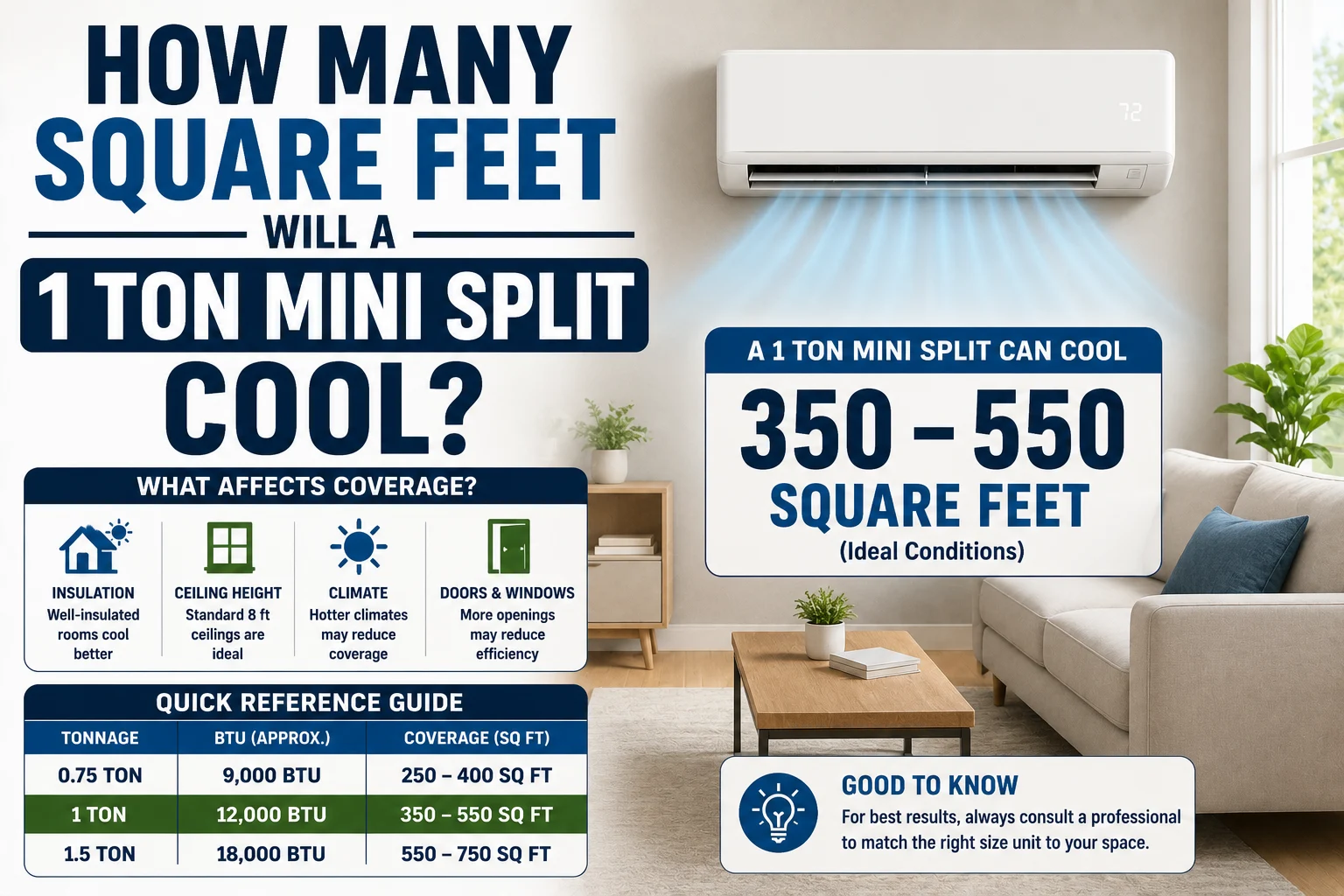
If you’re shopping for a ductless air conditioner, you may be wondering how many square feet will a 1 ton mini split cool. A typical 1-ton mini split has a cooling capacity of approximately 12,000 BTUs per hour, and it can commonly cool around 400 to 600 square feet under average conditions.
However, square footage is only a starting point.
A well-insulated 600-square-foot room in a mild climate may be comfortable with a 1-ton mini split, while a poorly insulated 600-square-foot space with high ceilings, large windows, and intense afternoon sun may need more capacity.
For a quick estimate:
1 ton = approximately 12,000 BTU/h
Typical coverage = about 400–600 square feet
The exact capacity you need depends on climate, insulation, ceiling height, windows, room layout, occupancy, and heat-producing appliances.
Quick Answer: How Many Square Feet Will a 1 Ton Mini Split Cool?
A 1-ton mini split can generally cool about 400–600 square feet, although actual performance depends heavily on the building and climate.
A 1-ton unit is usually equivalent to approximately 12,000 BTU/h of cooling capacity.
| Mini Split Size | Approx. BTU Capacity | General Coverage* |
|---|---|---|
| 0.5 ton | 6,000 BTU | 200–300 sq ft |
| 0.75 ton | 9,000 BTU | 300–450 sq ft |
| 1 ton | 12,000 BTU | 400–600 sq ft |
| 1.5 ton | 18,000 BTU | 600–900 sq ft |
| 2 ton | 24,000 BTU | 800–1,200 sq ft |
| 2.5 ton | 30,000 BTU | 1,000–1,500 sq ft |
| 3 ton | 36,000 BTU | 1,200–1,800 sq ft |
*These are broad estimates, not a substitute for a proper cooling-load calculation.
What Does 1 Ton Mean in a Mini Split?
The word ton can be confusing because it does not refer to the physical weight of the mini split.
In HVAC, one ton represents approximately 12,000 BTUs of cooling capacity per hour.
Therefore:
1 ton = 12,000 BTU/h
The term originated from historical refrigeration measurements and is still widely used when describing air-conditioning capacity.
For mini splits, you’ll often see the capacity listed in both tons and BTUs.
For example:
- 6,000 BTU = 0.5 ton
- 9,000 BTU = 0.75 ton
- 12,000 BTU = 1 ton
- 18,000 BTU = 1.5 tons
- 24,000 BTU = 2 tons
So when someone asks about a 1 ton mini split, they’re generally referring to a mini split with around 12,000 BTUs of cooling capacity.
How Much Area Can a 1 Ton Mini Split Cool?
Under average conditions, a 1-ton mini split can often handle approximately 400–600 square feet.
But this range is not a fixed rule.
Consider two rooms that are both 500 square feet.
Room A
- Good insulation
- 8-foot ceilings
- Few windows
- Moderate outdoor temperatures
- Limited direct sunlight
A 12,000 BTU mini split may work well.
Room B
- Poor insulation
- 10-foot ceilings
- Large south- or west-facing windows
- Strong afternoon sunlight
- Hot outdoor temperatures
- Several occupants and appliances
The same 12,000 BTU unit may struggle to maintain the desired temperature.
This is why square footage alone should not determine AC size.
1 Ton Mini Split Room Size Chart
The following chart provides a useful starting point for estimating cooling capacity.
| Area | Possible Mini Split Size |
| 200–300 sq ft | 0.5 ton / 6,000 BTU |
| 300–450 sq ft | 0.75 ton / 9,000 BTU |
| 400–600 sq ft | 1 ton / 12,000 BTU |
| 600–900 sq ft | 1.5 ton / 18,000 BTU |
| 800–1,200 sq ft | 2 ton / 24,000 BTU |
| 1,000–1,500 sq ft | 2.5 ton / 30,000 BTU |
| 1,200–1,800 sq ft | 3 ton / 36,000 BTU |
These ranges overlap because cooling requirements vary significantly from one building to another.
Is a 1 Ton Mini Split Enough for 500 Square Feet?
Often, yes.
A 500-square-foot room or open space falls within the commonly estimated coverage range of a 12,000 BTU mini split.
However, you should consider the room’s characteristics.
A 1-ton mini split may be suitable when the space has:
- Average ceiling height
- Good insulation
- Reasonable window area
- Limited direct sunlight
- Moderate occupancy
- A relatively mild climate
If the room has extreme heat gain, poor insulation, or unusually high ceilings, a larger system may be appropriate.
It’s also important to consider whether the 500 square feet is one open room or several separate rooms.
Can a 1 Ton Mini Split Cool 600 Square Feet?
A 1-ton mini split may be able to cool 600 square feet, especially when the building has good insulation and moderate cooling loads.
At the upper end of the typical range, however, conditions become more important.
For example, a 600-square-foot open living area with good insulation could be a reasonable application.
A 600-square-foot garage with poor insulation and a large amount of heat entering through the roof may require substantially more cooling capacity.
The same square footage can therefore produce very different cooling requirements.
Factors That Affect Mini Split Sizing
1. Climate
Outdoor temperature is one of the biggest factors.
A room in a mild climate generally requires less cooling than a similarly sized room in a very hot climate.
The hottest design conditions in your area should be considered when sizing an AC system.
2. Insulation
Insulation slows the transfer of heat into the building.
Well-insulated walls, ceilings, and floors can reduce the amount of cooling required.
Poor insulation can increase the cooling load.
3. Ceiling Height
Most basic square-foot estimates assume a fairly standard ceiling height.
A room with a 12-foot ceiling contains considerably more air volume than a room with an 8-foot ceiling.
Large or unusually tall spaces may therefore require additional capacity.
4. Windows
Windows can contribute significant heat gain, particularly when they receive direct sunlight.
Large windows can increase the cooling load even when the room itself isn’t particularly large.
5. Sun Exposure
A room receiving strong afternoon sunlight can become much hotter than a shaded room of the same size.
Roof exposure can also matter, particularly in top-floor rooms and poorly insulated buildings.
6. Occupants
People produce heat.
A room that regularly contains many people may require more cooling than a room occupied by only one or two people.
7. Appliances
Computers, televisions, refrigerators, cooking equipment, lighting, and other electrical devices can add heat to a space.
Why Oversizing a Mini Split Isn’t Always Better
It may seem logical to buy a larger AC because more cooling sounds better.
However, an oversized air conditioner isn’t necessarily the best choice.
A system that is too large may cool the room quickly without running long enough to remove moisture effectively.
This can affect comfort, especially in humid environments.
Oversizing can also result in:
- More frequent cycling
- Uneven temperatures
- Reduced humidity control
- Less consistent comfort
- Higher upfront costs
The goal isn’t to buy the biggest mini split available.
The goal is to choose a capacity appropriate for the actual cooling load.
Why Undersizing Can Also Be a Problem
An undersized mini split can struggle to keep up with the heat entering the room.
You may notice:
- The room doesn’t reach the desired temperature
- The system runs continuously
- Comfort decreases during very hot weather
- The unit struggles in direct sunlight
- Energy consumption may increase because of extended operation
A 9,000 BTU unit, for example, may be inadequate for a space that genuinely requires around 12,000 BTUs.
How to Estimate Mini Split Size
You can use a basic estimate as a starting point.
A commonly used rough approach is to estimate BTU requirements from square footage and then adjust for building conditions.
For example, suppose a room is:
500 square feet
Using a rough estimate of approximately 20–25 BTUs per square foot:
500 × 20 = 10,000 BTU
to
500 × 25 = 12,500 BTU
That places the room around the range of a 9,000–12,000 BTU system, depending on actual conditions.
This is only a preliminary estimate. A professional load calculation is more accurate because it considers heat entering through walls, windows, roofs, occupants, appliances, and other sources.
1 Ton Mini Split vs. Other Sizes
Understanding the differences can help when comparing systems.
0.5 Ton Mini Split
Approximately 6,000 BTU.
Often used for small bedrooms, offices, or compact spaces.
0.75 Ton Mini Split
Approximately 9,000 BTU.
Suitable for somewhat larger bedrooms or small living areas.
1 Ton Mini Split
Approximately 12,000 BTU.
Often appropriate for around 400–600 square feet, depending on conditions.
1.5 Ton Mini Split
Approximately 18,000 BTU.
Can serve larger rooms or open areas.
2 Ton Mini Split
Approximately 24,000 BTU.
Often used for substantially larger spaces.
The correct size should be based on cooling demand rather than square footage alone.
Can One 1 Ton Mini Split Cool Multiple Rooms?
Sometimes, but it depends on the layout.
A single wall-mounted mini-split indoor unit works best when it can distribute conditioned air throughout an open area.
For example, one 12,000 BTU unit may cool a large open living room and kitchen reasonably well.
It may perform poorly if you’re trying to use it to cool several closed bedrooms.
Air does not move efficiently through closed doors and walls.
For multiple separate rooms, a multi-zone mini-split system with separate indoor units may be a better solution.
Mini Split Efficiency Matters Too
BTU capacity isn’t the only specification worth considering.
When comparing mini splits, look at efficiency ratings and operating performance.
Modern inverter-driven mini splits can adjust compressor output rather than simply switching fully on and off.
This can provide more consistent temperature control and potentially improve efficiency under appropriate conditions.
However, efficiency ratings should be considered alongside:
- Cooling capacity
- Climate
- Installation quality
- Insulation
- Desired indoor temperature
- Operating schedule
A highly efficient unit that is incorrectly sized may still provide poor comfort.
Common Mistakes When Choosing a 1 Ton Mini Split
Using Only Square Footage
Square footage is useful for an initial estimate, but it doesn’t capture all sources of heat gain.
Ignoring Climate
A sizing rule that works in a mild climate may not work in a very hot one.
Forgetting Insulation
Poor insulation can significantly increase cooling requirements.
Choosing the Largest Unit
Bigger isn’t automatically better.
Oversizing can affect humidity control and cycling.
Ignoring Room Layout
An open 500-square-foot room is very different from three separate rooms totaling 500 square feet.
Installing the Indoor Unit in the Wrong Location
Placement affects air distribution.
The indoor unit should be positioned to distribute conditioned air effectively throughout the intended space.
Expert Tips for Choosing a 1 Ton Mini Split
Before buying a 12,000 BTU mini split, consider these points:
- Measure the actual conditioned area.
- Check ceiling height.
- Consider insulation quality.
- Count and measure large windows.
- Think about direct sunlight.
- Consider the local climate.
- Account for occupants and heat-producing appliances.
- Check the manufacturer’s rated capacity.
- Look at performance at high outdoor temperatures.
- Use a professional cooling-load calculation for important installations.
If you’re close to the boundary between two sizes, professional sizing can help avoid buying a system that is either too small or unnecessarily large.
FAQs
1. How many square feet will a 1 ton mini split cool?
A typical 1-ton, 12,000 BTU mini split can often cool approximately 400–600 square feet under average conditions. Actual coverage depends on climate, insulation, ceiling height, windows, sunlight, and other heat loads.
2. Is a 1 ton mini split enough for 500 square feet?
In many situations, yes. A 500-square-foot space is within the commonly recommended range for a 12,000 BTU mini split. However, very hot climates, poor insulation, high ceilings, or large sunny windows may increase the required capacity.
3. How many BTUs is a 1 ton mini split?
A 1-ton mini split has approximately 12,000 BTU/h of cooling capacity.
4. Can a 1 ton mini split cool 600 square feet?
It can, depending on the building. A well-insulated 600-square-foot space in moderate conditions may work well with 12,000 BTUs. A poorly insulated space in a very hot climate may need more capacity.
5. What size mini split do I need for 1,000 square feet?
A 1,000-square-foot space may require approximately 24,000 BTUs or 2 tons under common sizing estimates, but the actual requirement can be higher or lower depending on climate, insulation, windows, ceiling height, and heat gain.
Conclusion
So, how many square feet will a 1 ton mini split cool? A typical 1-ton mini split provides about 12,000 BTUs of cooling capacity and can commonly cool around 400–600 square feet under average conditions.
A 500-square-foot room is often a reasonable application for a 12,000 BTU mini split, while 600 square feet may also work when the space has good insulation and moderate heat gain.
However, square footage should never be the only factor in your decision. Climate, insulation, ceiling height, windows, sunlight, occupancy, appliances, and room layout can all change the amount of cooling required.
For the best results, use the 400–600-square-foot range as an initial guide, then verify the manufacturer’s specifications and, for a significant installation, have the space properly sized using a cooling-load calculation.
Choosing the right mini split size can improve comfort, efficiency, humidity control, and long-term operating costs.