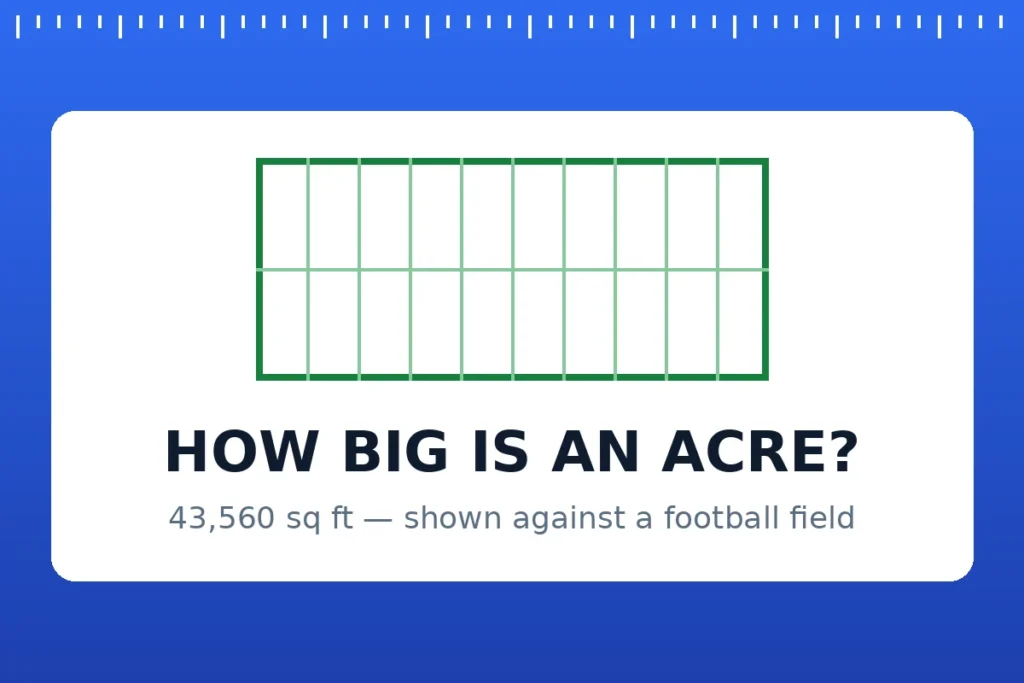
How Big Is an Acre? Visual Guide with Comparisons
Every property listing uses the same phrase: “set on a one-acre lot.” It sounds generous…
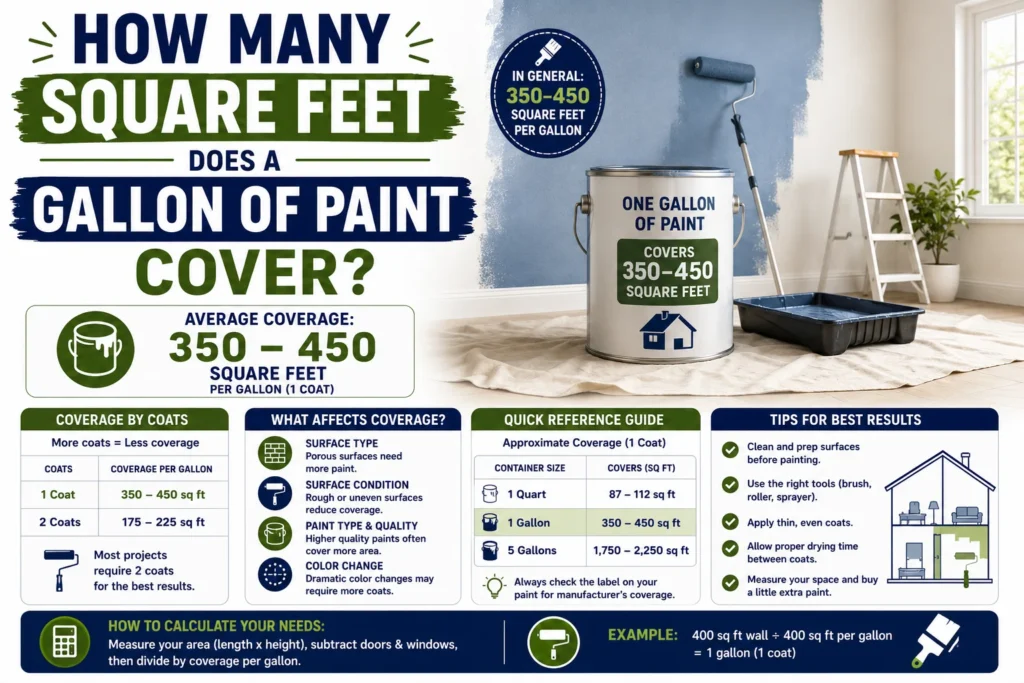
If you’re preparing to paint a room, house, ceiling, or other surface, one of the first questions you’ll probably ask is, how many square feet in a gallon of paint?
A typical gallon of interior paint generally covers approximately 350 to 400 square feet with one coat, although actual coverage varies by product and surface.
Some high-quality paints may advertise coverage around 400 square feet per gallon, while certain primers, textured paints, exterior coatings, and specialty products may cover less.
The amount of paint you need also depends on whether you’re applying one coat or two coats. For example, if a gallon covers 400 square feet with one coat, you would need roughly two gallons to apply two coats to 400 square feet.
Surface condition matters, too. Porous drywall, unpainted wood, rough surfaces, and dramatic color changes can require additional paint.
A=lw
A=6×4=24
4 rows by 6 columns = 24 square units.
w
w
l
l24 square unitsw = 6l = 4
Give feedback
The best way to estimate your project is to calculate the total surface area first and then divide it by the manufacturer’s stated coverage rate.
However, this is an estimate rather than a universal rule.
A practical guide is:
| Paint Coverage | Approximate Area |
|---|---|
| Lower coverage | 250–300 sq ft |
| Typical coverage | 350–400 sq ft |
| High coverage | 400–450+ sq ft |
Always check the paint can or manufacturer’s product information for the specific coverage rate.
For a typical interior wall paint, you can use 350–400 square feet per gallon as a starting estimate.
For example, if your walls total 1,200 square feet and the paint covers 400 square feet per gallon:
1,200 ÷ 400 = 3 gallons
That would provide approximately one coat.
For two coats:
3 × 2 = 6 gallons
In practice, you may want to purchase a little extra to account for absorption, waste, touch-ups, and differences between the estimated and actual coverage.
Paint coverage isn’t determined by the gallon alone. Several factors can affect the amount of surface you can cover.
Different paints have different formulations and coverage rates.
Interior wall paint, ceiling paint, primer, exterior paint, and specialty coatings may all cover different amounts.
Smooth drywall generally requires less paint than rough or heavily textured surfaces.
A rough surface has more exposed area, which can increase paint consumption.
New drywall, bare wood, masonry, and other porous surfaces can absorb paint.
Primer may help reduce absorption and create a more consistent surface.
Two coats require approximately twice the paint of one coat, although the exact amount can vary.
Covering a dark color with a much lighter color can require additional coats.
Brushes, rollers, and sprayers can produce different levels of waste and coverage.
A simple calculation can help estimate your paint requirement.
For a rectangular wall:
Length × Height = Wall Area
For example:
A wall is 15 feet long and 8 feet high.
15 × 8 = 120 square feet
If there are four walls, calculate each wall separately and add them together.
You can subtract doors and windows if you want a more precise estimate.
If your total area is 1,200 square feet and the paint covers 400 square feet per gallon:
1,200 ÷ 400 = 3 gallons
For two coats:
3 × 2 = 6 gallons
The basic formula is:
For example:
1,000 sq ft ÷ 400 sq ft per gallon × 2 coats = 5 gallons
Therefore, approximately 5 gallons would be needed for two coats.
Because actual coverage varies, round up when purchasing rather than assuming you can use every drop.
This depends on how you interpret coverage.
If a gallon covers 400 square feet for one coat, then that gallon can cover approximately:
Why?
The same 400 square feet needs to be painted twice:
400 ÷ 2 = 200 square feet
So, approximately:
| Coats | Area Covered by 1 Gallon |
|---|---|
| 1 coat | 400 sq ft |
| 2 coats | 200 sq ft |
| 3 coats | 133 sq ft |
These are simplified estimates based on 400 square feet per gallon for one coat.
Assuming one gallon covers 400 square feet:
500 ÷ 400 = 1.25 gallons
So you would need approximately:
For two coats:
1.25 × 2 = 2.5 gallons
In practice, buying 3 gallons would give you a reasonable margin for waste and touch-ups.
Assuming coverage of 400 square feet per gallon:
1,000 ÷ 400 = 2.5 gallons
For one coat, you would need approximately 2.5 gallons.
For two coats:
2.5 × 2 = 5 gallons
So approximately 5 gallons would be needed for two coats under this coverage assumption.
At 400 square feet per gallon:
1,500 ÷ 400 = 3.75 gallons
Therefore, you would need approximately:
For two coats:
3.75 × 2 = 7.5 gallons
You’d generally round up and consider purchasing approximately 8 gallons, depending on the actual product coverage.
Using 400 square feet per gallon:
2,000 ÷ 400 = 5 gallons
Therefore:
This assumes the full 2,000 square feet is the surface being painted and that the paint actually achieves 400 square feet per gallon.
Assuming approximately 400 square feet per gallon for one coat:
| Surface Area | 1 Coat | 2 Coats |
|---|---|---|
| 100 sq ft | 0.25 gal | 0.5 gal |
| 200 sq ft | 0.5 gal | 1 gal |
| 300 sq ft | 0.75 gal | 1.5 gal |
| 400 sq ft | 1 gal | 2 gal |
| 500 sq ft | 1.25 gal | 2.5 gal |
| 600 sq ft | 1.5 gal | 3 gal |
| 800 sq ft | 2 gal | 4 gal |
| 1,000 sq ft | 2.5 gal | 5 gal |
| 1,500 sq ft | 3.75 gal | 7.5 gal |
| 2,000 sq ft | 5 gal | 10 gal |
Actual requirements should be based on the coverage rate printed on the specific paint product.
A quart is one-fourth of a gallon.
If one gallon covers 400 square feet:
400 ÷ 4 = 100 square feet
So a quart could theoretically cover about:
Actual coverage varies by paint and surface.
Quarts can be useful for:
A pint is one-eighth of a gallon.
If a gallon covers 400 square feet:
400 ÷ 8 = 50 square feet
So one pint could cover approximately:
This is a rough estimate and is more useful for small projects and touch-ups than full-room painting.
If one gallon covers 400 square feet:
5 × 400 = 2,000 square feet
Therefore, five gallons could cover approximately:
For two coats:
2,000 ÷ 2 = 1,000 square feet
So five gallons could theoretically provide two coats over approximately 1,000 square feet.
Many interior paints advertise coverage in the general range of 350–400 square feet per gallon.
However, some products may have higher or lower coverage ratings.
You should always look at the product label because coverage depends on the formulation and recommended application thickness.
Not necessarily.
Primer coverage can differ from paint coverage.
Primers are often used on:
The specific product’s label should provide its recommended coverage.
If you’re calculating a project requiring both primer and paint, calculate them separately.
A 12 × 12 room has:
12 × 12 = 144 square feet of floor area
But this does not mean the walls contain only 144 square feet.
To calculate wall area, you need the room’s perimeter and ceiling height.
The perimeter is:
12 + 12 + 12 + 12 = 48 feet
If the ceiling is 8 feet high:
48 × 8 = 384 square feet of wall area
If you subtract doors and windows, the actual paintable area will be lower.
At 400 square feet per gallon, one gallon may be enough for one coat in this simplified example, while two coats would require roughly two gallons.
A 10 × 10 room has a perimeter of:
10 + 10 + 10 + 10 = 40 feet
With an 8-foot ceiling:
40 × 8 = 320 square feet
So the walls contain approximately 320 square feet before subtracting doors and windows.
At 400 square feet per gallon, approximately one gallon could cover one coat.
For two coats, approximately two gallons may be required.
Suppose your walls total:
500 square feet
and your doors and windows account for:
60 square feet
Then the approximate paintable surface is:
500 − 60 = 440 square feet
At 400 square feet per gallon:
440 ÷ 400 = 1.1 gallons
You would likely want more than exactly 1.1 gallons to account for application losses and touch-ups.
Yes.
Smooth surfaces generally allow more predictable coverage.
Textured walls can require more paint because the coating has to cover the raised and recessed portions of the surface.
Examples include:
For heavily textured surfaces, don’t assume the manufacturer’s maximum coverage will always be achieved.
New drywall and joint compound can be porous and absorb paint unevenly.
A suitable drywall primer can help seal the surface and improve the uniformity of the finish coat.
Without proper preparation, you may need additional coats of paint to achieve the desired appearance.
It can.
If you’re painting a dark wall a much lighter color, one coat may not completely hide the original color.
You might need:
The number of coats depends on the existing surface, colors, paint formulation, and desired finish.
Paint can be lost through:
Having leftover paint from the same batch can also be useful for future touch-ups.
However, don’t buy excessive quantities. Check the manufacturer’s coverage information and calculate your project carefully.
Estimating paint for an entire house requires more than using the home’s total square footage.
For example, a 2,000-square-foot house does not necessarily have 2,000 square feet of walls.
The home’s floor area and paintable wall area are different measurements.
To estimate wall paint:
Ceilings should generally be calculated separately.
This distinction is extremely important.
A room with a floor area of:
12 × 12 = 144 square feet
doesn’t have only 144 square feet of paintable walls.
If the ceiling is 8 feet high, the four walls have approximately:
48 × 8 = 384 square feet
before subtracting openings.
Therefore, when calculating paint, don’t simply use the home’s floor area unless the product or estimator specifically calls for that measurement.
A typical gallon of interior paint often covers approximately 350–400 square feet for one coat, but the actual coverage depends on the specific product and surface.
If a gallon covers 400 square feet with one coat, it will cover approximately 200 square feet with two coats.
At 400 square feet per gallon, approximately 2.5 gallons are needed for one coat or 5 gallons for two coats.
Usually, the coverage listed on a paint can refers to one coat, unless the manufacturer states otherwise. Always check the product label.
If one gallon covers 400 square feet, a quart theoretically covers about 100 square feet for one coat.
Often, yes. Textured or rough surfaces can require more paint than smooth surfaces because they have more surface area and can absorb or hold more coating.
Yes. Subtracting large doors and windows can make your estimate more accurate, although buying a small amount of extra paint is still advisable for waste and touch-ups.
So, how many square feet are in a gallon of paint?
A typical gallon of interior paint generally covers approximately:
However, actual coverage varies depending on the paint product, surface texture, porosity, application method, color change, and number of coats.
For a quick estimate, if your paint covers 400 square feet per gallon, you can use:
Total paintable area ÷ 400 = gallons for one coat
For two coats, multiply the result by two.
For example, a 1,000-square-foot paintable surface would require approximately 2.5 gallons for one coat or 5 gallons for two coats at a 400-square-foot coverage rate.
The most accurate approach is to check the manufacturer’s stated coverage, measure your actual paintable surface, account for doors and windows, and allow some extra for waste and future touch-ups.
Every property listing uses the same phrase: “set on a one-acre lot.” It sounds generous…
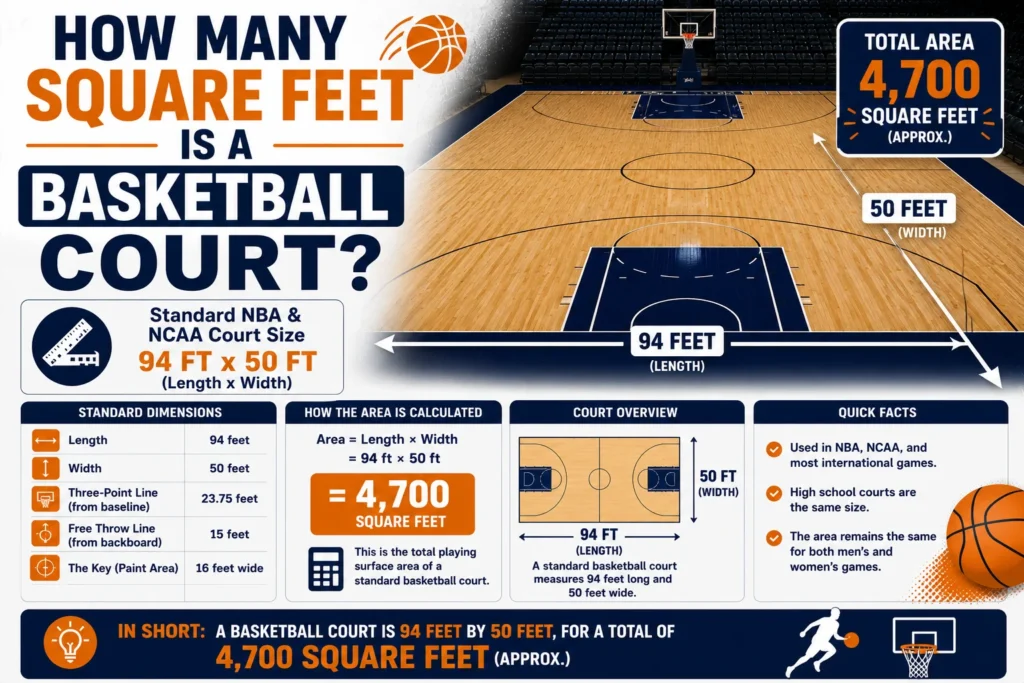
If you’re planning to build a basketball court, comparing gym sizes, estimating flooring requirements, or…
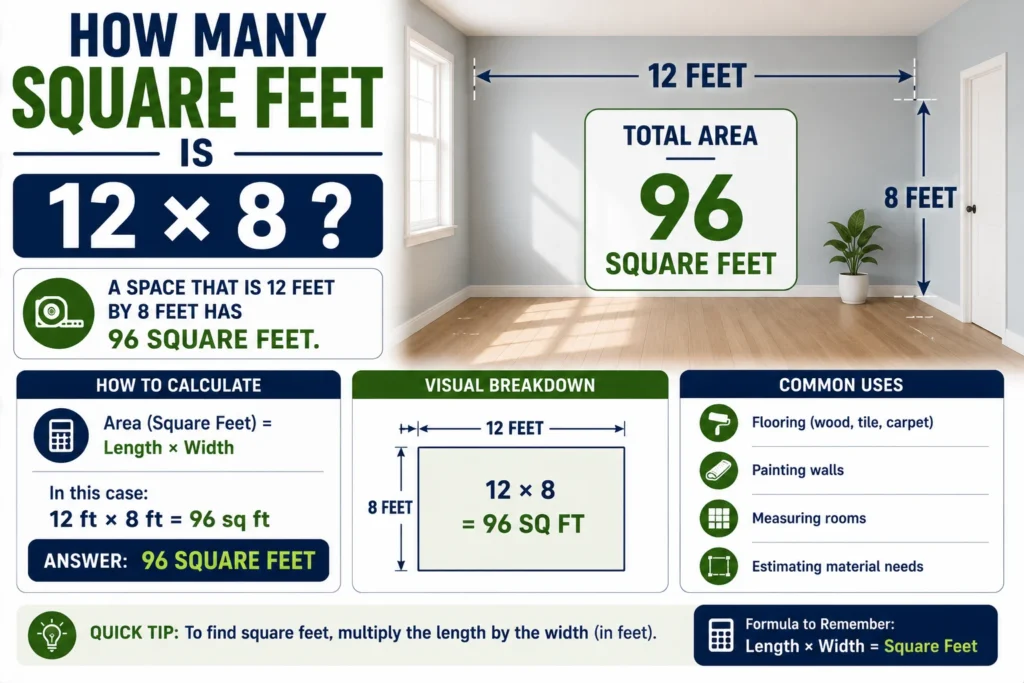
If you’re trying to determine how many square feet is 12 × 8, the calculation…