Tire Size Meaning: 225/45R17 Decoded + Load Index and Speed Rating Charts
Tire size meaning explained: 225/45R17 decoded step by step, load index and speed rating charts, overall diameter math,…
There is a particular kind of panic that only ring shopping produces. The ring is right, the price is survivable — and then the page asks for a size, one small number or letter standing between a perfect fit and a trip back to the jeweller. The good news: ring sizes are built on one simple measurement, and you can find yours with a strip of paper and a ruler.
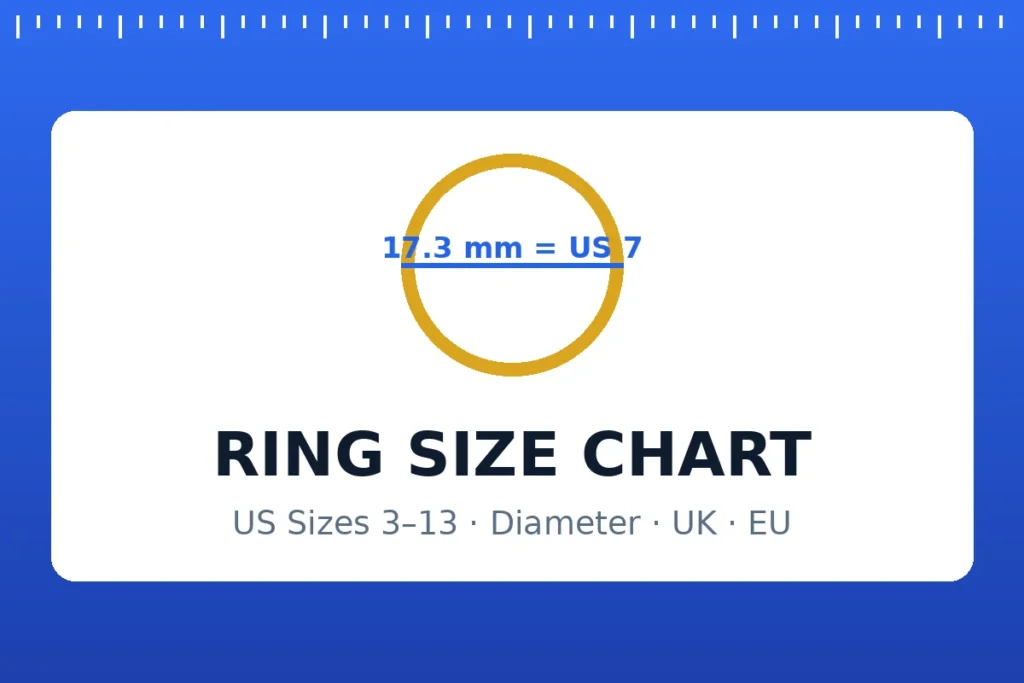
Quick Answer: A US ring size comes from the ring’s inner circumference. Each full size adds about 2.55 mm of circumference (roughly 0.8 mm of diameter). A US 7 measures 17.3 mm across and 54.4 mm around — that is UK N and EU 54.5.
The US system uses numbers, and each whole number steps the inner circumference up by about 2.55 mm. The UK system (also used in Australia and Ireland) uses letters, each worth roughly half a US size, matching the US half sizes in the chart below. The EU system is the friendliest: its number is almost the inner circumference in millimetres, so an EU 54.5 fits a finger measuring 54.4 mm around.
The chart below is laid out like our shoe size conversion chart.
It is the same wrap-and-measure job as taking a calf measurement for boots — just with higher stakes and much smaller numbers.
Wrap a thin strip of paper (or non-stretch string) around the base of the finger — snug, not tight — and mark where the end meets it. Lay it flat and measure that length in millimetres: that is your circumference, and the chart turns it into a size. Measure carefully, because one full size is only 2.55 mm of string. An online ruler works in a pinch, and our guide on how to read a tape measure explains the marks.
Lay a ring that fits flat on a ruler and read the inside diameter — the widest distance between the inner edges, not counting the metal of the band. Match it to the chart’s Diameter column. The steps are tiny: each size changes the diameter by about 0.8 mm, less than the thickness of a credit card. Our 2 mm size guide shows how small that is — two and a half size steps between your fingertips.
For a few dollars you can buy a loop of plastic sample rings, or a tapered mandrel like the ones jewellers use. Real rings beat every paper method — worth it if the ring is a surprise and you get one chance to measure a borrowed one.
Tips that change the answer: measure at the end of the day, when fingers are at their largest, and warm your hands first — cold fingers shrink by as much as half a size. If your knuckle is wider than the base of your finger, size for the knuckle. Measure the exact finger: the dominant hand often runs half a size bigger.
| US | Diameter (mm) | Circumference (mm) | UK | EU |
|---|---|---|---|---|
| 3 | 14.1 | 44.2 | F | 44 |
| 3.5 | 14.5 | 45.5 | G | 45 |
| 4 | 14.9 | 46.8 | H | 46.5 |
| 4.5 | 15.3 | 48.0 | I | 48 |
| 5 | 15.7 | 49.3 | J | 49 |
| 5.5 | 16.1 | 50.6 | K | 50.5 |
| 6 | 16.5 | 51.9 | L | 51.5 |
| 6.5 | 16.9 | 53.1 | M | 53 |
| 7 | 17.3 | 54.4 | N | 54.5 |
| 7.5 | 17.7 | 55.7 | O | 56 |
| 8 | 18.1 | 56.9 | P | 57 |
| 8.5 | 18.5 | 58.2 | Q | 58.5 |
| 9 | 19.0 | 59.5 | R | 59.5 |
| 9.5 | 19.4 | 60.8 | S | 61 |
| 10 | 19.8 | 62.1 | T | 62 |
| 10.5 | 20.2 | 63.4 | U | 63.5 |
| 11 | 20.6 | 64.6 | V | 65 |
| 11.5 | 21.0 | 65.9 | W | 66 |
| 12 | 21.4 | 67.2 | X | 67 |
| 13 | 22.2 | 69.7 | Z | 69.5 |
Few fingers land exactly on a chart row. Between two sizes, choose the larger one — a loose ring stays comfortable all day; a tight one is miserable by evening.
Band width changes the fit. A wide band — 6 mm or broader — grips more of the finger, so go up half a size; thin bands stay true to size. And size for the knuckle if it is wider than the base — a loose base is far easier to live with.
Measuring in the morning, or with cold hands. Fingers are smallest after a night’s rest and shrink further in the cold — a ring sized then can spin loosely by lunchtime on a warm day. Measure in the evening, ideally on two different days.
Using stretchy string or thread. Anything with give stretches as you wrap, and the mark creeps longer — half a size of error hides in a pulled thread. Use a paper strip, snug not tight, and measure twice.
Confusing diameter with circumference. The big number in ring sizing — 54.4 mm for a US 7 — is the distance around the ring, not across it. Order by it as if it were the diameter and you would receive something closer to a bangle, roughly three times too wide. Check which column your number came from.
As typical averages, most women fall around US 6–7 and most men around US 9–10. Treat those as a starting point for a guess or a gift, not a substitute for measuring.
Usually, yes — a jeweller can move a plain band up or down by one to two sizes. Full eternity bands, very hard metals and some patterned designs cannot be resized, so those styles have to be right at the order.
Roughly, yes. The EU number tracks the inner circumference in millimetres, so the string method reads almost straight off an EU chart — a 54.4 mm measurement lands you at EU 54.5.
Up, in almost every case — definitely for wide bands (6 mm or more) or prominent knuckles. A loose ring can be steadied with a sizing insert; a tight one is unwearable by evening.
Your finger does, yes — size shifts with the season, exercise and weight, and fingers grow slowly with age. Measure twice, on different days, to get an honest number.
Tire size meaning explained: 225/45R17 decoded step by step, load index and speed rating charts, overall diameter math,…
Standard door dimensions: interior 30 or 32 x 80 inches, front door 36 x 80, plus rough opening…

Full paper sizes chart: Letter 8.5x11, Legal, Tabloid, A4 210x297 mm, A3, A5, plus the envelope that fits…