How Many Cubic Feet of Concrete Are in a Yard?
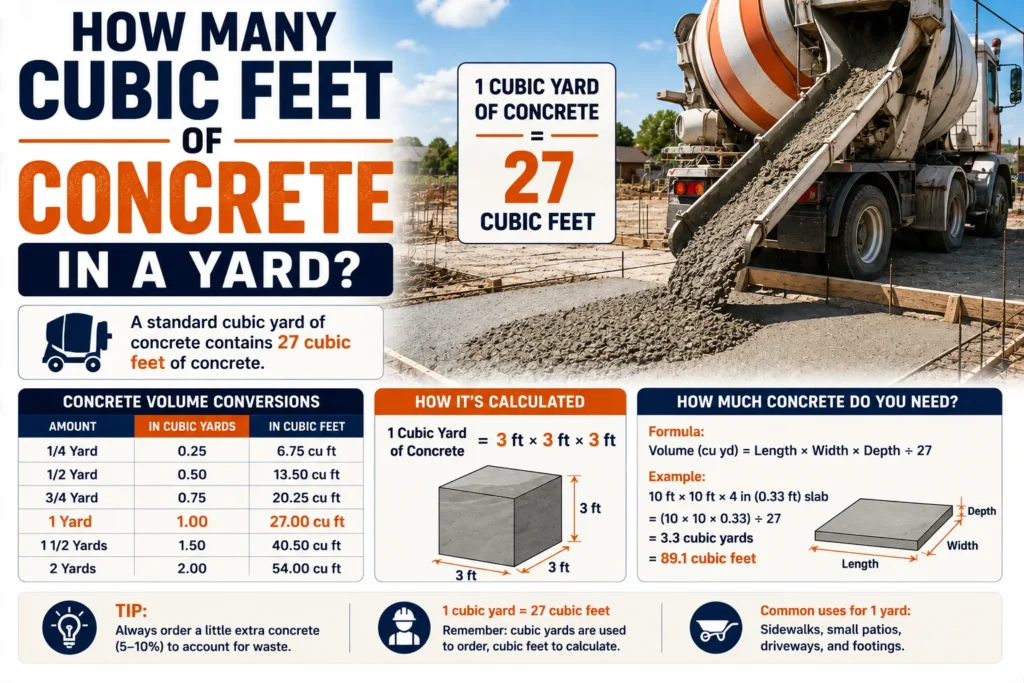
If you’re planning a concrete project, understanding how concrete is measured is essential. One of…
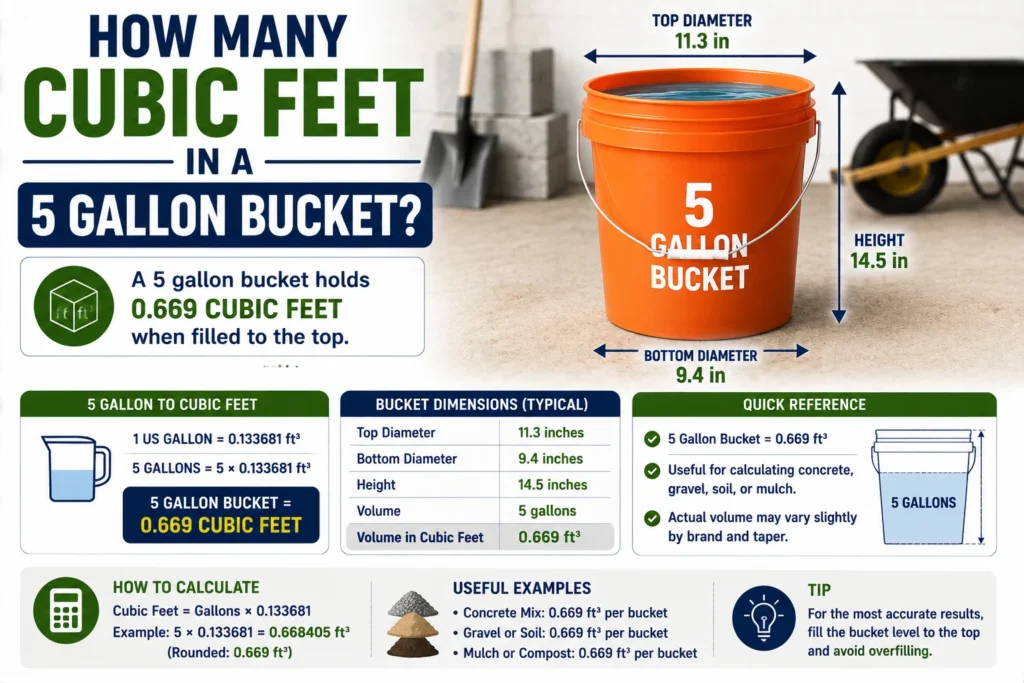
A standard 5-gallon bucket holds approximately 0.668 cubic feet of volume when using U.S. liquid gallons.
For most practical calculations, you can round this to:
This conversion is useful when estimating how many buckets of soil, sand, gravel, concrete, water, mulch, or other materials are needed for a project.
The calculation comes from the relationship between U.S. gallons and cubic feet. One U.S. gallon is approximately 0.1337 cubic feet, so five gallons is approximately 0.668 cubic feet.
It’s important to remember that a bucket’s physical dimensions and its actual usable capacity can vary slightly by manufacturer. A bucket marketed as 5 gallons may not hold exactly 5 gallons when filled to the very top.
More precisely:
5 U.S. gallons ≈ 0.668 cubic feet
So you can use the following rule of thumb:
5-gallon bucket = about ⅔ of a cubic foot
V=lwh
V=4×3×2=24
l
l
w
w
h
hl = 4h = 2w = 3
Give feedback
This is a volume conversion, so it doesn’t matter whether the bucket contains water, soil, sand, or another material. The volume remains approximately 0.668 cubic feet; only the weight changes.
The easiest way is to use the standard U.S. volume conversion.
One U.S. gallon equals approximately:
0.133681 cubic feet
Therefore:
5 × 0.133681 ≈ 0.6684 cubic feet
So:
For everyday estimating, 0.67 cubic feet is usually sufficient.
Another useful conversion is cubic inches.
One U.S. gallon contains:
231 cubic inches
Therefore:
5 × 231 = 1,155 cubic inches
So a 5-gallon volume is:
Since one cubic foot contains 1,728 cubic inches:
1,155 ÷ 1,728 ≈ 0.668 cubic feet
This produces the same result.
If one 5-gallon bucket contains approximately 0.668 cubic feet, divide one cubic foot by 0.668.
1 ÷ 0.668 ≈ 1.5
Therefore:
In practical terms, you need approximately 1½ full 5-gallon buckets to make one cubic foot.
Because buckets aren’t always filled perfectly and their actual capacities differ, this should be treated as an estimate.
Using approximately 0.668 cubic feet per bucket:
2 ÷ 0.668 ≈ 2.99
Therefore:
This is a particularly convenient conversion because three 5-gallon buckets contain approximately:
3 × 0.668 = 2.004 cubic feet
So you can use 3 buckets ≈ 2 cubic feet as a quick rule of thumb.
For 10 cubic feet:
10 ÷ 0.668 ≈ 14.96
Therefore:
This can be useful when moving or measuring loose materials such as:
| Number of 5-Gallon Buckets | Approximate Cubic Feet |
|---|---|
| 1 | 0.67 cu ft |
| 2 | 1.34 cu ft |
| 3 | 2.00 cu ft |
| 4 | 2.67 cu ft |
| 5 | 3.34 cu ft |
| 6 | 4.01 cu ft |
| 7 | 4.68 cu ft |
| 8 | 5.35 cu ft |
| 9 | 6.02 cu ft |
| 10 | 6.68 cu ft |
| 15 | 10.03 cu ft |
| 20 | 13.37 cu ft |
These figures assume each bucket contains a full 5 U.S. gallons.
A 5-gallon bucket filled with water contains approximately:
The volume doesn’t change simply because the material is water.
However, the weight does change depending on what material you put in the bucket.
A U.S. gallon of water weighs approximately 8.34 pounds.
Therefore, 5 gallons of water weighs roughly:
5 × 8.34 = 41.7 pounds
So a full 5-gallon bucket of water weighs approximately 41.7 pounds, plus the weight of the bucket itself.
If you fill a 5-gallon bucket with soil, its volume is still approximately:
The important difference is weight.
Dry soil, wet soil, potting soil, and compacted soil can have dramatically different weights even though they occupy the same approximate volume.
For gardening and landscaping estimates, the volume conversion remains useful:
1 bucket ≈ 0.67 cubic feet
A full 5-gallon bucket contains approximately:
However, the weight of the bucket will depend on the type and moisture content of the sand.
Fine, wet sand can be considerably heavier than dry, loose sand.
For volume calculations, use:
5 gallons ≈ 0.668 cubic feet
A 5-gallon bucket filled with gravel contains approximately:
The exact amount of gravel by weight depends on:
This is why volume and weight should not be treated as interchangeable measurements.
A 5-gallon bucket has approximately:
If you fill the bucket with mixed concrete, the volume is still approximately 0.67 cubic feet.
However, you should be careful when using buckets to measure concrete. Fresh concrete is heavy, and a full 5-gallon bucket can be difficult or unsafe to lift.
For larger concrete projects, concrete is usually measured in cubic yards or cubic feet rather than buckets.
This is a common question for landscaping and concrete projects.
One cubic yard contains:
A 5-gallon bucket contains approximately:
Therefore:
27 ÷ 0.668 ≈ 40.4
So:
In practical terms, you can think of a cubic yard as approximately 40–41 five-gallon buckets.
This assumes the buckets are filled to their full 5-gallon capacity.
A half cubic yard contains:
27 ÷ 2 = 13.5 cubic feet
Now divide by the capacity of a 5-gallon bucket:
13.5 ÷ 0.668 ≈ 20.2
Therefore:
This is useful for estimating smaller landscaping projects.
As noted earlier:
1 cubic foot ≈ 1.5 five-gallon buckets
The reverse calculation is:
1 five-gallon bucket ≈ 0.67 cubic feet
So the relationship can be summarized as:
| Measurement | Approximate Volume |
|---|---|
| 1 gallon | 0.134 cu ft |
| 2 gallons | 0.267 cu ft |
| 3 gallons | 0.401 cu ft |
| 4 gallons | 0.535 cu ft |
| 5 gallons | 0.668 cu ft |
| 10 gallons | 1.337 cu ft |
| 20 gallons | 2.674 cu ft |
| 27 gallons | 3.609 cu ft |
This table uses U.S. gallons.
A cubic foot is a three-dimensional measurement.
One cubic foot is a cube measuring:
1 foot × 1 foot × 1 foot
A 5-gallon bucket is usually cylindrical or slightly tapered, so its shape looks very different from a cubic-foot box.
The volumes can nevertheless be equivalent.
A 5-gallon bucket contains approximately 1,155 cubic inches, while one cubic foot contains 1,728 cubic inches.
Therefore, a 5-gallon bucket occupies about:
1,155 ÷ 1,728 ≈ 67%
of one cubic foot.
Not necessarily.
The term “5-gallon bucket” generally describes its nominal capacity. Actual dimensions and usable capacity can vary.
Factors include:
Some buckets marketed as 5-gallon containers may have slightly more or less usable capacity.
For precise applications, check the manufacturer’s specifications or measure the container.
If you know the dimensions of a cylindrical bucket, you can calculate its approximate volume using the cylinder-volume formula.
V=πr2h
V=πr2h=π(3.0)2(8.0)=226.19
r
r
h
h r = 3.0h = 8.0
Give feedback
For a perfect cylinder, you use the radius and height.
However, most 5-gallon buckets are tapered, meaning the top is wider than the bottom. As a result, the simple cylinder calculation may not perfectly match the actual bucket capacity.
For everyday material estimates, the nominal 5-gallon capacity is usually the easier measurement to use.
To determine the number of buckets required for a project, first determine the total volume in cubic feet.
Then use:
Number of Buckets = Total Cubic Feet ÷ 0.668
For example, suppose you need to move 5 cubic feet of soil.
5 ÷ 0.668 ≈ 7.49
You would need approximately:
This calculation assumes each bucket is filled to its full 5-gallon capacity.
Suppose you need to move 10 cubic feet of mulch.
Calculate:
10 ÷ 0.668 ≈ 14.97
Round up:
So approximately 15 full 5-gallon buckets are required to move 10 cubic feet of mulch.
In real-world use, you may need more trips if the buckets aren’t filled completely.
One cubic yard contains 27 cubic feet.
A 5-gallon bucket contains approximately 0.668 cubic feet.
Therefore:
27 ÷ 0.668 ≈ 40.4
You need approximately:
if you’re counting whole buckets and want enough capacity to move the entire cubic yard.
A 5-gallon bucket contains approximately:
The exact metric conversion is approximately 18.927 liters for 5 U.S. gallons.
Be careful when using the term “gallon.”
A U.S. gallon and an Imperial gallon are different sizes.
Approximately 0.1337 cubic feet
Approximately 0.1605 cubic feet
Therefore, a 5-U.S.-gallon bucket and 5-Imperial-gallon container do not have the same volume.
In the United States, a “5-gallon bucket” normally refers to 5 U.S. gallons.
Gallons and cubic feet are different volume units.
5 gallons ≠ 5 cubic feet.
Five gallons is only about 0.67 cubic feet.
Cubic feet measure volume, while square feet measure area.
A bucket’s capacity should be measured in cubic feet, gallons, liters, or another volume unit.
Always determine which gallon measurement you’re using.
Different manufacturers may produce buckets with slightly different actual dimensions.
Five gallons of water and five gallons of soil have approximately the same volume but very different weights.
For quick reference:
≈ 0.67 cubic feet
≈ 1.34 cubic feet
≈ 2.00 cubic feet
≈ 3.34 cubic feet
≈ 6.68 cubic feet
≈ 10.03 cubic feet
≈ 13.37 cubic feet
≈ 26.74 cubic feet
≈ 27.41 cubic feet
Therefore, approximately 40–41 five-gallon buckets equal one cubic yard.
A standard 5-gallon bucket contains approximately 0.668 cubic feet, commonly rounded to 0.67 cubic feet.
One cubic foot is approximately 1.5 five-gallon buckets.
One cubic yard contains 27 cubic feet, which is approximately 40.4 five-gallon buckets. For whole buckets, approximately 41 buckets provide enough nominal capacity.
Five U.S. gallons equal approximately 1,155 cubic inches.
Five U.S. gallons equal approximately 18.93 liters.
Yes. If both buckets are filled to the same capacity, they contain approximately the same volume—0.668 cubic feet. Their weights will be different.
By volume, a full 5-gallon bucket holds approximately 0.67 cubic feet of concrete. However, concrete is very heavy, so transporting a full bucket can be difficult and potentially unsafe.
So, how many cubic feet is a 5-gallon bucket?
The answer is:
The most useful conversions to remember are:
This conversion works for estimating the volume of water, soil, sand, gravel, mulch, concrete, and other materials. However, the weight of the material can vary considerably.
For everyday projects, the easiest rule to remember is one full 5-gallon bucket is roughly two-thirds of a cubic foot.
If you’re planning a concrete project, understanding how concrete is measured is essential. One of…
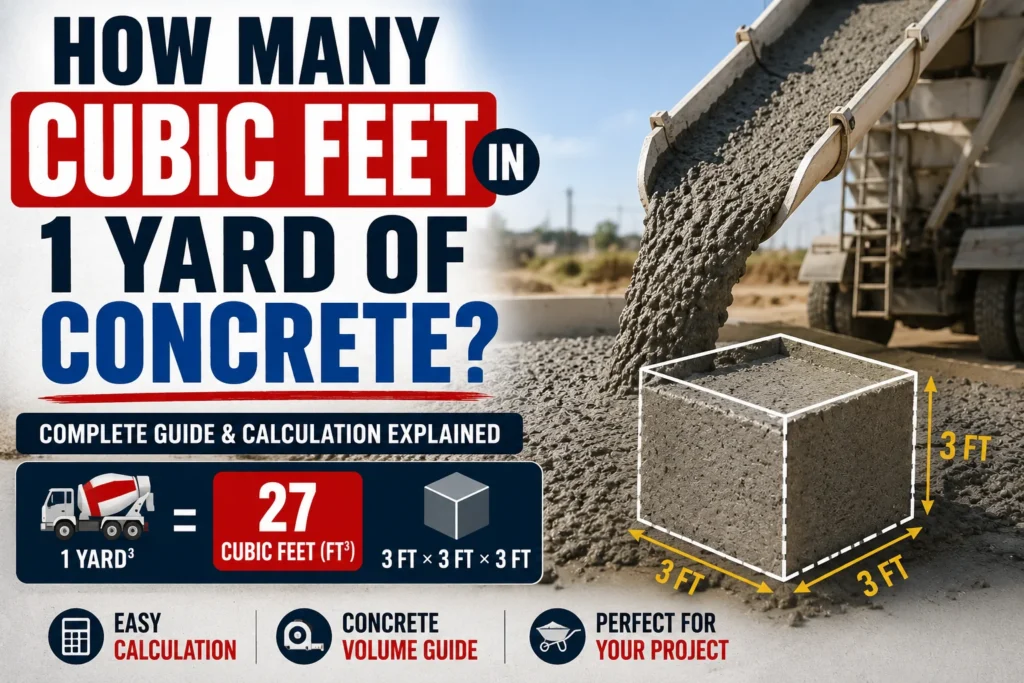
If you’re planning a concrete project, one of the most important measurements to understand is…
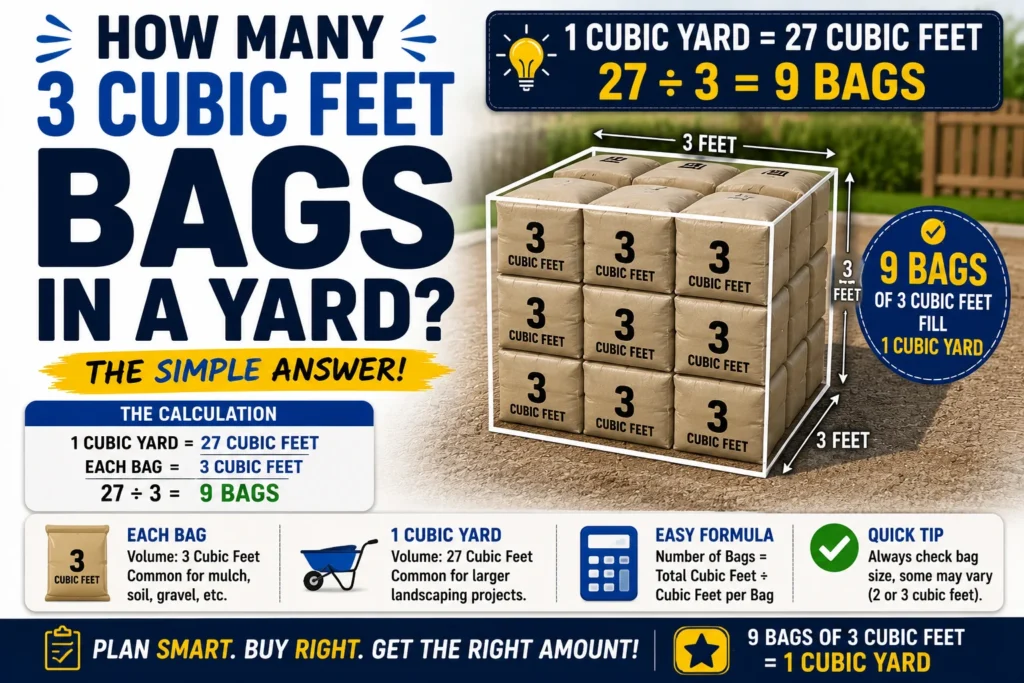
If you’re buying mulch, soil, compost, or gravel, you may be wondering: How many 3…