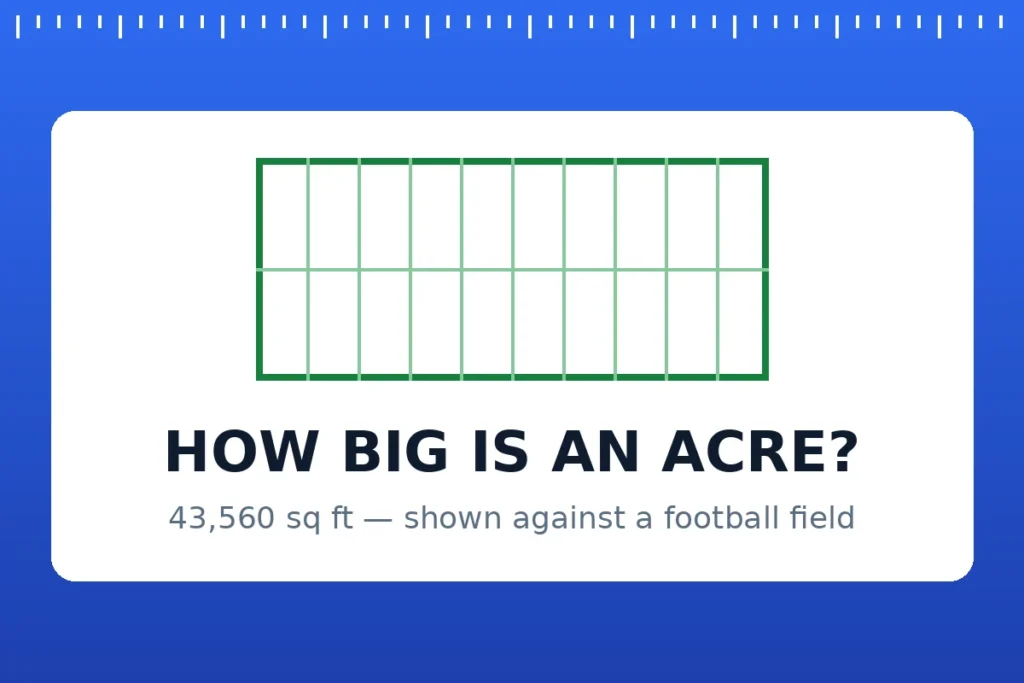
How Big Is an Acre? Visual Guide with Comparisons
Every property listing uses the same phrase: “set on a one-acre lot.” It sounds generous…
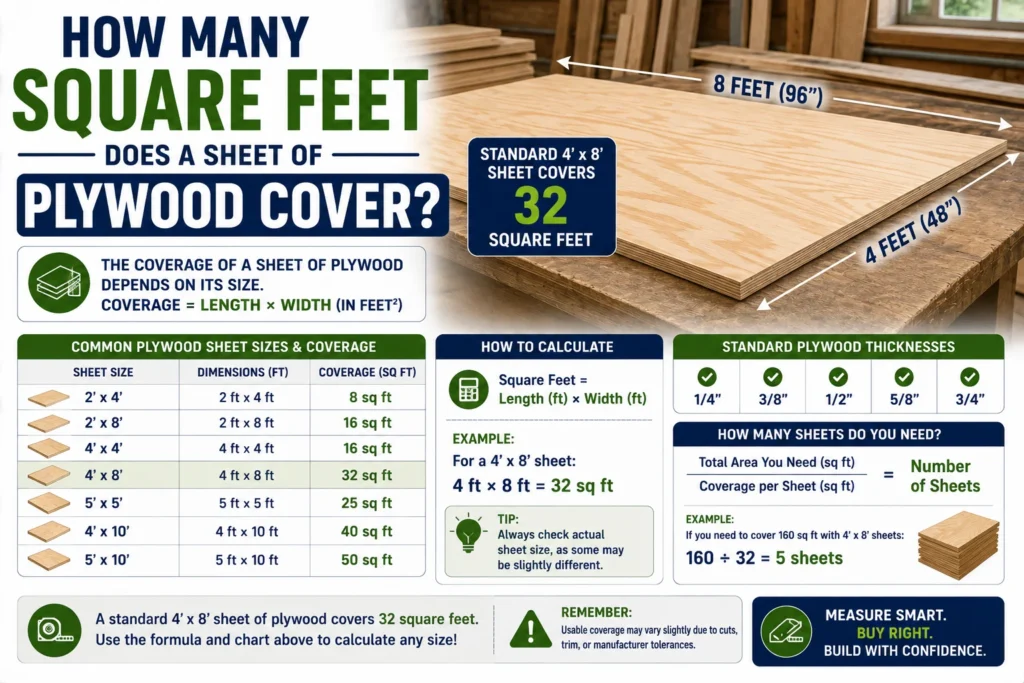
If you’re planning a construction, remodeling, flooring, roofing, or woodworking project, knowing how many square feet a sheet of plywood covers is essential for estimating how much material to purchase.
The most common plywood sheet size is 4 feet by 8 feet. A standard 4 × 8 sheet covers:
4 × 8 = 32 square feet
Therefore:
The thickness of the plywood does not change its surface coverage. Whether the sheet is ¼-inch, ½-inch, ⅝-inch, or ¾-inch thick, a 4 × 8 panel still covers 32 square feet.
However, plywood is available in other dimensions, so you should always check the actual length and width before calculating coverage.
A standard plywood sheet measuring 4 feet × 8 feet covers:
A=lw
A=6×4=24
4 rows by 6 columns = 24 square units.
w
w
l
l24 square unitsw = 6l = 4
Give feedback
The calculation is straightforward:
4 feet × 8 feet = 32 square feet
So, if you’re using standard 4 × 8 plywood panels, each sheet provides approximately 32 square feet of coverage before accounting for cuts and waste.
To calculate the coverage of any rectangular plywood sheet, multiply its length by its width.
Square Feet = Length × Width
For a standard 4 × 8 sheet:
4 × 8 = 32 square feet
For a 4 × 10 sheet:
4 × 10 = 40 square feet
For a 5 × 5 sheet:
5 × 5 = 25 square feet
The important point is that the dimensions must be expressed in feet before multiplying.
A standard 4 × 8 plywood sheet measures:
Therefore:
4 × 8 = 32 square feet
This is the most common plywood coverage figure used for estimating construction materials.
For example, if you need to cover a 320-square-foot surface:
320 ÷ 32 = 10 sheets
You would need at least 10 full sheets if there were no cutting waste.
In real projects, you will often need additional material.
No.
Plywood thickness affects the panel’s:
But it does not change its surface area.
For example:
| Plywood Thickness | Sheet Size | Coverage |
|---|---|---|
| ¼ inch | 4 × 8 ft | 32 sq ft |
| ⅜ inch | 4 × 8 ft | 32 sq ft |
| ½ inch | 4 × 8 ft | 32 sq ft |
| ⅝ inch | 4 × 8 ft | 32 sq ft |
| ¾ inch | 4 × 8 ft | 32 sq ft |
A ¾-inch sheet and a ¼-inch sheet with identical 4 × 8 dimensions both cover 32 square feet.
While 4 × 8 is the standard size, plywood can come in different dimensions.
| Plywood Size | Square Feet |
|---|---|
| 2 × 4 ft | 8 sq ft |
| 2 × 8 ft | 16 sq ft |
| 4 × 4 ft | 16 sq ft |
| 4 × 8 ft | 32 sq ft |
| 4 × 10 ft | 40 sq ft |
| 4 × 12 ft | 48 sq ft |
| 5 × 5 ft | 25 sq ft |
Availability varies by manufacturer, plywood type, thickness, and supplier.
To estimate the number of sheets, divide the total surface area by the coverage of one sheet.
Number of Sheets = Total Area ÷ Area per Sheet
For standard 4 × 8 plywood:
Number of Sheets = Total Area ÷ 32
Suppose you need to cover 640 square feet.
640 ÷ 32 = 20
You need at least:
before accounting for cuts and waste.
A 4 × 8 sheet covers 32 square feet.
Calculate:
100 ÷ 32 = 3.125
Since you can’t purchase 0.125 of a full sheet in a normal sheet-goods purchase, you would need at least:
Four sheets provide:
4 × 32 = 128 square feet
That leaves approximately 28 square feet before considering cuts and waste.
Calculate:
200 ÷ 32 = 6.25
You would need at least:
Seven 4 × 8 sheets provide:
7 × 32 = 224 square feet
Depending on the project’s layout, you may need more than seven sheets because of cutting waste.
For a 500-square-foot project:
500 ÷ 32 = 15.625
Round up:
Sixteen sheets provide:
16 × 32 = 512 square feet
Because only 12 square feet of extra material remains, a project with many cuts may require additional sheets.
For 1,000 square feet:
1,000 ÷ 32 = 31.25
Round up to:
Thirty-two 4 × 8 sheets provide:
32 × 32 = 1,024 square feet
Again, this is the theoretical minimum before accounting for cutting waste, defects, openings, and layout.
Suppose a rectangular floor measures:
20 feet × 30 feet
The floor area is:
20 × 30 = 600 square feet
Each standard plywood sheet covers 32 square feet.
Calculate:
600 ÷ 32 = 18.75
So the theoretical minimum is:
However, you may want to purchase more because plywood sheets must be cut and arranged according to the floor layout.
For subflooring, staggered joints and proper installation practices can also affect the number of sheets required.
The same area calculation applies to wall sheathing.
Suppose a wall is:
10 feet high × 40 feet long
Its surface area is:
10 × 40 = 400 square feet
Using 4 × 8 sheets:
400 ÷ 32 = 12.5
You would need at least:
before accounting for openings and waste.
If the wall contains doors and windows, the actual plywood requirement may be lower, but cutting the sheets efficiently becomes important.
Plywood roofing calculations depend on the roof’s actual surface area, not simply the home’s floor area.
For example, suppose the total roof surface is 2,000 square feet.
Using 4 × 8 sheets:
2,000 ÷ 32 = 62.5
The theoretical minimum is:
But roofing projects commonly require additional material for:
The appropriate allowance depends on the roof design.
Simply dividing the project area by 32 doesn’t always give you the correct purchase quantity.
You may need additional plywood because of:
A common estimating approach is to add approximately 10% extra for waste, although the appropriate allowance depends heavily on the project.
For a 500-square-foot project:
500 × 1.10 = 550 square feet
Then:
550 ÷ 32 = 17.19
You would round up to:
This is an estimate rather than a universal rule. A contractor or experienced installer may use a different waste factor based on the layout.
If each sheet is 4 × 8 feet:
10 × 32 = 320 square feet
Therefore:
before accounting for cutting waste.
Each 4 × 8 sheet covers 32 square feet.
Therefore:
20 × 32 = 640 square feet
Calculate:
50 × 32 = 1,600 square feet
Therefore:
This is the theoretical coverage before cuts and waste.
| Number of 4 × 8 Sheets | Theoretical Coverage |
|---|---|
| 1 | 32 sq ft |
| 2 | 64 sq ft |
| 3 | 96 sq ft |
| 4 | 128 sq ft |
| 5 | 160 sq ft |
| 10 | 320 sq ft |
| 15 | 480 sq ft |
| 20 | 640 sq ft |
| 25 | 800 sq ft |
| 30 | 960 sq ft |
| 40 | 1,280 sq ft |
| 50 | 1,600 sq ft |
| 100 | 3,200 sq ft |
A 12 × 12 room has:
12 × 12 = 144 square feet
Each standard plywood sheet covers:
32 square feet
Divide:
144 ÷ 32 = 4.5
Therefore, the theoretical minimum is:
Five sheets provide:
5 × 32 = 160 square feet
You may need additional plywood depending on the installation layout and waste.
A 12 × 14 room has:
12 × 14 = 168 square feet
Now divide by 32:
168 ÷ 32 = 5.25
Therefore, you need at least:
Six sheets provide:
6 × 32 = 192 square feet
Additional material may be needed depending on cuts and waste.
A 20 × 20 room contains:
20 × 20 = 400 square feet
Divide by the coverage of one 4 × 8 sheet:
400 ÷ 32 = 12.5
Therefore, you need at least:
Without waste, 13 sheets provide:
13 × 32 = 416 square feet
Yes.
The nominal dimensions are 4 feet by 8 feet:
4 × 8 = 32 square feet
However, actual plywood dimensions can vary slightly from the nominal dimensions depending on the product and manufacturer.
For estimating purposes, 32 square feet per 4 × 8 sheet is the standard figure.
For precision work, verify the actual dimensions printed on the product or manufacturer’s specifications.
It’s important not to confuse square feet with linear feet.
Measures area.
A 4 × 8 sheet contains:
32 square feet
Measures length.
An 8-foot plywood sheet has an 8-foot length, but that does not mean it covers 8 square feet.
For material estimation, use square feet when calculating surface coverage.
| Project | Example Area | 4 × 8 Sheets, Minimum |
|---|---|---|
| Small floor | 100 sq ft | 4 |
| 12 × 12 room | 144 sq ft | 5 |
| 12 × 14 room | 168 sq ft | 6 |
| 200 sq ft floor | 200 sq ft | 7 |
| 400 sq ft floor | 400 sq ft | 13 |
| 500 sq ft floor | 500 sq ft | 16 |
| 1,000 sq ft floor | 1,000 sq ft | 32 |
| 2,000 sq ft surface | 2,000 sq ft | 63 |
These figures represent mathematical minimums and don’t include waste.
A 4 × 8 sheet isn’t 12 square feet. Its area is:
4 × 8 = 32 square feet
Buying exactly the calculated number of sheets may leave you short.
Thickness doesn’t affect square-foot coverage.
Doors, windows, vents, and other openings can change material requirements.
A theoretical calculation doesn’t account for how panels will actually be cut and installed.
4 × 8 is common, but other sizes exist.
Determine the total floor, wall, ceiling, or roof area.
Confirm whether you’re buying 4 × 8, 4 × 10, 4 × 12, or another size.
Add a reasonable allowance based on the project’s complexity.
Efficient cutting can significantly reduce waste.
For visible applications, matching plywood species, grade, thickness, and finish can help maintain consistency.
Structural applications such as subfloors and roof sheathing may require specific plywood grades and thicknesses.
A standard 4 × 8-foot sheet covers 32 square feet.
A 4 × 8 sheet contains:
4 × 8 = 32 square feet.
At 32 square feet per sheet:
1,000 ÷ 32 = 31.25
You need at least 32 sheets, before accounting for waste.
No. A 4 × 8 sheet has approximately 32 square feet regardless of whether it is ¼-inch, ½-inch, ⅝-inch, or ¾-inch thick.
A 12 × 12 room has 144 square feet.
144 ÷ 32 = 4.5
So you need at least 5 standard sheets, with additional material potentially required for waste.
A 10% waste allowance is commonly used as a starting estimate, but the appropriate amount depends on the project’s shape, cuts, and installation method.
Yes. Plywood can be available in sizes such as 4 × 10, 4 × 12, and 5 × 5 feet, depending on the product and supplier.
So, how many square feet does a sheet of plywood cover? The answer depends on the sheet’s dimensions, but the most common 4 × 8-foot plywood sheet covers 32 square feet.
The basic calculation is:
4 feet × 8 feet = 32 square feet
For a project, divide the total surface area by 32 to estimate how many standard sheets you need. For example, a 500-square-foot project requires at least 16 sheets mathematically, while a 1,000-square-foot project requires at least 32 sheets.
Remember that these calculations represent theoretical coverage. Real projects usually require additional plywood because of cutting, irregular layouts, openings, damaged panels, and waste.
For the most accurate material estimate, measure the actual surface, confirm the plywood sheet dimensions, plan the panel layout, and then add an appropriate allowance for waste.
Every property listing uses the same phrase: “set on a one-acre lot.” It sounds generous…
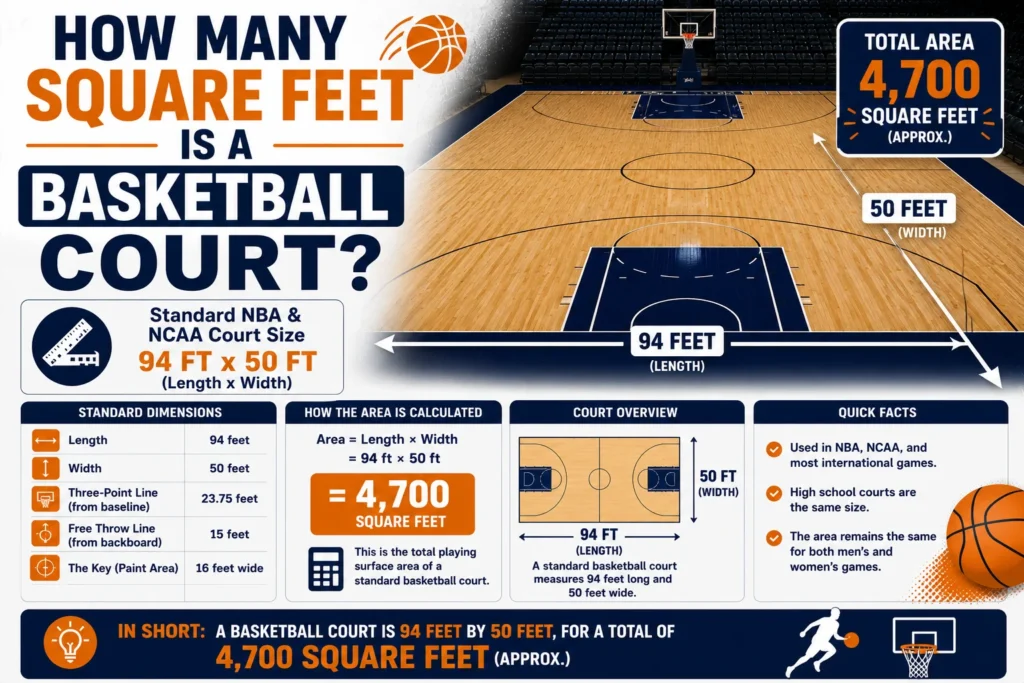
If you’re planning to build a basketball court, comparing gym sizes, estimating flooring requirements, or…
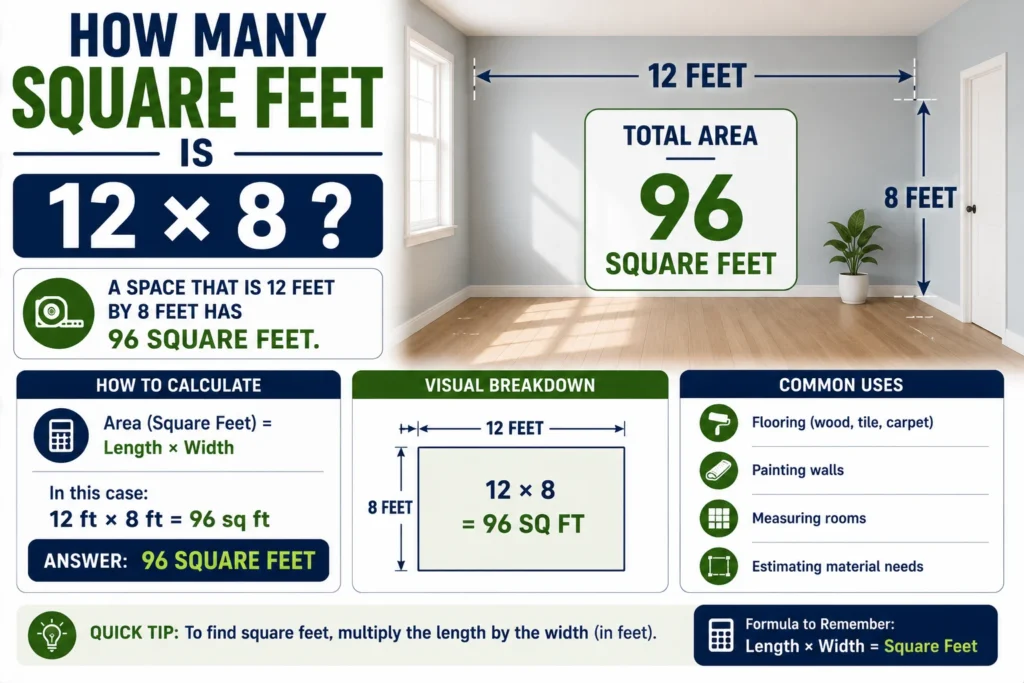
If you’re trying to determine how many square feet is 12 × 8, the calculation…