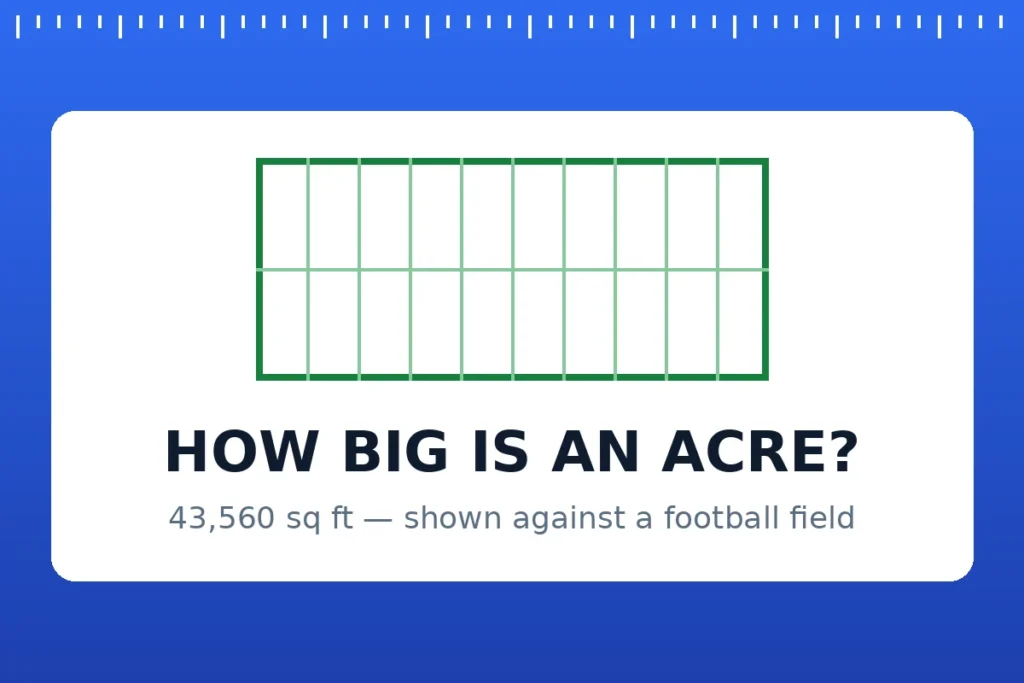
How Big Is an Acre? Visual Guide with Comparisons
Every property listing uses the same phrase: “set on a one-acre lot.” It sounds generous…
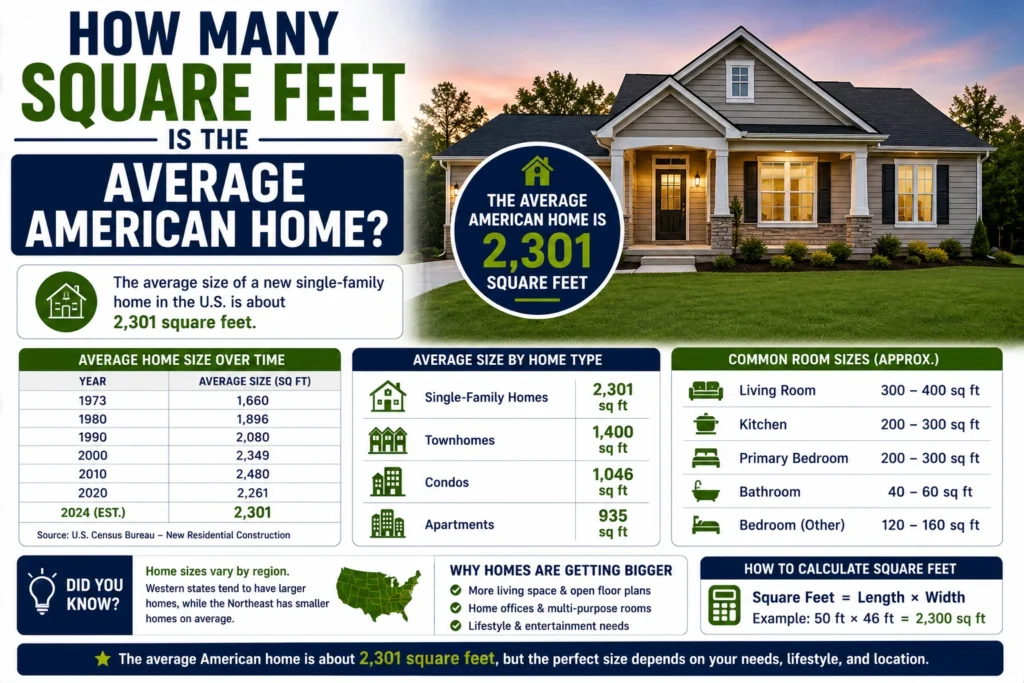
If you’ve ever wondered how many square feet is the average American home, the answer depends on exactly what type of home and measurement you’re talking about.
According to the latest U.S. Energy Information Administration data for 2024, the average U.S. housing unit was about 1,845 square feet. However, when looking specifically at single-family homes, the average was considerably larger at approximately 2,248 square feet.
Newly built homes are generally larger than the overall housing stock. The U.S. Census Bureau reported that the median floor area of new single-family homes completed in 2025 was 2,142 square feet, while the median size of new single-family homes sold was 2,194 square feet.
So, if you’re looking for a simple answer, you can think of the average American home as roughly 1,800–2,200 square feet, depending on the definition being used.
The answer varies by data source and housing type:
| Home Category | Average or Median Size |
|---|---|
| All U.S. homes | 1,845 sq ft |
| Single-family homes | 2,248 sq ft |
| New single-family homes completed in 2025 | 2,142 sq ft median |
| New single-family homes sold in 2025 | 2,194 sq ft median |
| Median U.S. home inventory, June 2026 | 1,842 sq ft |
The EIA’s 2024 figure of 1,845 square feet includes the broad U.S. housing stock, while the 2,248-square-foot figure specifically represents single-family homes.
The distinction matters because apartments, manufactured homes, attached homes, and other housing types tend to have different average sizes.
Single-family houses are typically larger than the average across all U.S. housing units.
The EIA’s 2024 Residential Energy Consumption Survey reported an average of approximately:
This measurement represents the total square footage of the housing unit, rather than just heated or cooled space.
The same data shows that size varies substantially according to the number of bedrooms.
| Bedrooms | Average Square Feet |
|---|---|
| 1 bedroom | 1,090 sq ft |
| 2 bedrooms | 1,560 sq ft |
| 3 bedrooms | 2,005 sq ft |
| 4 bedrooms | 2,740 sq ft |
| 5+ bedrooms | 3,701 sq ft |
These figures demonstrate why there isn’t one perfect number for the “average American home.” A one-bedroom home and a five-bedroom home naturally have very different space requirements.
New construction is generally larger than the overall U.S. housing stock.
According to the U.S. Census Bureau’s latest 2025 Characteristics of New Housing data, the median floor area of a newly completed single-family home was:
For new single-family homes sold during 2025, the median was:
This is a median, not an average. The median means half of the homes were smaller and half were larger.
For another perspective, Census/HUD quarterly data showed the average floor area of newly completed one-family homes at 2,374 square feet in the third quarter of 2025.
This illustrates why you may see different numbers when searching for the average American home size.
One of the biggest sources of confusion is the difference between average and median.
An average, or mean, is calculated by adding all measurements and dividing by the number of homes.
A few extremely large houses can push the average upward.
The median is the middle value when homes are arranged from smallest to largest.
It can provide a better picture of the “typical” home when there are many very large properties.
For example, if five homes were:
1,000, 1,500, 2,000, 2,500, and 6,000 square feet
the median would be 2,000 square feet, while the average would be 2,600 square feet.
That’s why reliable sources may report different figures without actually contradicting one another.
The number of bedrooms is strongly associated with home size.
According to 2024 EIA data for single-family homes:
| Number of Bedrooms | Average Home Size |
|---|---|
| 1 | 1,090 sq ft |
| 2 | 1,560 sq ft |
| 3 | 2,005 sq ft |
| 4 | 2,740 sq ft |
| 5 or more | 3,701 sq ft |
A 3-bedroom home, therefore, is a useful reference point for understanding a typical family-sized American house.
At approximately 2,005 square feet, a three-bedroom single-family home is close to the size many people picture when discussing an average American house.
A 1,000-square-foot house is smaller than the average U.S. home.
A home this size might contain:
For someone accustomed to a larger house, 1,000 square feet may feel compact. However, efficient floor planning can make a 1,000-square-foot home comfortable.
It can also be attractive for people who want lower maintenance and potentially lower utility costs.
A 1,500-square-foot home is below the average for U.S. single-family homes but is still large enough for many households.
A typical floor plan could include:
For a smaller family, 1,500 square feet can provide a good balance between living space and maintenance.
A 2,000-square-foot home is very close to the average size of a three-bedroom U.S. single-family home.
It could potentially include:
According to the EIA, the average 3-bedroom single-family home was approximately 2,005 square feet in 2024.
A 2,500-square-foot house is larger than the average single-family home in the EIA’s 2024 data, but it is not unusually large by U.S. standards.
It could comfortably accommodate:
The perception of size also depends on the layout. A well-designed 2,000-square-foot house can sometimes feel larger than a poorly designed 2,500-square-foot house.
A 3,000-square-foot home is larger than the average American single-family home.
It may offer enough space for:
For a smaller household, 3,000 square feet can provide substantial unused or flexible space.
For a large family, however, it may feel appropriately sized.
American homes have become substantially larger over the long term, although new-home sizes have declined from their recent peaks.
The National Association of Home Builders reported that new single-family home sizes have generally declined since 2015 as affordability pressures have increased.
In the third quarter of 2025, NAHB reported an average new single-family home size of approximately 2,405 square feet, while the median was 2,176 square feet.
This represents an important trend: builders and buyers have increasingly had to balance desired living space against construction costs, home prices, and mortgage affordability.
Home sizes have changed dramatically over the decades.
For example, NAHB analysis shows that the average size of new homes increased for many years before beginning a longer decline in the mid-2010s. The trend was temporarily interrupted by a rise in home sizes during the pandemic-era building boom.
This means the phrase “average American home” can produce different answers depending on the year being considered.
A home built several decades ago may be considerably smaller than a newly constructed home today.
Don’t confuse home square footage with lot square footage.
The house itself might be:
2,000 square feet
while the property could sit on:
8,000 square feet of land
These are two completely different measurements.
For 2025, the Census Bureau reported a median lot size of 8,855 square feet for new single-family homes completed.
NAHB’s analysis of new single-family detached homes sold in 2025 found a median lot size of 8,543 square feet.
Therefore, a typical new home may occupy only part of the total property area.
Home sizes vary geographically.
The EIA’s 2024 data reports these average sizes across broad U.S. regions:
| Region | Average Square Feet |
|---|---|
| Northeast | 1,815 sq ft |
| Midwest | 2,003 sq ft |
| South | 1,863 sq ft |
| West | 1,684 sq ft |
| United States | 1,845 sq ft |
The Midwest had the largest regional average in this dataset, while the West had the smallest.
Several factors can contribute to regional differences, including land costs, housing density, climate, construction patterns, and the mix of housing types.
Home size depends on many factors.
Land and construction costs vary significantly between cities and regions.
Larger families often need additional bedrooms and living areas.
Higher household incomes can make larger homes more financially accessible.
Areas with inexpensive and abundant land can accommodate larger houses and lots.
Older homes may be considerably smaller than newer construction.
Some markets favor compact homes, while others commonly feature larger suburban houses.
Affordability affects the size of homes that buyers can realistically purchase.
There isn’t a universal square-foot requirement for every person.
A household’s ideal size depends on:
For example, a couple may be perfectly comfortable in a 1,200-square-foot home, while a family with four children may prefer 2,500 square feet or more.
The number of people per household can be just as important as the total square footage.
There is no universally required amount of space for a family of four.
A family of four could live in:
The difference comes down to layout, lifestyle, storage, bedrooms, and personal preferences.
A highly efficient 1,500-square-foot floor plan can work well for a family that doesn’t need large individual rooms.
Yes. An 1,800-square-foot home is close to the overall U.S. housing average of 1,845 square feet reported by the EIA for 2024.
It can potentially accommodate:
For many households, 1,800 square feet provides a practical balance between space and maintenance.
A 2,200-square-foot house is around the size of many modern single-family homes.
The Census Bureau reported a 2,194-square-foot median for new single-family homes sold in 2025.
That makes 2,200 square feet a useful benchmark for thinking about the size of a newly built American single-family home.
A home this size could comfortably support three or four bedrooms depending on the floor plan.
The overall U.S. average of 1,845 square feet includes different types of housing units.
Single-family homes are larger on average, while apartments and other smaller housing units bring the overall figure down. The EIA’s 2024 data reports approximately 2,248 square feet for single-family homes.
This is why saying “the average American house is 1,845 square feet” can be misleading if you’re specifically talking about detached single-family houses.
For a detached or single-family home, a figure around 2,000–2,250 square feet is a more useful modern benchmark.
If you want to calculate your own home’s square footage, divide the floor plan into simple shapes.
For a rectangular room:
A=lw
A=6×4=24
4 rows by 6 columns = 24 square units.
w
w
l
l24 square unitsw = 6l = 4
Give feedback
For example:
20 feet × 15 feet = 300 square feet
Repeat the calculation for each room or rectangular section and add the results together.
For an irregular home, divide the floor plan into rectangles or other measurable sections.
Remember that official real estate square footage can follow specific measurement standards, so a DIY calculation may not exactly match an official listing.
| Home Size | General Description |
|---|---|
| 500–1,000 sq ft | Small home |
| 1,000–1,500 sq ft | Compact/moderate home |
| 1,500–2,000 sq ft | Moderate-sized home |
| 2,000–2,500 sq ft | Typical modern single-family range |
| 2,500–3,000 sq ft | Larger home |
| 3,000–4,000 sq ft | Large home |
| 4,000+ sq ft | Very large home |
These categories are general descriptions rather than official classifications.
A source reporting 2,200 square feet may be referring to a median rather than an average.
New construction is generally larger than the overall housing stock.
A 2,000-square-foot home can sit on an 8,000-square-foot lot.
Apartments, manufactured homes, townhouses, and detached houses have different typical sizes.
Two homes with identical square footage can feel completely different because of their layouts.
There are no universal official categories, but square footage can provide a useful general guide.
Under 1,500 square feet
1,500–2,000 square feet
Around 2,000–2,500 square feet
2,500–3,500 square feet
3,500+ square feet
These categories are useful for comparison but shouldn’t be treated as government definitions.
According to 2024 EIA data, the average U.S. housing unit was approximately 1,845 square feet. For single-family homes specifically, the average was about 2,248 square feet.
The Census Bureau reported that the median floor area of new single-family homes completed in 2025 was 2,142 square feet, while newly sold single-family homes had a median of 2,194 square feet.
Yes, 2,000 square feet is a useful benchmark for an American single-family home. It is very close to the EIA’s 2024 average for three-bedroom single-family homes, which was 2,005 square feet.
Compared with the current average single-family home, 1,500 square feet is relatively small. However, it can provide comfortable living space for a small household with an efficient floor plan.
Yes. A 3,000-square-foot house is larger than the average U.S. single-family home and generally provides substantial living space.
New single-family home sizes have generally declined from their mid-2010s levels, although the exact trend varies by year. NAHB reports that affordability pressures have contributed to the recent reduction in new-home size.
The average adds all home sizes and divides by the number of homes, while the median is the middle value in the distribution. Large homes can push the average higher, making the median useful for describing a typical home.
So, how many square feet is the average American home? The answer depends on which homes you’re counting.
The latest EIA data shows that the average U.S. housing unit was approximately 1,845 square feet in 2024, while the average single-family home was about 2,248 square feet.
For newly built single-family homes, the Census Bureau reported a 2025 median of 2,142 square feet for homes completed and 2,194 square feet for homes sold.
Therefore, a practical answer is that a typical American home is roughly 1,800–2,200 square feet, depending on whether you’re considering all housing units or focusing specifically on single-family homes.
The most important point is that “average American home” doesn’t have one universal square-footage number. The result changes depending on whether you’re measuring all housing units, single-family homes, new construction, existing homes, or a particular number of bedrooms.
Every property listing uses the same phrase: “set on a one-acre lot.” It sounds generous…
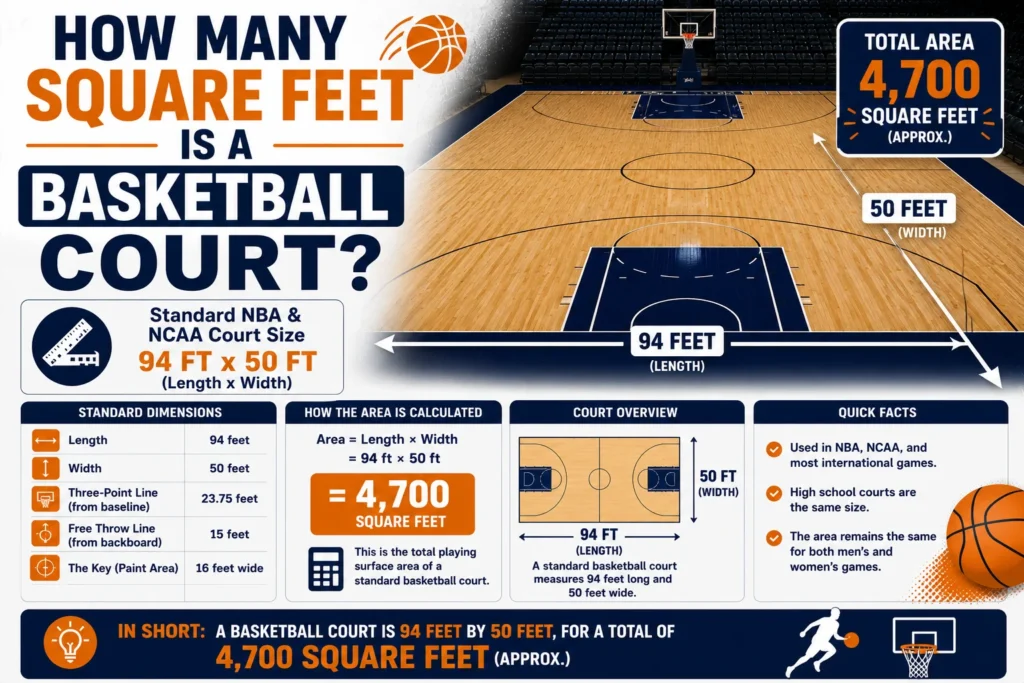
If you’re planning to build a basketball court, comparing gym sizes, estimating flooring requirements, or…
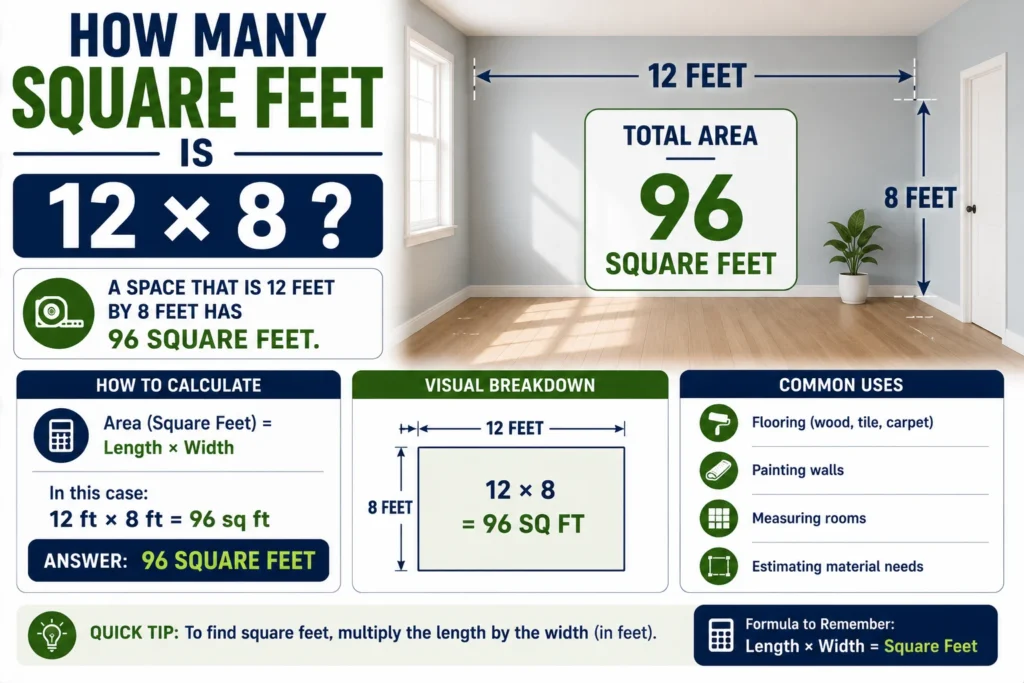
If you’re trying to determine how many square feet is 12 × 8, the calculation…